
Jobs & Careers · UK Guide 2026
Write a Role Handover Before Starting Recruitment
JASOTO · Updated 5 November 2026 · 1,646 words
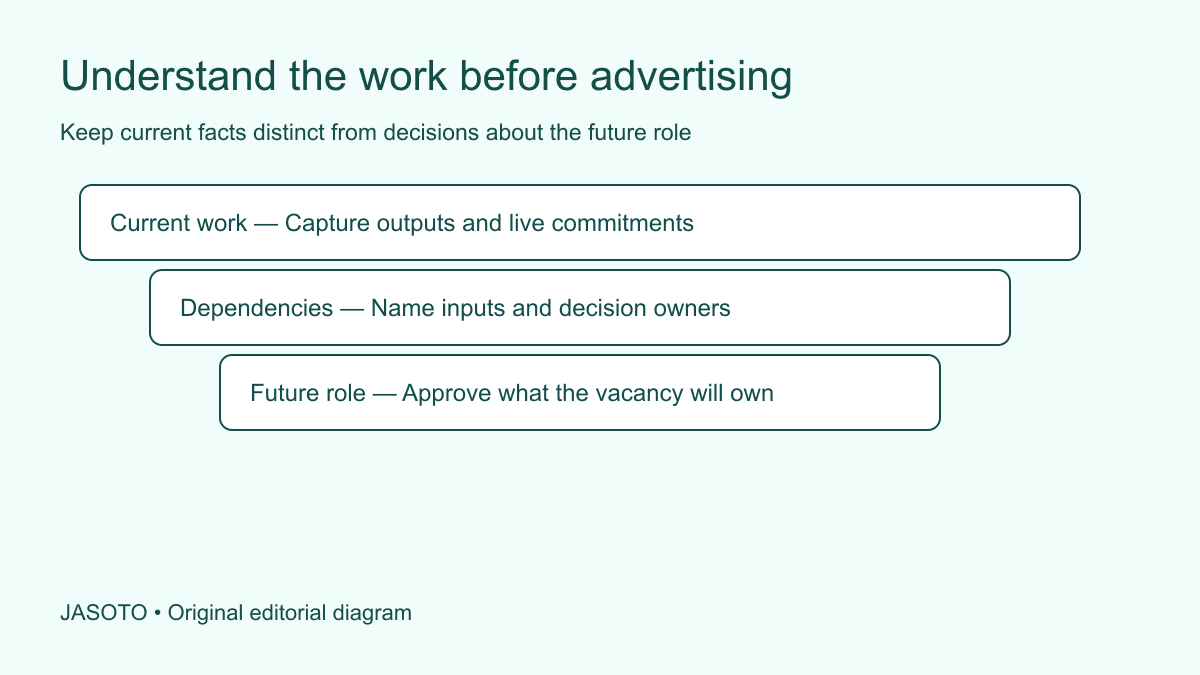
Original JASOTO editorial diagram. Its complete workflow is explained in the article; no actual customer outcome is depicted.
Write the role handover before recruitment by recording what work currently happens, which decisions the role makes, who depends on its outputs and what remains unfinished. Then let the manager decide what the future vacancy should own, using that factual record rather than copying an old job advertisement.
For a small UK organisation, this order is especially useful when one person has quietly accumulated several responsibilities. Their job title may explain only part of the work. A pre-recruitment handover makes those responsibilities visible while there is still time to verify them, arrange interim cover and prepare a more realistic vacancy.
The practical answer
- Capture the work currently performed before deciding what the vacancy should contain.
- Record decisions, dependencies and unfinished commitments alongside recurring tasks.
- Separate the existing role from the manager's proposed future design.
- Use the handover evidence to improve requirements and interim cover.
State the purpose of this handover
Explain that the document is a record of the current role's work and knowledge, prepared to support continuity and recruitment planning. That purpose helps contributors distinguish facts about existing practice from suggestions about how the role should change.
Name an owner who can resolve conflicting accounts and approve the final record. The departing employee can describe the work, but the manager remains responsible for deciding what the organisation needs next. Colleagues who provide inputs or receive outputs can confirm important dependencies.
Set a practical scope. A role handover does not need to reproduce every shared procedure or contain the entire history of the department. It should identify the work, explain important exceptions and point to current authorised records. Start early enough to test uncertain statements while the relevant people are still available to clarify them.
Walk through a representative work cycle
Ask the current role holder to describe a real week, month or other relevant cycle. Begin with the outputs people rely on: a checked booking list, an approved order pack, a reconciled record or a prepared meeting file. Outputs are often easier to verify than broad statements about being responsible for administration.
For each output, record the trigger, expected timing, recipient and location of the working record. Ask what happens immediately before and after the role's contribution. That reveals work which may be invisible in a task list, such as chasing a missing approval before an apparently simple report can be issued.
Look beyond the most recent busy week. Include seasonal or less frequent activities where they materially affect the role. Mark their frequency honestly rather than making every occasional task sound like a daily requirement. Use existing calendars and records to verify the pattern where appropriate.
Capture decisions and their boundaries
Tasks alone do not explain a role's responsibility. Record which decisions the person can make independently, which require approval and what information they check before acting. A colleague may be able to prepare an order without being authorised to approve it.
Use a specific decision example. Ask what the person does when a request is incomplete, a deadline conflicts or two records disagree. Identify who receives the escalation and what evidence that person needs. Keep the answer tied to the organisation's actual authority arrangements.
Avoid turning a personal workaround into an official rule without review. The role holder may have developed a useful shortcut, or may be compensating for an unresolved process gap. Mark the practice for the manager to verify. The handover should make decision boundaries visible so the employer can assess them, rather than silently transfer uncertain authority to the next recruit.
Map inputs and dependent colleagues
Identify the people or teams that supply the role with information, permission or materials. Record what the role expects from them and what happens if the input is late or unclear. Then identify the people who use the role's output.
For instance, a bookings administrator may depend on a confirmed room allocation before sending a final attendance list. The person receiving that list needs to know whether it is a draft or a confirmed version. Describing the relationship prevents the task from appearing more independent than it is.
Check these dependencies with the colleagues concerned. The role holder's understanding and the recipient's expectation may differ. Resolve the important discrepancies or record a named owner for the open question. Recruiting someone with excellent organisational skills will not, by itself, resolve a process where two departments disagree about who approves the source information.
Record live commitments separately
Create a short register of unfinished work that will exist during the transition. Include the current status, next action, due date where confirmed, responsible person and relevant record. Distinguish a firm external commitment from an internal aspiration or an unconfirmed request.
This register supports interim cover even if recruitment takes longer than expected. The next hire's start date should not be the only plan for a commitment due before they arrive. Assign current ownership through the manager and identify anything that needs prompt attention.
Keep the register current until responsibility transfers. A detailed handover drafted several weeks before departure can become misleading if nobody records completed work or new commitments. Use a clear cut-off date and a final review. The document should let the responsible colleague see the actual next action, rather than search a narrative for clues about whether a task still exists.
Point to knowledge without copying secrets
Link to current procedures, shared records and authorised system guidance. Explain what each reference is for and who maintains it. “See the shared drive” is rarely enough when several folders contain similarly named versions of a document.
Describe the access the role needs at a useful level, such as the appropriate system role or shared workspace. Follow the organisation's proper account and access process for the successor. Do not place passwords, private credentials or unnecessary personal information in the handover.
Identify knowledge that is currently held only by one person. It may be a recurring exception, a reason behind an unusual report column or the right route for resolving a disputed input. Capture the explanation where appropriate and have the responsible colleague verify it. That is more useful than a vague warning that the job requires someone who can cope with unwritten rules.
Separate existing practice from the future role
Use a clear status beside each major responsibility: retain in the vacancy, move elsewhere, change before recruitment or awaiting decision. The manager should own these classifications and explain who will take any work removed from the role.
Do not present proposed improvements as facts about current practice. If the employer intends to replace a manual process, state what is confirmed and what remains a proposal. Candidates need a realistic account of the work they may enter, including relevant transition responsibilities.
[Acas's recruitment guidance discusses job descriptions and person specifications](https://www.acas.org.uk/recruitment/how-to-advertise-a-job). Use the approved future role to prepare those recruitment materials. The handover provides the evidence behind the responsibilities, while the recruitment process determines how the employer describes requirements appropriately. Keep the version approved for advertising identifiable so later edits do not blur the decision.
Work through a membership-office example
Imagine a fictional membership organisation losing its office coordinator. The old advertisement describes enquiries and meeting administration. The handover reveals that the coordinator also prepares renewal exception lists, checks returned correspondence and gathers approvals before membership records are updated.
The manager reviews these outputs with their recipients. A finance colleague confirms ownership of payment decisions, while the coordinator's task is to assemble the supporting information. The manager also identifies an upcoming renewal batch needing interim cover before any new recruit can start.
The future vacancy retains enquiries, meeting preparation and record coordination, with clear boundaries around approval. An occasional facilities task moves to another named colleague. This example turns a vague replacement request into a more accurate role discussion. It does not imply that every organisation should combine these duties or that the same selection requirements follow automatically.
Turn verified work into sensible requirements
For each retained responsibility, ask what capability a person needs to perform it and how the employer could assess that capability appropriately. Checking conflicting records might point to careful information handling and clear escalation, rather than an arbitrary requirement for experience with one former employer's terminology.
Distinguish what someone must bring on entry from knowledge they can learn through a proper induction. Organisation-specific folder names, colleague contacts and internal approval routes usually require explanation regardless of the recruit's previous experience. Do not describe a missing internal training plan as a candidate deficiency.
Review the proposed requirements through the organisation's recruitment arrangements and obtain relevant support for consequential employment questions. The handover can reveal genuine complexity, but it should not inflate the vacancy into a collection of every skill any former role holder happened to possess. Keep the advertised expectations tied to the approved future work.
Validate the document with a handover test
Ask an authorised colleague to take one representative item and locate the information needed for its next action. Can they find the current record, identify the decision owner and explain what completion means? Record where they had to guess and improve those parts.
Close unresolved questions with named owners rather than leaving general warnings for the eventual recruit. Agree who maintains the handover during the recruitment period and which information will feed the new starter's induction. The document should remain a usable operational reference after the advertisement is published.
Explore business support where documentation or recruitment coordination help is useful, prepare clear vacancy information, and confirm actual workplace arrangements before discussing commuting or travel. The handover has done its job when the employer understands both the work it must cover now and the role it has chosen to recruit.
Put the guide into practice
- Review a representative work cycle with the current role holder.
- Identify decisions, inputs, outputs and accountable colleagues.
- Mark open commitments and knowledge that needs confirmation.
- Approve the future role separately from the factual handover.
Frequently asked questions
Is the handover the same document as the job description?
No. The handover records the current work, live commitments and knowledge needed for continuity. The job description states the role the employer intends to recruit. The manager should use the factual handover to inform that decision, while clearly identifying responsibilities that will change or move elsewhere.
What if the departing employee has already left?
Build the record from current authorised work records and colleagues who supply or receive the role's outputs. Label uncertain points and name someone to verify them. Avoid presenting a reconstructed description as the former employee's confirmed account or relying on assumptions from an old job advertisement.
Should every current task become an essential hiring requirement?
No. Decide which work belongs in the future role and which capabilities are needed on entry or can be developed appropriately. Use the employer's recruitment process and relevant guidance to review requirements. The handover supplies evidence; it does not automatically justify every proposed selection criterion.
Explore JASOTO tools
Discuss work documentation and vacancy preparation with relevant service providers.
Prepare an accurate vacancy →Translate the approved future responsibilities into clear role information.
Confirm future workplace attendance →Research travel after the actual work location and attendance arrangements are settled.
Continue with JASOTO
Compare your next step
Discover UK businesses, compare services and request written quotes before making a decision.