
Business Growth · UK Guide 2026
Prepare a Room Change Message Guests Can Follow
JASOTO · Updated 5 November 2026 · 1,600 words
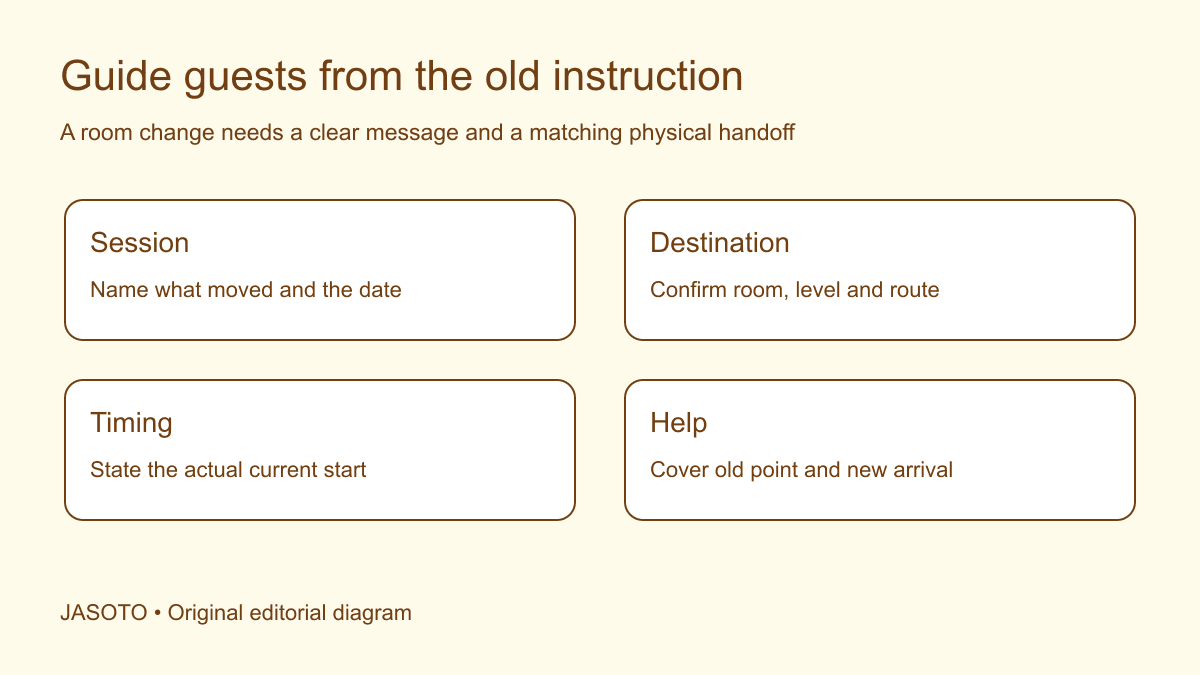
Original JASOTO editorial diagram. Its complete workflow is explained in the article; no actual customer outcome is depicted.
A room-change message should tell guests which session moved, the confirmed new room and how to reach it from where they are likely to be. State whether the time changes and who can help. Update the event team and the old room or decision point as well as the digital invitation. People already walking through a venue may never see a calendar edit before reaching the original door.
This guide offers an original communication method for UK events. Government guidance on accessible formats emphasizes audience needs and clear communication; Google Calendar documents guest-update options. Use the actual venue's approved route and current event arrangements. The method below turns the change into a practical instruction, without assuming every guest has the same device, arrival point or ability to use a particular route.
The practical answer
- Confirm the room and readiness before announcing.
- Lead with destination, timing and action.
- Reach guests at actual route points.
- Replace old directions and brief the team.
Confirm the room and receiving arrangement
Ask the authorized event and venue contacts to confirm the new room, relevant level, entrance and access window. Establish who will receive guests there. A room proposed as a fallback is not necessarily available or ready for the actual session. Keep the change pending until the responsible people settle the essential facts, or label an early alert clearly if guests need to know a decision is still being made.
Check what else changes with the room: seating arrangement, equipment, access or a planned activity. Do not tell guests that all details remain the same until the relevant dependencies have been reviewed. The public message can stay concise while the team handles those checks in its working record. A confirmed room name is the beginning of the instruction, not proof that the entire session has transferred successfully.
Identify where guests will encounter the change
List the likely points: an email before arrival, registration, the original corridor, the old room and the new entrance. Consider guests already onsite and people arriving late. One message cannot be assumed to reach all of them at the same moment. Choose the appropriate channels and human contacts for the actual event rather than broadcasting through every available tool without a clear purpose.
Use the existing attendee and venue information to decide who needs a direct update. Keep personal contact handling appropriate and avoid exposing the full participant list in a broad message. The team should know who maintains the current instruction and which part each channel serves. An email can provide the detailed confirmed change, while a host at the old point can redirect someone who is already following earlier directions.
Lead with the session and new destination
Name the affected session, date where needed and the confirmed new room near the start. Use the room name guests recognize and add the practical level or building detail. Avoid a long explanation of the internal problem before the instruction. The guest's first question is where to go now, and the message should answer that directly.
State whether the time remains the same or give the confirmed revised time. Include relevant local-time context for remote or traveling participants where necessary. Do not leave a time change implied by a new calendar event title. Keep the main facts consistent across text, map and invitation. A concise instruction can still be complete when it identifies the session, destination, timing and the next action without asking guests to infer any of them.
Describe the route from a useful starting point
Use the actual approved route from registration or another relevant recognizable point. Identify the decision that matters, such as the corridor, level or named entrance. A room number alone may be insufficient in a venue with several wings or different numbering systems. Ask the venue about uncertainty and test the description from the guest's approach where practical.
Keep an appropriate contact for individual access questions. Do not assume a staircase direction applies to every attendee or that a general statement about accessibility resolves the particular room move. Confirm the relevant route with the responsible contact. The public message can identify the help route without disclosing personal arrangements. A useful correction guides people to the new room while preserving the venue's actual access and safety processes.
State what the guest should do now
Choose an explicit action suited to the audience. Before arrival, ask guests to use the new room instruction and replace the old detail. Onsite, direct them to the confirmed route or receiving host. If the session is not yet ready to receive people, state the approved waiting instruction rather than letting guests gather at a room whose access remains unresolved.
Avoid asking people to rearrange unrelated travel or bookings unless the actual change requires it and the proper process is clear. A room move within the venue may need no travel change, while a different building can create another dependency. The message should describe the actual action. Keep open questions assigned to the event team instead of handing every unresolved planning issue to guests through a broad “please check everything” instruction.
Use a short practical example
An invented onsite update could read: “The afternoon writing workshop has moved to Cedar Room on Level Two. The confirmed start time is unchanged. From registration, follow the venue-approved route described below to Cedar Room. This replaces the earlier instruction for Oak Room. A host at the original room will redirect arrivals, and the named event contact can help with route or access questions.”
Add the real route and contact in the actual message. If the timing changes, replace the unchanged-time sentence with the confirmed detail. The example demonstrates the structure; the room names and arrangements are fictional. It works because each sentence resolves a practical question and identifies the earlier instruction being replaced. It does not require a guest to read an internal explanation of why the venue reassigned the room.
Update the team before guests need to act
Tell registration, the session host, technical support and relevant venue staff the same confirmed instruction. Identify who updates signs, who receives at the new room and who covers the old point. Confirm those assignments rather than assuming every person who receives the message will act. Give the old-room host the same concise destination text as registration. This avoids a well-intended verbal shortcut that sends guests through another route, especially when the venue has confirmed a particular entrance or level for the replacement session. A room-change notice can be accurate while failing operationally because nobody owns the actual redirect.
Keep the session's equipment and material handoff with the appropriate responsible people. Do not ask general guest-facing staff to move technical equipment outside their role. The communication plan can show readiness status and a decision owner. If the new room cannot support an essential activity, the program owner must decide the next step. Guests should receive the current confirmed plan rather than several speculative alternatives produced by different helpers.
Replace old active directions consistently
Update the maintained program, relevant calendar event and venue-approved temporary signs. Google Calendar offers update messages, but recipient settings and current tool behavior matter. Use the agreed channel for the practical instruction and check that the event's written description agrees with its location field. A correct map pin with an old room name still visible can recreate the confusion.
Consider printed or downloaded information already in use. Guests may carry an earlier program or view a saved page without a connection. Put a clear redirect at the relevant old decision point through the venue's approved process, and provide a human help route where appropriate. Do not cover required safety information or invent an unofficial shortcut. The correction should work through the actual route people use, including those who never receive the latest digital message.
Check whether the instruction is understood
Ask a suitable person unfamiliar with the change to explain where they would go and when. Test the route or inspect the final placement where practical. Note the specific ambiguity and fix it. A message can look obvious to the organizer because they already know the building and supply missing context mentally. A short test can reveal that the wing name or starting point was omitted.
Find event communication or print support through business listings, confirming the actual material, deadline and venue permission. Confirm any changed building or arrival instruction before guests plan travel. If session coordination is continuing work, describe it accurately in relevant roles, distinguishing message ownership, venue approval and technical readiness. The test should verify the guest instruction, while the operational owners confirm the arrangements behind it.
Close the change with one current record
When the session begins in the confirmed room, update any relevant status and keep a late-arrival route for the appropriate period. Remove obsolete temporary directions through the agreed process when they are no longer needed. Preserve the useful event record without leaving a room-change notice active for another session. A correction can become tomorrow's confusing sign if nobody owns its removal.
Afterwards, record which channel or route point needed improvement. If the message grew too long, restore the essentials: affected session, new destination, timing, practical route and help contact. If an unconfirmed detail was sent, correct it plainly and identify the replacement. A useful room-change process connects the message with people and places, helping guests reach the current session without requiring them to solve the venue team's internal handoff.
Put the guide into practice
- Assign new-room and old-point hosts.
- Check written and calendar details agree.
- Test the route with an unfamiliar reader.
- Remove obsolete notices when appropriate.
Frequently asked questions
What should a room-change message say first?
Name the affected session and confirmed new room, then state whether the time changes and what the guest should do. Include the practical route or a clear help contact. Identify the old instruction being replaced so people do not compare competing versions.
How do we reach guests already onsite?
Use the relevant registration or host contacts and an approved redirect at the old room or decision point, alongside the digital update. People following an earlier printed program may not see a calendar edit. Give the event team matching current instructions.
Should we explain the reason for the move?
Include a brief factual reason only when it helps the guest act. Keep internal planning detail separate from the practical instruction. The essential message is the current destination, timing, route and next action, with unresolved operational questions owned by the team.
Explore JASOTO tools
Discover providers and check support for your specific task.
Explore roles and responsibilities →Consider the practical responsibilities involved when recruiting or joining a team.
Plan work-related travel →Research a journey when joining, training or meeting colleagues in person.
Continue with JASOTO
Compare your next step
Discover UK businesses, compare services and request written quotes before making a decision.