
Business Growth · UK Guide 2026
Keep Meeting Actions Separate From Discussion Notes
JASOTO · Updated 5 November 2026 · 1,614 words
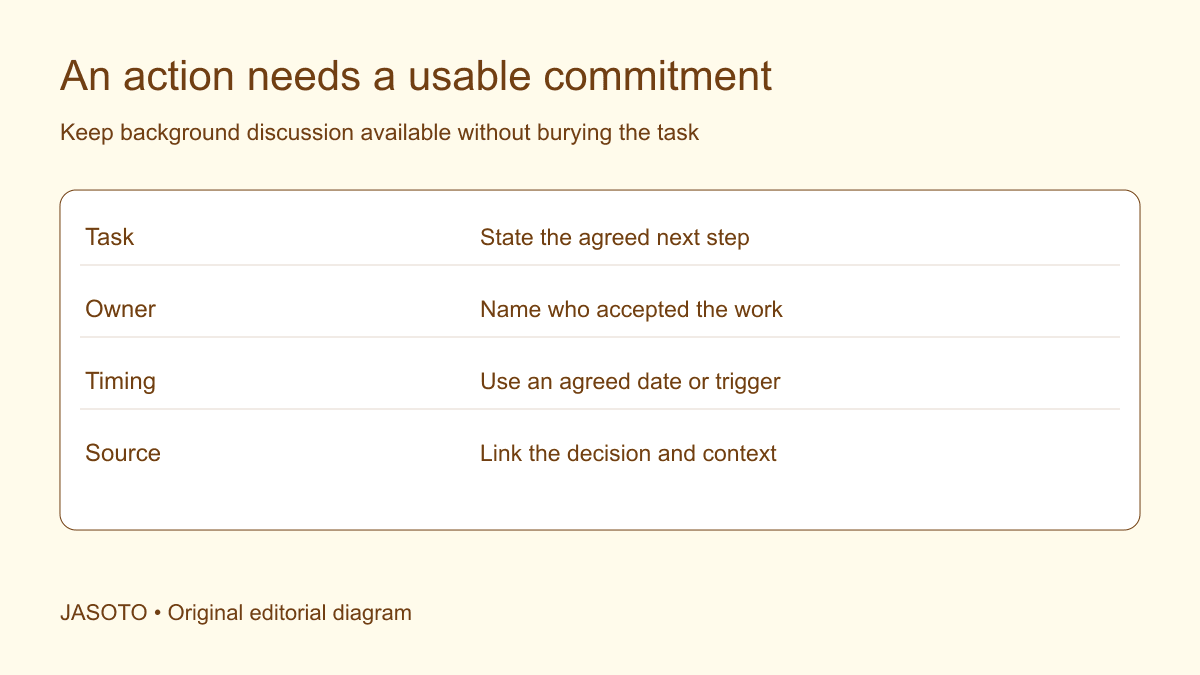
Original JASOTO editorial diagram. Its complete workflow is explained in the article; no actual customer outcome is depicted.
Keep meeting actions separate from discussion notes by recording the agreed task, owner, timing and source reference in a concise action list. Preserve ideas, background and decisions in the appropriate meeting record. Before the conversation ends, confirm what people actually agreed to do so an interesting suggestion does not become an invented commitment when someone writes up the notes.
This guide is an original method for UK small teams running ordinary operational meetings. Formal governance or contractual decisions may require particular records and processes. The worked example uses an invented service studio planning a new appointment form. The practical aim is to make the next work visible while keeping enough context to understand why it was agreed.
The practical answer
- Distinguish an idea, a decision and an assigned action.
- Write actions as useful next steps with clear ownership.
- Link the action to its source without copying the whole discussion.
- Review evidence of completion and keep unresolved work visible.
Distinguish discussion, decision and action
A discussion explores information or options. A decision establishes an agreed position through the appropriate authority. An action assigns work to carry something forward. These can occur in the same conversation but should not be treated as interchangeable. A team may decide it needs more evidence and assign a research task without approving the underlying proposal.
Use those distinctions when taking notes. A comment such as perhaps we should change the form is a suggestion until the team decides what happens next. Do not convert it automatically into redesign the form by Friday. Preserve the uncertainty and ask the relevant question during the meeting. A useful record can show that no decision was made and that a specific person will obtain missing information.
Define the role of the action list
Use the list to show current assigned work and its status. It should be easy for an owner to find their next step without reading a long account of the whole conversation. Link to the source notes or decision where useful. Avoid copying every paragraph into the action row, which can bury the task and make later progress updates difficult to scan.
Keep required formal records in their proper process. For example, the [Charity Commission's current meetings guidance](https://www.gov.uk/government/publications/charities-and-meetings-cc48/charities-and-meetings) explains record obligations within its charity-governance context. Those rules do not automatically apply to every small-business catch-up. The action list here is an operational aid; check the actual requirements where a meeting involves formal authority, legal duties or another specific decision process.
Write the task as an observable next step
Start with an action that someone can complete and report: review a defined document, ask a named provider a particular question or prepare a draft for an identified purpose. Avoid broad labels such as website or sort bookings. They hide the scope and make it hard to distinguish progress from a change in direction.
State the expected output where it matters. A task to investigate appointment confusion might produce a short evidence summary rather than a finished form. Keep that distinction explicit. Otherwise one colleague may expect research while another believes implementation has been authorised. A clear action should describe what the owner has agreed to deliver, without making a stronger commitment than the conversation supports.
Name the person who accepted ownership
Assign one responsible owner for the next action, with collaborators identified separately where helpful. A row assigned to everyone can leave nobody knowing who should begin or report progress. Confirm that the named person understands and accepts the task through the team's actual process. Do not assign work to an absent colleague as though they have already agreed to its scope and timing.
If the task needs another person's authority or information, record that dependency. The owner may coordinate the request without controlling the final decision. Keep the distinction fair and practical. A late specialist response should not automatically be reported as the owner's failure to complete work they were never empowered to finish independently.
Agree timing rather than inventing a date
Record an agreed date, event or useful next checkpoint. A task may need completion before a supplier call rather than on an arbitrary weekday. Explain that relationship where it affects priorities. Use unambiguous dates in the actual record and distinguish a target from a confirmed external commitment. A number entered in a spreadsheet does not book a provider or secure a response.
If timing was not agreed, say so and assign the scheduling question appropriately. Do not fill every empty date cell to make the list look complete. Where another action depends on it, raise the gap promptly. The useful result is a realistic sequence the team can act on, not a set of precise-looking deadlines nobody has accepted.
Preserve authority and limits
State whether the action is to propose, approve, implement or verify. Those verbs represent different authority and evidence. A task to request a quote does not approve expenditure. A task to draft wording does not authorise publication. Keep the appropriate approval process connected so progress does not quietly expand the scope while the team assumes everything was settled in the meeting.
If the meeting itself could not authorise a decision, record the next route rather than pretending the vote or conversation creates authority. Use the actual contract, policy or governance process where applicable. The action list should make the remaining decision visible and help the owner prepare it, without becoming a parallel system that bypasses the organisation's proper responsibilities.
Link context without overwhelming the task
Give each action a stable reference and connect it to the relevant agenda item, decision or case. Include enough context to distinguish similar work. A link to the current source is usually more useful than a pasted extract that may become outdated. Check that authorised colleagues can open the reference through the intended system.
Keep sensitive information appropriately controlled. A general action list may need to say review the relevant case without displaying private customer or staff details. Use a suitable restricted record for the actual material. Do not forward the entire meeting transcript to every supplier simply because one action involves obtaining their answer. Share the information needed for the task through the proper channel.
Confirm the action summary before closing
Read back the meaningful actions, owners and timing while participants can correct misunderstandings. Focus on decisions that created work rather than repeating the entire meeting. Ask whether any condition or authority limit has been omitted. A brief confirmation can reveal that two people understood the same discussion differently before either acts on the wrong interpretation.
Afterwards, circulate the appropriate current record and a route for corrections. Keep revisions traceable. If someone clarifies that a date was provisional, update the list accurately rather than treating the first write-up as unquestionable. The record should preserve agreement, not gain authority merely because one participant typed it first.
Worked example: reviewing an appointment form
Imagine a service studio discussing repeated booking questions. One person suggests changing the form immediately. The team instead agrees that a colleague will review a defined set of enquiries and prepare a short summary before the next decision. The action list records that output, owner and checkpoint, while the discussion notes preserve the proposed redesign as an option that remains unapproved.
When the summary arrives, the team can decide what change, if any, is justified. This invented example claims no reduced enquiries or faster meetings. It shows how an action list can preserve the actual next step without converting a plausible suggestion into an implementation instruction or requiring the owner to reconstruct the whole conversation later.
Update status from actual progress
Use statuses that explain the real position: not started, in progress, awaiting a defined response, ready for review or complete under the team's process. Keep a short next-action note where something remains open. Avoid marking an action complete simply because an email was sent if the agreed output was an answer or an approved decision.
Record relevant evidence of completion, such as the draft location, response reference or decision record. Do not demand unnecessary attachments for simple work, but preserve what the next user needs. If the action has changed, document the revised scope and authority rather than stretching the original task until completion becomes impossible to define.
Review actions without repeating the meeting
Keep completed actions searchable through an appropriate archive or status view. Removing them from the live list can improve focus, but deleting the only record may lose the link between a decision and its outcome. Use the team's actual retention and access arrangements, and preserve relevant references for later questions.
At the next review, focus on changes, blocked decisions and completed outputs. Use the background notes when context is needed, while keeping the live list concise. Close or retire work that is no longer valid with an explanation rather than letting old actions linger indefinitely. A cancelled proposal should not appear as an overdue commitment forever.
Review recurring confusion in the record itself. If owners repeatedly misread draft as approved, change the wording or status labels. If dates lack dependencies, improve that field. Keep the previous template and observe later comparable work before claiming an improvement. A useful action system remains small enough that people update it during ordinary operations.
Use JASOTO businesses to discover appropriate meeting or coordination support and verify capability directly. If follow-up becomes continuing work, explore project administration roles within a staffing review. For a confirmed meeting elsewhere, research travel after agreeing its purpose and location. Clear action records preserve what people actually committed to and make the next authorised step easy to find.
Put the guide into practice
- Confirm actions and authority before the meeting ends.
- Record the task, owner and agreed date or trigger.
- Keep a link to the relevant decision or notes.
- Update progress through the actual work record.
Frequently asked questions
Does every discussion point need an action?
Record an action when someone has agreed to do defined work. A question, idea or observation can remain in the notes until a decision creates a task. Turning every comment into an action can invent commitments and make the list harder to use.
Can the action list replace formal minutes?
Use the record requirements that apply to the actual meeting and organisation. Formal decisions or governance meetings can have specific rules. An operational action list can link to the proper source record, but should not be assumed to replace it.
What if an action has no agreed date?
Record that honestly and identify an appropriate next trigger or scheduling decision. Do not insert a deadline that the owner never accepted. If timing matters to another task, make the dependency visible and resolve the date through the appropriate conversation.
Explore JASOTO tools
Discuss defined coordination and recordkeeping needs with suitable providers.
Explore project administration roles →Consider staffing where following up actions becomes continuing work.
Research a confirmed meeting journey →Plan travel after agreeing the meeting's purpose and location.
Continue with JASOTO
Compare your next step
Discover UK businesses, compare services and request written quotes before making a decision.