
Building & Home Improvements · UK Guide 2026
Plan a Service Appointment Around Tenant Availability
JASOTO · Updated 5 November 2026 · 1,605 words
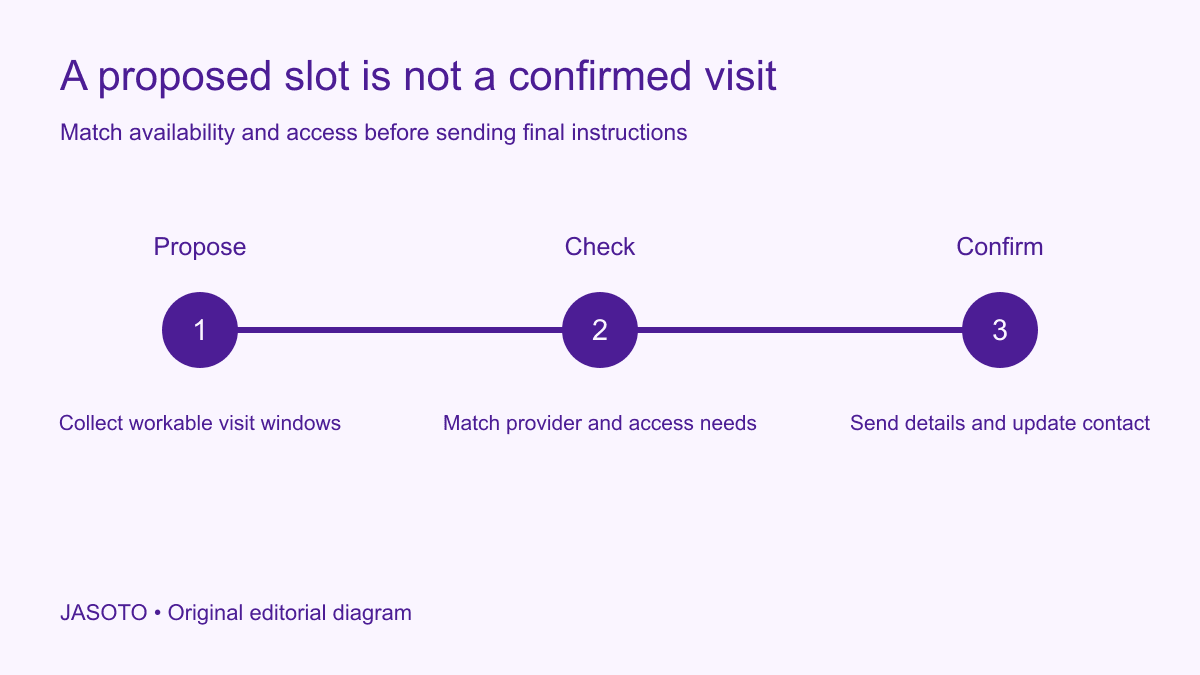
Original JASOTO editorial diagram. Its complete workflow is explained in the article; no actual customer outcome is depicted.
Plan a service appointment around a tenant's availability by collecting workable time windows, checking them with the provider and confirming the actual access arrangement before attendance. Keep proposed, reserved and confirmed slots distinct. Tell both parties how changes will be communicated so a late update does not remain in one person's inbox while someone else travels to the property.
This guide covers administrative coordination of planned visits to rented property in the United Kingdom. It does not determine a landlord's right of entry or replace the legal process applicable to a particular property. Rules differ by location and tenancy. [GOV.UK's making-repairs guidance](https://www.gov.uk/renting-out-a-property/making-repairs) explicitly points to different rules in Scotland and Northern Ireland; check the relevant current requirements before arranging access.
The practical answer
- Collect workable availability before presenting a booking as confirmed.
- Separate a proposed slot, provider reservation and agreed visit.
- Explain the visit and relevant access needs without collecting unnecessary personal detail.
- Check the rules for the location and tenancy rather than assuming one UK process.
Establish the purpose before asking for dates
Explain what the provider is being asked to do: investigate a reported issue, carry out an agreed repair or perform a planned service. A tenant can give more useful availability if they understand which area may need access and whether someone needs to discuss the reported problem. Avoid promising a completed repair when the first visit is only an assessment. Ask the provider what can realistically be confirmed in advance.
Record the job reference and responsible coordinator. If the tenant has already reported the issue, use the existing reference rather than making them repeat the history with every scheduling message. Keep technical details in the relevant job record and share only what the attending provider needs. The appointment request should be understandable without exposing unrelated information about the tenant or other occupants.
Ask for time windows that can actually be used
Offer a manageable way to respond, such as two or three suitable windows, while making clear whether the provider has confirmed any of them. Ask about practical constraints that affect access without demanding a personal explanation. “Available after two on Wednesday” is often sufficient. Do not translate it into “any time Wednesday” because a broader entry is easier to fit into the contractor's calendar.
Distinguish availability from a guarantee that a visit will finish within that period. If the provider's likely arrival window is broad or the duration uncertain, explain that before asking for confirmation. A tenant may be able to receive someone at a particular time but unable to remain for an undefined visit. Clarifying that early is more useful than discovering the mismatch after the contractor arrives.
Check the provider's actual scheduling limits
Ask the provider what arrival windows it can offer, how it handles delays and what information it needs before reserving a slot. Do not promise a precise arrival time on the provider's behalf unless it has agreed one. Keep an estimated arrival, a booked window and a guaranteed time clearly differentiated in the record. The tenant should be able to understand what the confirmation actually commits to.
Check whether another dependency affects attendance, such as required parts, approval of a quotation or a specialist colleague. A provisional slot may be useful, but label it accordingly. If a part has not been confirmed, avoid presenting the visit as a definite repair appointment. Explain the outstanding condition and who will update the tenant when the provider can confirm the next stage.
Keep access agreement separate from key possession
A manager or agent may hold a key, but the appointment still needs the appropriate access process. Do not write “access available” simply because a spare exists. Record what arrangement has actually been made, who confirmed it and which visit it covers. If the tenant will be present, say so without assuming they are also responsible for authorising technical changes or approving additional charges.
If access is disputed or the relevant rules are unclear, refer the question to the responsible person and obtain appropriate advice. An administrator should not settle it by choosing a convenient calendar status. Keep the provider informed that the booking remains unresolved where necessary. Sending a contractor to test whether entry happens is a poor substitute for resolving the access question through the proper process.
Send one useful confirmation
A confirmation should identify the property or reporting point, job reference, provider, purpose, agreed timing and contact for changes. Explain any preparation that has been appropriately agreed with the provider. Avoid adding generic instructions that the tenant cannot safely or reasonably carry out. If a specialist needs something checked, pass on the relevant professional instruction accurately rather than inventing a preparatory task yourself.
Use a short message that can stand alone: “The agreed visit is [purpose] at [address], within [window], with [provider]. Please use [contact] if availability changes. We will use [channel] for any provider update.” Add any specific access arrangement through the appropriate channel. Make the confirmation easy to locate later, rather than scattering essential details across several replies and an attachment.
Give changes a reliable route
Name the contact who can act on a cancellation, delay or changed window. A general mailbox may be appropriate if it is actually monitored for that purpose. An unattended reply address is not a usable same-day update route. Explain what happens outside normal office hours through the property's proper arrangements, and keep planned scheduling separate from urgent repair reporting.
When a change arrives, update all affected parties and mark the previous slot accordingly. Confirm whether the provider has accepted the revised time rather than assuming that forwarding a request changes its booking. Keep a brief history: original window, requested change, response and current status. This helps a substitute coordinator answer a query without reconstructing the entire conversation from memory.
Avoid unnecessary personal information in shared calendars
The contractor usually needs practical visit details, not the tenant's work pattern, medical history or private reasons for preferring a slot. Record a relevant access requirement in an appropriate way and use a suitable channel for sensitive information. Ask the responsible person how the business handles such details rather than copying every explanation into a widely shared calendar entry.
Keep contact information accurate and limited to the purpose. If another person is helping with access, confirm the arrangement through the appropriate process rather than assuming that a named neighbour or family member has agreed. Do not publish private telephone numbers in a group message simply because several providers are attending. Share what each authorised participant actually needs to coordinate the visit.
Worked example: a tenant with a limited afternoon window
Imagine a tenant who can be available on Thursday afternoon but needs to leave at a fixed time. The provider offers a broad afternoon arrival window and cannot yet confirm the visit length. Instead of marking the booking confirmed, the coordinator explains the mismatch and asks whether a different day or a different appropriate access arrangement can be agreed through the property's process.
Once both sides confirm a workable option, the coordinator sends a single clear appointment message and records the update route. This invented example does not imply that every schedule can be accommodated or that a particular entry right exists. It shows how preserving the tenant's actual constraint prevents an apparently convenient appointment from being based on information that was never given.
Record what happened without assigning blame prematurely
After the appointment, record whether the provider attended, whether the agreed access occurred and what next step was reported. If the visit did not proceed, separate known facts from explanations still being checked. “Provider called at ten; tenant reports no call received” may need investigation. Do not immediately convert it into either “tenant refused access” or “provider failed to attend”.
Ask each relevant party for a factual account and preserve the original messages. Use the actual booking and complaint process for any charges or disagreement. The scheduling log should make the history easier to assess, not prejudge responsibility. If another visit is needed, identify what must be clarified before rebooking so the same uncertainty is not simply carried forward to a new date.
Review the process and recurring workload
Review a sample of appointment records from the tenant's perspective. Can the recipient tell whether a response is requested, which slots are provisional and whom to contact if circumstances change? Check the provider's perspective too: does its instruction show the same window and current access position? This is a communication check, not a legal assessment. If the two records differ, resolve the mismatch before another visit is arranged. Keep an earlier version of the message template so the team can compare wording and reverse a change that makes confirmations harder to understand.
Look for repeated friction that the coordinator can change: vague visit purposes, confirmations sent before parts arrive, no monitored update contact or broad windows presented as exact times. Improve the specific step and review the result on later appointments. Do not claim a reduction in failed visits without measuring actual comparable outcomes. Keep earlier wording or templates so a confusing change can be revised.
Use JASOTO businesses to discover suitable providers and ask directly about attendance arrangements. If visit coordination has become ongoing work, explore property support roles within a staffing review. For an agreed appointment requiring a journey, research travel after the address and reporting point are confirmed. A useful schedule respects the real availability and access process while giving everyone a clear next action.
Put the guide into practice
- Check the applicable access process for the property.
- Ask for suitable windows through the tenant's agreed contact channel.
- Confirm the provider, purpose, timing and update route.
- Record changes and whether access was actually agreed.
Frequently asked questions
Does sending a notice mean the appointment is agreed?
Do not use the appointment log to assume that silence resolves access. Follow the applicable legal and tenancy process and seek appropriate advice where access is disputed. Administratively, keep a proposed visit distinct from a confirmed arrangement so the contractor is not sent on the basis of an unsupported assumption.
Should I ask why a tenant cannot attend a slot?
Usually the practical scheduling information is the availability itself. Ask only for information relevant to arranging the visit, and give a clear way to discuss a particular access requirement. Avoid recording personal explanations in a contractor calendar when they do not help the appointment happen.
What if the repair is urgent?
Use the property's appropriate urgent or emergency process and the relevant professional advice. This article concerns planned scheduling; its example timings and messages should not delay action needed for a genuine urgent problem. Record the facts and contact the responsible person promptly.
Explore JASOTO tools
Discuss the required service and realistic attendance windows directly.
Explore property coordination roles →Consider staffing when arranging and following up visits is continuing work.
Research travel for a confirmed visit →Plan a journey once the appointment and reporting address are agreed.
Continue with JASOTO
Compare your next step
Discover UK businesses, compare services and request written quotes before making a decision.