
Business Growth · UK Guide 2026
Build a Service-Area Page Around Actual Coverage Limits
JASOTO · Updated November 5, 2026 · 1,599 words
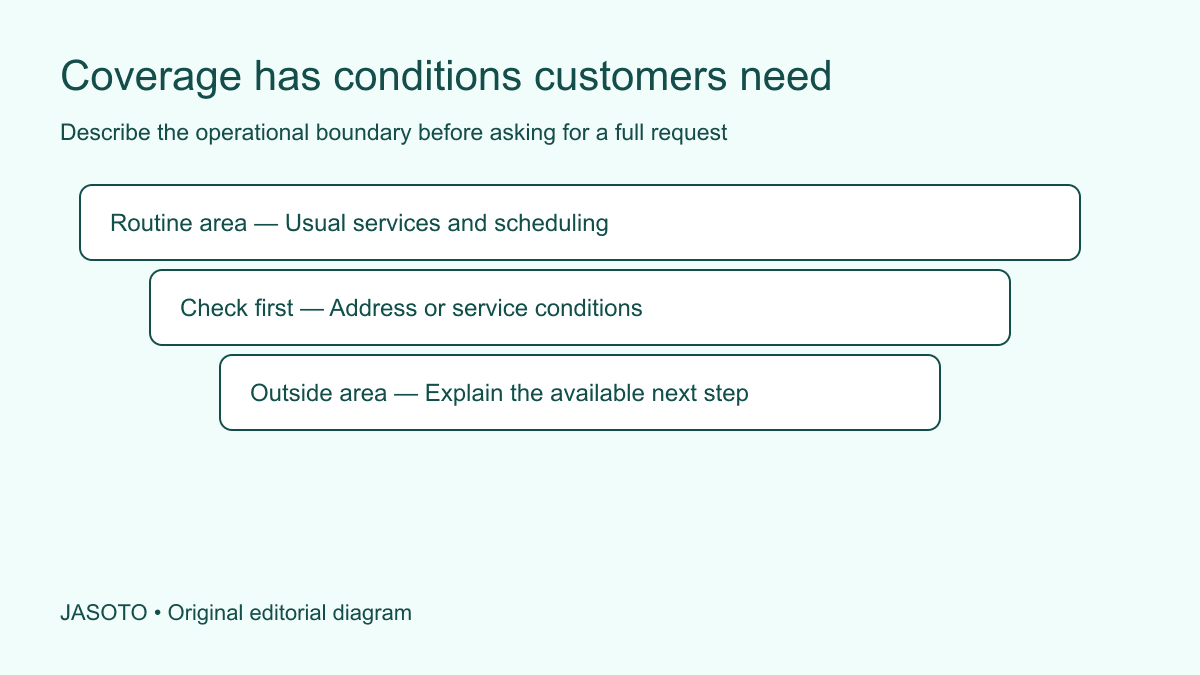
Original JASOTO editorial diagram. Its complete workflow is explained in the article; no actual customer outcome is depicted.
Build a service-area page by confirming where the business actually works, which services are available in each area, and how an uncertain address is checked. Answer those questions before asking for a full quote request. A list of city names or a large map is not enough when the customer still cannot tell whether the business will visit their location for the service they need.
This guide uses a small service business in the United States as its context. It offers an editorial planning method rather than a local ranking guarantee or a transport cost model. The examples are fictional. Actual coverage, charges and scheduling depend on the business's verified operating arrangements, not on a standard radius that every company should copy.
The practical answer
- Define coverage from operations rather than a list of target search terms.
- Distinguish routine coverage, conditional coverage and unavailable locations.
- Explain the service and scheduling limits that affect an address.
- Provide a proportionate way to check uncertain locations before a full request.
Start with the work the business can deliver
Ask the people handling scheduling and service delivery to describe current coverage. Compare their answer with recent accepted and declined requests, using records appropriately. Identify whether the same area applies to every service, team and operating day. A marketing list may reflect ambitions or an older staffing arrangement rather than the service customers can obtain now.
Write the operating rule in plain language before drafting the page. For example, routine visits may be available in a defined group of locations, while a specialist service needs individual review. Keep that distinction explicit. Do not broaden the public promise simply because the business once accepted an exceptional project farther away. An exception shows what happened once, not necessarily what can be offered repeatedly.
Identify the customer's earliest useful question
For most local service inquiries, the first question is whether the business can consider the required service at the customer's location. Put that answer near the top of the page. Include a short description of the services covered and a clear route to check uncertain addresses. Avoid opening with several paragraphs praising the region while postponing the operational answer.
Think about customers arriving directly from search. They may not have read the home page or understood your service range. Briefly explain what the business does and how the area information applies. A useful page can be specific without repeating the entire service description. Link to the relevant service detail where needed, so someone can investigate scope after establishing that their location may be covered.
Separate routine, conditional and unavailable coverage
Use categories that reflect real decisions. Routine coverage means the service is normally offered there under the stated process. Conditional coverage means a relevant factor needs review. Unavailable coverage means the business cannot currently provide the requested service there. Define those terms in customer language rather than presenting a color-coded map with no explanation of what each shade promises.
State meaningful conditions. “Subject to availability” alone may leave customers unable to judge whether an inquiry is worthwhile. If the deciding factor is the particular service, access arrangement or scheduling pattern, explain that at a helpful level. Do not publish private operational details, but do give enough information to prevent someone completing a lengthy form for a clearly unavailable request.
Choose locations that help people recognize the area
Use city, neighborhood, county or ZIP-code information when it accurately reflects the business's boundary and is understandable to customers. Check ambiguous place names and avoid implying that an entire administrative area is covered if only part is served. If a boundary cuts through a place, explain that a specific address check is needed rather than leaving the list misleadingly broad.
Keep any map aligned with the written definition. A smooth circle may look appealing while including locations the business cannot serve and excluding locations it routinely visits. Choose a representation that supports the actual rule. If the map is illustrative rather than exact, label it clearly and make the address-check route easy to find. The visual should help a decision instead of providing unjustified certainty.
Explain service-specific differences explicitly
A business may provide one service widely and another within a smaller area. Separate those boundaries in text or a simple comparison. For a fictional example, a maintenance company might offer remote consultation more widely than onsite visits, with specialist work reviewed separately. Describe the actual delivery method so a customer does not mistake remote availability for a promise of attendance.
Ask whether urgency changes the area. A routine planned service and a rapid-response claim can involve different capacity and scheduling. Do not use a broad area headline to imply that every service has the same response arrangement. If no emergency service exists, avoid language that suggests one. Match the page to what staff can explain and provide when the customer contacts the business.
Keep profile settings and website claims consistent
[Google's service-area guidance](https://support.google.com/business/answer/9157481?hl=en) explains the platform's approach to service-area and hybrid business profiles and asks businesses to be specific and accurate. Use the current provider instructions for profile configuration. A website page can explain operational conditions in greater detail, but it should not contradict the areas represented in the business's public profile.
Review directory descriptions, ads and social profiles where they make area claims. Updating the website alone leaves customers exposed to older promises elsewhere. Maintain a short inventory of those statements and their owners. Do not describe profile settings as proof that the business can deliver a particular service; the operating arrangement must support the claim independently of what a platform allows someone to enter.
Give edge-case customers a proportionate check
Offer a way to ask about a location before demanding the full job history, photographs and detailed personal information. The initial check may need the relevant area and service category, with more precise information requested through an appropriate channel when necessary. Design the question around what the team actually uses to decide coverage. Avoid collecting data merely because the form template includes it.
Explain what happens after the check and distinguish eligibility review from a quote or booking. “We can review your address” is different from “we will visit.” Give staff a consistent response for outside-area inquiries and a route for genuine uncertainty. If the business cannot help, a clear answer respects the customer's time more than repeatedly asking for details while hoping an exception might emerge.
Describe travel and charges without inventing a formula
If travel affects whether work can be considered or changes the quotation process, state that clearly using the actual policy and relevant terms. Do not publish an invented mileage rule or a guessed surcharge. Where price depends on assessment, explain what information is required and when the customer will receive a clear offer. Keep a possible additional charge distinct from an accepted quotation.
Use business travel research as one input to practical planning, recognizing that a map's estimated journey does not establish staffing, access or profitability. The operational team should decide coverage with the relevant evidence. Customers need the resulting service boundary and next step, rather than a presentation of a travel estimate as if it guarantees an appointment or arrival time.
Work through a fictional boundary inquiry
Imagine a customer in a neighborhood beside the routine coverage boundary who needs a specialist inspection. The page identifies the neighborhood as “check first” and explains that specialist availability requires review. The customer submits the service type and area through the initial check. Staff then confirm what additional information is needed, without implying an appointment has been reserved.
If the business declines the request, the response states the limit plainly rather than blaming the customer for reading the map incorrectly. If it can consider the work, the next message explains the quote or scheduling process. This scenario demonstrates a useful information sequence. It does not establish an appropriate boundary for another business or prove that every edge-case inquiry deserves an exception.
Review expansion before announcing it
When the business wants to expand, identify the practical change that supports the promise: staffing, scheduling, supplier arrangements or another verified capacity. Test the proposed area against the actual service before adding its locations to the public page. An intention to grow is different from a service customers can request today. Keep planned coverage clearly distinguished from available coverage.
Explore local service roles if staffing is part of the expansion, and research business providers where operational support is required. Do not assume hiring interest or a supplier conversation establishes capacity. Confirm readiness with the responsible team and update the page, profile and inquiry process together when the business is prepared to deliver the new arrangement.
Measure whether the page answers the boundary question
After publication, review relevant inquiries: which locations caused confusion, which services were misunderstood and whether customers still completed long forms for unavailable work. Record the baseline and any other changes affecting demand. A reduction in one category of inquiries may be useful, but do not interpret a small or changing sample as proof of a general conversion improvement.
Assign a review owner and keep the earlier wording available for rollback. Recheck the page when routes, services or staffing change, and correct overbroad claims promptly. The page succeeds operationally when a customer can understand the business's actual coverage and obtain an honest next step for an uncertain address. Search rankings and qualified demand should be assessed separately using real evidence after release.
Put the guide into practice
- Confirm coverage with the people scheduling actual work.
- Record service-specific boundaries and conditions.
- Write a direct answer for central and edge locations.
- Align maps, location lists and inquiry messages.
- Review the page when staffing or routes change.
Frequently asked questions
Should we list every nearby town for search visibility?
List locations when they help customers understand real coverage. Do not imply routine service in a place merely because you would like to appear in its search results. If a town has conditional or limited service, explain the condition clearly and provide a way to check a particular address.
Can a map replace a written service-area explanation?
A map can support the explanation, but boundaries may be difficult to interpret and may not show service-specific conditions. Include readable location information and a route for uncertain addresses. Describe what the map represents and ensure its displayed area matches the operational decision rather than an arbitrary marketing radius.
What if we sometimes accept work outside the usual area?
State that outside-area requests are reviewed individually if that is the actual policy. Explain the useful factors without implying acceptance or a guaranteed price. Keep routine service distinct from an occasional exception, and make sure the inquiry team uses the same distinction when replying.
Explore JASOTO tools
Continue with JASOTO
Compare your next step
Discover UK businesses, compare services and request written quotes before making a decision.