
Business Growth · UK Guide 2026
Build a Service Calendar With Realistic Dependencies
JASOTO · Updated 5 November 2026 · 1,604 words
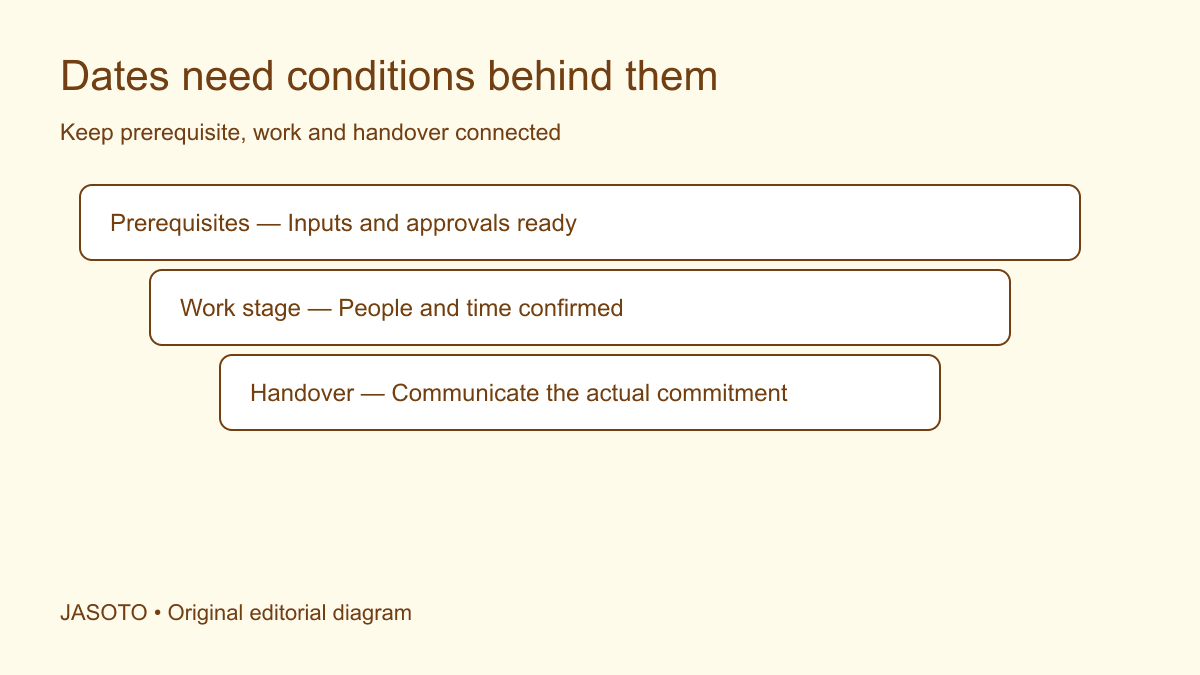
Original JASOTO editorial diagram. Its complete workflow is explained in the article; no actual customer outcome is depicted.
Prepare a realistic service calendar by connecting every important date to the inputs, approvals and people it requires. Separate tentative planning from confirmed commitments, and review downstream effects when a condition changes. A calendar slot shows intended timing; it does not prove that the work can start or that the customer has agreed every prerequisite.
This guide is an original scheduling worksheet for small UK service businesses. The example concerns a translation project requiring a source document, terminology decisions and an available reviewer. It focuses on administrative dependencies rather than specialist translation practice. Use the actual provider agreement and appropriate expertise for service quality, commercial commitments and consequential deadlines.
The practical answer
- Identify what must be true before each task can start.
- Separate work time, waiting time and fixed external commitments.
- Label tentative and confirmed dates clearly.
- Update affected people when a dependency changes.
Define the deliverable before filling dates
State what the customer is meant to receive and which version or scope the plan covers. A translation draft, reviewed document and publication-ready file can be different deliverables. Ask the responsible provider to define the actual stages. A date attached only to a broad project name can hide disagreement about what should be complete by that point.
Record who can confirm scope and accept a change. The customer contact, specialist reviewer and purchasing approver may have different roles. Keep their decisions distinct in the planning record. Avoid assuming that a person attending a scheduling call can approve every technical, commercial or publication question simply because they are easiest to reach.
Identify what each stage needs to begin
For every meaningful task, ask what must be available before it starts. The answer may be a final source file, access, a decision or another task's output. Make the dependency specific. Waiting for customer is less useful than waiting for the approved source-document version and the named terminology response. The latter identifies an action and owner.
Check whether the dependency is genuinely required or merely habitual. A provider may be able to begin a limited stage while another question remains open, but that should be an appropriate explicit arrangement. Do not assume parallel work is possible or impossible from the calendar alone. Ask the competent people performing the service and record the conditions they actually confirm.
Distinguish work time from waiting time
A task may take a certain amount of active effort while spanning a longer period because someone must review or supply information. Keep those concepts separate. Do not turn a provider's estimate of working effort into a guaranteed elapsed turnaround without checking availability and dependencies. The customer needs an accurate commitment, not arithmetic that ignores the intervals between stages.
Record the relevant basis and uncertainty. An internal review expected by a certain day is not confirmed simply because the planner needs an answer. Ask the reviewer what availability they can agree and what input they need. If the answer remains pending, show it as a condition and assign follow-up rather than placing a firm-looking task block over an assumption.
Check people and capacity in the actual period
Confirm who performs and reviews each stage, including cover arrangements where appropriate. A role may exist in the business while the relevant person is unavailable during the proposed window. Do not assume that one employee can simultaneously complete several tasks because their calendar has not been filled with detailed work entries. Ask about the actual workload through the responsible process.
Preserve fixed commitments separately from movable internal targets. A booked customer event or an external submission may constrain the plan, while an internal review preference may be flexible. Both matter, but should not appear identical. Explain which dates are confirmed and who can authorise changes so a substitute coordinator understands the real planning choices.
Make date status visible
Use clear labels for proposed, provisionally reserved and confirmed arrangements, with definitions suited to the business. Avoid colors as the only explanation if recipients may not understand them or see the same display. Put important conditions in readable text and connect them to the source record. A tentative note should not become a firm commitment when copied into a customer message.
The [government project delivery standard](https://projectdelivery.gov.uk/library-products/government-functional-standard-govs-002-project-delivery/) includes planning and control practices in its government context. The original small-business method here uses a modest principle: preserve the assumptions and dependencies behind a forecast. It does not import government governance requirements or establish a particular service turnaround for private work.
Build the calendar from relationships
Arrange the stages according to actual dependencies and confirmed availability. Give important milestones a reference so messages can identify them consistently. Use the level of detail needed for decisions. A small assignment may need only a few stages, while a more complex service requires appropriate project support. Avoid an elaborate schedule whose detailed entries all rely on the same unchecked prerequisite.
Record the next confirmation point for tentative stages. If the source file is due before the provider can confirm a review date, show that sequence. This helps colleagues explain why a customer-facing date remains unconfirmed. Do not fill the gap with a guessed completion date merely to make every row look finished; the missing confirmation is itself actionable information.
Agree how changes reach the calendar owner
Name who updates the authoritative schedule and how others report a changed input or availability. A specialist may learn that a source document is revised while the coordinator continues using the old plan. Keep the communication route practical for the actual team. The calendar is reliable only if material changes reach the person who maintains its dependencies.
Preserve the important change history and authority. A revised source file may alter more than one stage, so review the actual effect before promising a new date. Use the commercial change process where required. An updated calendar entry should reflect a decision, not create approval for a changed scope or additional work that nobody has authorised.
Review downstream consequences before updating customers
When a prerequisite moves, identify which later tasks depend on it and which can proceed. Ask the relevant owners to confirm the practical consequence. Do not shift every stage by the same number of days automatically if reviewer availability or external commitments have changed. A simple-looking delay can require a new sequence rather than a mechanical calendar adjustment.
Communicate confirmed changes and remaining questions in plain language. The customer may need to know what action can help and what date is actually supportable. Avoid blaming language unsupported by the record. Keep the operational facts and appropriate commercial discussion connected, while using the actual agreement and professional advice for consequential deadline disputes.
Worked example: a translation project with a reviewer
Imagine a business arranging translation of a short service document. The provider needs the agreed source version, while an internal reviewer must confirm specific terminology. The planner records those inputs and checks the reviewer's availability before describing a handover date as confirmed. An early calendar entry remains tentative because the source version has not yet been approved.
When the source changes, the planner asks the provider and reviewer to confirm the effect on their stages. This invented example makes no claim about translation speed or quality. It shows how a calendar can preserve the actual conditions behind the plan and prevent a provisional internal target from becoming a stronger customer promise through repeated copying.
Test the plan with a substitute coordinator
Check a scenario where the requested customer deadline remains fixed but an input moves. Ask the substitute to identify which options need provider confirmation rather than assuming the remaining work can simply be compressed. A date in a calendar does not create extra specialist capacity or justify reducing an appropriate review. Record who can discuss the actual trade-off with the customer. This test can expose an unspoken assumption about flexibility before the team communicates an unsupported revised plan to people relying on it.
Ask an authorised colleague who did not build the calendar to identify the next required input, its owner and the milestone it affects. Check whether they can distinguish an agreed date from a target. If they need the original planner's memory, improve the relevant condition, reference or status. This review tests communication and does not certify the specialist work itself.
Use a realistic change scenario, such as an unavailable reviewer or revised input. Can the colleague identify whom to contact before communicating a new date? Keep the exercise proportionate and preserve the earlier plan. A useful test should reveal an actual decision gap, not simply confirm that someone can navigate the calendar software.
Review real outcomes without inventing certainty
After completion, compare the meaningful stages with what occurred. Identify whether a missing dependency, unclear ownership or unsupported assumption caused confusion. Do not claim every difference from the first plan is a failure; the service may have changed appropriately as information developed. Record the actual reason where known and leave uncertainty explicit.
Improve one relevant step and retain a rollback version. A clearer source-file approval trigger may be more useful than adding several reminders. Keep maintenance ownership current as people and providers change. A realistic calendar remains a living coordination record whose purpose is to support decisions, rather than a static promise that cannot acknowledge new evidence.
Use JASOTO businesses to discover suitable service providers and verify dependencies directly. If scheduling becomes continuing work, explore coordination roles within a staffing review. For an agreed visit, research travel after appointment conditions are confirmed. A useful service calendar makes the relationship between readiness, work and handover visible to everyone authorised to act on it.
Put the guide into practice
- Define the deliverable and prerequisite inputs.
- Confirm owners and relevant availability.
- Record conditions behind planned dates.
- Review downstream effects before communicating a revised commitment.
Frequently asked questions
Is an empty calendar slot proof that work can be booked?
Check the actual staff, inputs, approvals and service arrangements. A visually empty slot can still depend on something unavailable. Confirm the relevant conditions before treating it as a customer commitment.
Should every dependency have a precise date?
Record confirmed dates where available and label estimates or unresolved conditions honestly. A useful trigger can sometimes be more accurate than an invented date. If timing is needed for another commitment, assign the question and obtain an appropriate answer.
What if a customer changes an input after scheduling?
Use the actual change process and review the effect on related tasks. Preserve the original and current position, identify who can approve the revision and communicate confirmed consequences. Do not silently move one calendar entry while leaving affected people with the earlier promise.
Explore JASOTO tools
Discuss actual task dependencies and provider commitments directly.
Explore scheduling support roles →Consider staffing where calendars and approvals become continuing work.
Research a confirmed service visit →Plan travel after the necessary appointment conditions are confirmed.
Continue with JASOTO
Compare your next step
Discover UK businesses, compare services and request written quotes before making a decision.