
Websites & Visibility · UK Guide 2026
Check a Service Description Against Buyer Questions
JASOTO · Updated 5 November 2026 · 1,550 words
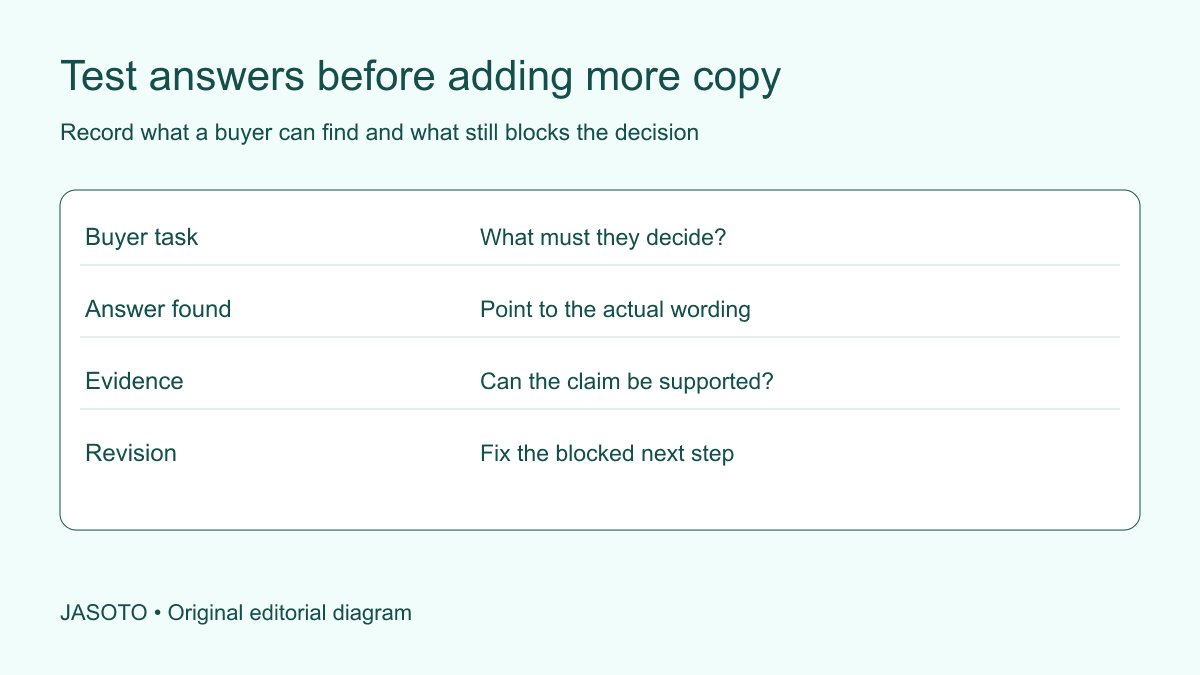
Original JASOTO editorial diagram. Its complete workflow is explained in the article; no actual customer outcome is depicted.
Check a service description by giving a reader realistic buyer questions and asking them to find the answers on the existing page. Record the text they rely on, their interpretation and what remains unclear. This reveals whether the description supports a purchase decision, rather than merely containing attractive phrases about quality, experience or customer care.
The method below audits an existing UK service page before rewriting it. It complements a writing template by testing what is already published. Examples are fictional and the proposed worksheet is an editorial tool, not a proven conversion formula. Use appropriate specialist review for regulated claims, contractual terms or technical information that the page needs to explain.
The practical answer
- Test an existing description against real purchase decisions.
- Separate a missing answer from an answer that cannot be found.
- Require evidence for objective claims and clarify dependencies.
- Prioritise revisions by the customer's blocked next step.
Choose the purchase decision you are testing
Identify a particular reader and task. Someone deciding whether a company can undertake a small repair has different questions from a purchasing team commissioning a continuing service. Describe the intended decision without inventing a detailed customer persona unsupported by evidence. The task should be plausible for the actual service and the point in the buying journey represented by the page.
Use existing enquiries, search terms or staff observations to choose an initial task. Mark assumptions where evidence is thin. Do not define success as “the reader contacts us” regardless of suitability. A useful description may correctly tell someone that the business is not the right provider. The audit should reward an informed next step, including deciding not to submit an unsuitable request.
Turn concerns into answerable questions
Write questions in the language a buyer might use: does this include the preparation, can you work at my location, what information do you need, and when is a price agreed? Avoid questions designed to make the current copy look good. “Does the business sound professional?” gives less actionable evidence than “Can the buyer identify what happens after submitting the form?”
[GOV.UK's user-needs guidance](https://www.gov.uk/service-manual/user-research/start-by-learning-user-needs) distinguishes evidence about users from untested assumptions. Apply that principle to the question list without treating government service guidance as a complete commercial research method. Record the source of each important concern and update the list when genuine customer evidence reveals a different decision or limitation.
Test suitability before persuasive detail
Ask whether a reader can identify the service, the type of need it addresses and the important exclusions. A description can contain a long list of capabilities without making suitability clear. Look for broad words such as “complete,” “all” or “any” that may imply a wider offer than the operating team can support. Refer uncertainty to the service owner.
Separate an unclear description from an unclear business decision. If staff disagree about whether a task is included, the writer cannot resolve that merely by choosing smoother language. Record the policy or scope question with an owner. Once the business agrees the boundary, publish a clear answer and ensure the enquiry team uses the same definition when responding to customers.
Ask the reader to show the supporting sentence
For every answer, require a reference to the actual page wording or linked information. A colleague may know that site visits are optional from years of experience even though the page never says so. That is useful business knowledge but not evidence that a new buyer can find the answer. Keep inferred answers distinct from explicit ones.
Record whether the answer was immediate, found after effort, ambiguous or absent. These are practical observations rather than universal usability scores. Note the path taken, including links opened and headings searched. An answer buried in unrelated material may need a clearer location rather than more prose. The worksheet should identify the problem precisely enough that an editor can choose an appropriate correction.
Check the service boundary and location together
Ask whether coverage applies to the specific service being considered. A general area statement can be mistaken for confirmation that every offering is available there. Test an ordinary location and an edge case. If the page requires an address check, the route should explain what information is needed and what the business can establish from it.
If a visit is involved, check whether the reader understands who travels and what must be confirmed first. Research service journeys only after the relevant arrangement is understood. The audit does not need to calculate travel feasibility itself. It should reveal whether the page leaves a buyer planning a journey or expecting attendance before the business has agreed that step.
Distinguish price information from a price commitment
Ask what a reader believes the displayed price covers and what could change it. Refer the commercial details to the responsible person and relevant terms. Do not add invented ranges or assumed exclusions to make the page appear complete. A useful answer may explain why assessment is needed and when a quotation is provided, if that matches the actual process.
Check whether the action implies a stronger result than the explanation. A button promising a final quote may conflict with a form that only requests a callback. Record the contradiction as a customer expectation problem, not merely inconsistent terminology. Any resulting wording change should be checked across the next screen and messages, since the buyer's understanding continues beyond the service description itself.
Inspect evidence behind reassuring claims
List objective statements about qualifications, experience, coverage, delivery or outcomes. Ask the relevant owner what supports them and whether the evidence remains current. The audit need not reproduce private records, but should establish that an appropriate review exists. Do not treat a polished testimonial or an impressive photograph as automatic proof of every claim placed beside it.
Consider the impression created by several statements together. A team biography, project image and headline may imply that a particular specialist personally performs every job even if the operating model differs. Record that possibility and ask the business to clarify. The goal is accurate expectations; it is not to remove every useful fact because a careless interpretation is theoretically possible.
Test the next step as a concrete task
Ask the reader what they would send, who would respond and what they would have after taking the action. Have them identify any preparation described on the page. If they cannot tell whether they are requesting information, booking a visit or accepting an offer, record the ambiguity and trace it to the exact wording or interface element.
Use the real next page in an appropriate test environment. A service description may be accurate while its linked form contradicts it. Keep the scope of the audit clear: you can identify the journey issue and assign it even if the current editing task only covers one page. Do not declare the description effective while a critical next-step contradiction remains unresolved.
Work through a fictional repair-page finding
Imagine a repair business whose page says it handles office equipment but does not explain collection. A test reader assumes the business collects items because a vehicle appears in the image. The operating team actually accepts equipment only through agreed appointments. The finding is not “add more logistics content.” It is a specific mismatch between the inferred collection promise and the actual handover process.
The editor adds a clear collection-versus-drop-off explanation near the relevant action and corrects an ambiguous caption. The next test asks the reader how equipment reaches the business and when arrival is agreed. This fictional example shows a proportionate fix driven by an observed decision. It does not establish an improvement in enquiries or revenue; those outcomes require later evidence.
Prioritise by the blocked customer decision
Rank findings by consequence and confidence. An inaccurate service promise or misleading booking status usually needs attention before a stylistic preference. A difficult-to-find answer may warrant a heading change, while an unsupported claim may need removal pending verification. Keep the proposed fix connected to the finding so the audit does not turn into an unrelated redesign wishlist.
Assign each change and its review to the appropriate owner. Explore content roles if review capacity is missing, or compare business support providers with a brief describing the actual task. Avoid asking someone simply to “improve conversions” when the evidence identifies a precise scope or process explanation that needs correction.
Retest the changed answers and retain the evidence
Save the original wording, worksheet and revised version so the change is reviewable and reversible. Retest the affected tasks without telling the reader the desired answer. Record remaining uncertainty honestly. A correction that resolves one question may introduce another, particularly when shortening a sentence removes an important condition or dependency.
After release, look at relevant customer questions and unsuitable requests against the starting position, noting other changes in traffic or operations. Do not infer commercial success from an internal readability exercise alone. The audit's immediate output is a defensible revision list: the buyer decisions tested, the answers available, the evidence gaps and the concrete changes that make the service easier to assess.
Put the guide into practice
- Choose realistic buyer tasks from existing evidence.
- Ask a reviewer to find and explain each answer.
- Record the supporting sentence and remaining uncertainty.
- Fix the most consequential gaps and retest them.
Frequently asked questions
Is this the same as rewriting the service page?
No. The audit identifies whether the existing page supports specific decisions and where it fails. It may lead to a small wording change, a better heading or a corrected link rather than a complete rewrite. Keep findings tied to observed tasks so editorial preference does not become the only reason for change.
Can staff act as test readers?
They can reveal useful issues, especially when they have not written the page, but their business knowledge may fill gaps a new buyer cannot. Ask them to point to the exact text supporting their answer and note the limitation. Where practical, include actual or likely customers through an appropriate research process.
How many questions should the audit include?
Use enough to cover the important decisions for the particular service without turning the exercise into a catalogue of every conceivable concern. Scope, suitability, location, process and the next commitment are useful starting areas. Add questions when customer evidence shows a distinct need, rather than meeting an arbitrary target.
Explore JASOTO tools
Continue with JASOTO
Compare your next step
Discover UK businesses, compare services and request written quotes before making a decision.