
Websites & Visibility · UK Guide 2026
Review a Service Page After the First Customer Questions
JASOTO · Updated 5 November 2026 · 1,617 words
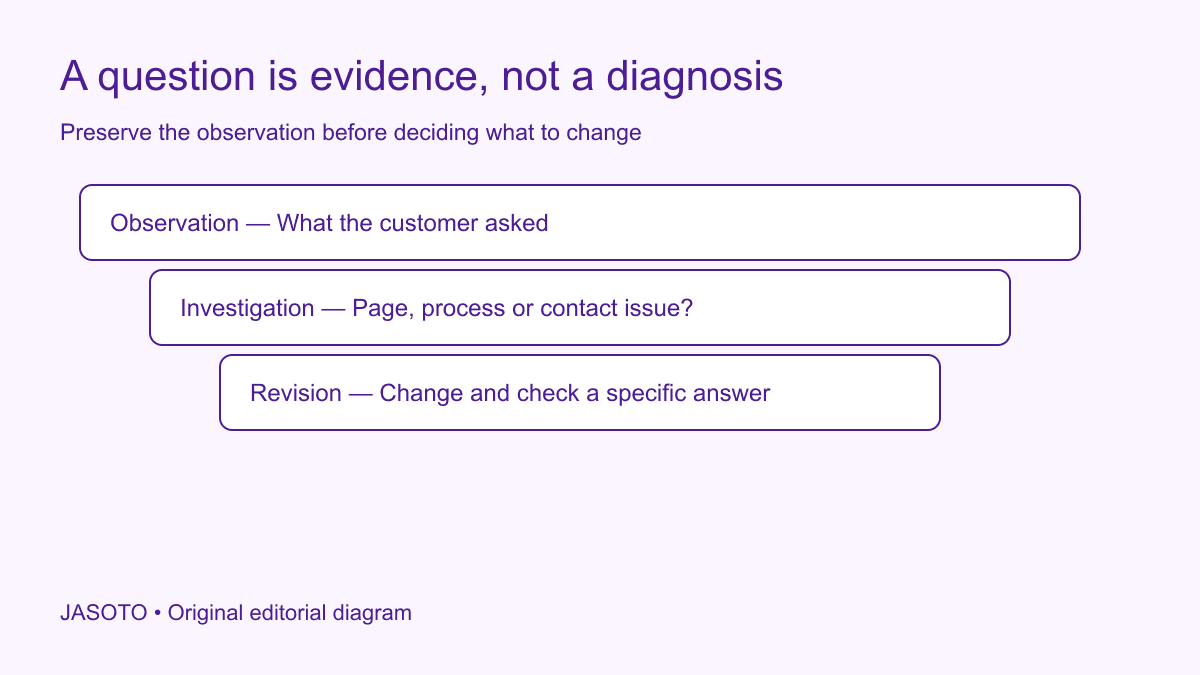
Original JASOTO editorial diagram. Its complete workflow is explained in the article; no actual customer outcome is depicted.
Review a service page after the first customer questions by recording what people asked, which page version they encountered and what they were trying to do. Investigate the cause before editing. The question may reveal a missing answer, a hard-to-find explanation, an inconsistent staff reply or a service decision the business has not settled. Those problems need different remedies.
This guide covers an early post-publication review for a small UK business. It differs from a pre-publication writing checklist by using actual questions to choose the next investigation. Examples are fictional and the proposed log is an editorial method, not a statistical research design or a guarantee that a change will improve sales.
The practical answer
- Keep the first questions with their context and page version.
- Separate observed confusion from your interpretation of its cause.
- Investigate whether the issue belongs to content, delivery or contact handling.
- Make a focused revision and check the same question again.
Preserve the page version being reviewed
Record the publication date, main changes and the page version customers could see. Keep earlier wording and relevant screenshots through the normal document process. If several edits occur during the observation period, note their effective dates. Otherwise the team may attribute a question to wording that was not present when the customer visited.
Identify related changes in forms, ads, pricing or operations. A new service page may launch alongside a revised booking process, so early questions cannot automatically be assigned to the prose. Keep the initial review scope clear: which service, which customer route and which period are being examined. This provides enough context to interpret the evidence without claiming a controlled experiment that did not occur.
Capture the question with its immediate context
Record the customer's question as accurately as possible, along with the task, channel and relevant service. Distinguish a direct quotation from a staff summary. Avoid collecting names or private details that are unnecessary for the review. Link to the controlled case record where appropriate rather than copying the full conversation into a widely shared worksheet.
Ask what the customer had seen before asking, when that can be established appropriately. They may have arrived through a search snippet, an old advertisement or a forwarded document. “Website question” is too broad if the issue concerns another source. Keep unknowns visible. Do not fill a gap by assuming every person who contacted the business read the new page from top to bottom.
Separate observations from explanations
Write the observation first: “Customer asked whether collection is included.” Then record possible causes separately: collection is not described, the answer is buried, or another channel implies it is included. This prevents a plausible explanation from becoming established fact through repetition. The log should show what the evidence supports and what still needs checking.
Include the business answer and who verified it. If staff disagree, that is an operational question requiring resolution before content can be accurate. Do not make the page sound certain while the service team remains uncertain. Assign the unresolved policy or scope issue and keep it distinct from the editorial action that will follow once the business has decided.
Group questions by the blocked decision
Sort entries into useful themes such as suitability, scope, area, price basis, preparation, booking status and aftercare. Preserve meaningful differences within a group. Two questions mentioning “time” may concern response hours and appointment duration, which require separate answers. Avoid grouping solely by a shared word when the customer tasks differ.
Record the number of relevant cases and the observation period without presenting them as a representative percentage of all visitors. People who ask questions are a selected group; those who leave silently are absent from the log. The review can reveal specific problems worth investigating while remaining honest about what it cannot show about the entire audience.
Follow up without leading the customer
Where an appropriate follow-up is possible, ask how the person understood the page and what they were trying to find. Avoid asking whether a sentence was confusing in a way that invites agreement. Use open questions and allow an unexpected explanation. Obtain any necessary permission through the business's research and information-handling process.
[GOV.UK's interview guidance](https://www.gov.uk/service-manual/user-research/using-in-depth-interviews) describes planning questions and exploring people's circumstances and service experience. Use suitable research practice for a fuller investigation. A short operational follow-up is not automatically a formal study; record its limits and avoid turning a handful of conversational impressions into a claim about every buyer.
Check the route where the uncertainty arose
Open the actual entry page, relevant links, form and acknowledgement. Look for contradictions or missing context. A service page may correctly say “request a visit” while the next screen says “booking confirmed.” Fixing the introduction alone will not resolve that journey. Identify which owner controls the step causing the problem.
Check mobile presentation and the customer-visible version where practical. A qualification may be clear in an editing document but separated from its claim on a small screen. If the issue involves travel or location expectations, inspect the directions and confirmation route before customers plan a journey. The review should trace the actual decision, rather than blame the customer for missing information whose placement made it difficult to use.
Choose whether the remedy is content or operations
A missing explanation may need a short paragraph. An inconsistent answer may need staff guidance. A service that cannot meet its published promise may require an operational or commercial decision. Record the remedy according to the cause. Adding more words to the page can make an unsettled service harder to understand without changing what customers actually receive.
Check whether an apparent question is reasonable personalization rather than a defect. Some services need an individual assessment, and a page cannot answer every case in advance. Explain the assessment process and required information where useful. Avoid promising universal certainty merely to reduce questions; the purpose is better informed contact, not suppressing legitimate discussion.
Work through a fictional first-week finding
Imagine a business receives several questions about whether an equipment estimate includes installation. The page's service list names installation but the form asks only about supply. Review shows that installation is available through a separate assessment. The issue is a boundary between services, not necessarily a missing price or a general lack of detail.
The team verifies the process, adds a clear distinction beside the service list and aligns the form introduction. It preserves the original wording and records the hypothesis: future visitors should understand that installation requires a separate review. This fictional scenario does not prove the revision improves conversion. It shows how customer questions can produce a specific, testable content change without rewriting unrelated material.
Prioritise consequential inaccuracies promptly
Correct a confirmed misleading promise or broken contact route through the appropriate publishing process without waiting for a larger pattern. Keep a record of the issue and why the action was necessary. Lower-confidence stylistic hypotheses can be reviewed with more evidence. Frequency and consequence both matter; a rare question can reveal a serious misunderstanding.
Assign each change, reviewer and rollback condition. If the proposed fix alters terms, technical instructions or regulated information, involve the responsible specialist. Find website support providers with a brief describing the observed task and verified business answer. Avoid commissioning an undefined redesign when the evidence supports a focused correction to a particular step.
Check the revised answer using the same task
Ask a reader unfamiliar with the change to answer the original customer question from the revised journey. Require them to identify the text supporting their answer. Test the next step where relevant and record remaining uncertainty. Do not announce the intended answer before the test, since that turns the exercise into a confirmation of the editor's explanation.
Retest proportionately after correction. A small text change does not need an elaborate evaluation if the relevant task is now clear and no new concern remains. Conversely, a repeated operational contradiction needs more than another wording tweak. Keep the investigation focused on the evidence and extend it when the failure or uncertainty justifies additional work.
Keep a short decision note for the revision
Write the chosen change, its evidence and the answer it should make easier to understand. Include the owner, publication point and next review. If the team rejects a proposed edit, record the practical reason. That prevents the same suggestion returning later without anyone remembering that the operating team had checked and rejected its assumption.
For example, a proposed promise of collection may be rejected because the service does not offer collection. The appropriate improvement is then a clearer handover explanation, not more persuasive collection language. Keeping that decision visible helps a new editor preserve the correct boundary. The note should be brief enough to maintain and specific enough that another colleague can distinguish a settled business fact from a hypothesis still awaiting evidence.
Review later evidence without manufacturing success
At the next review point, compare relevant question patterns with the starting record, noting inquiry volume, traffic sources and operational changes. A lower count may reflect fewer visitors rather than improved understanding. A higher count may reflect more qualified interest rather than worse copy. Describe the observations and uncertainty before drawing conclusions.
Assign continuing ownership, considering customer insight or content roles where the workload warrants it. Keep the question log useful and limited rather than collecting every message indefinitely. The practical output is a learning record: what customers asked, what the team verified, what changed and which assumption remains to be tested. That supports further improvement without inventing an outcome the evidence has not established.
Put the guide into practice
- Record the launch version and observation period.
- Log relevant questions without unnecessary personal details.
- Check the actual customer route and current business answer.
- Prioritise supported revisions and preserve rollback wording.
- Review subsequent questions with sample limits visible.
Frequently asked questions
Does one customer question justify changing the page?
It can justify investigation, especially where the issue is consequential or reveals an inaccurate promise. It does not automatically establish a common pattern. Check the route, wording and business process, then make a proportionate correction if the evidence supports it. Keep the distinction between a confirmed defect and a hypothesis about frequency.
Should every repeated question become an FAQ?
No. The answer may belong beside the service description, price explanation or action that caused the uncertainty. A repeated question can also reveal an operational problem that copy cannot resolve. Choose the location and remedy based on the customer's task rather than adding an FAQ entry by default.
How long should we wait before reviewing?
Choose a practical review point based on actual traffic, inquiry volume and the consequences of errors. Correct a known misleading statement promptly rather than waiting for a large sample. Broader conclusions about customer behavior need enough relevant evidence, with unusual periods and other changes noted.
Explore JASOTO tools
Continue with JASOTO
Compare your next step
Discover UK businesses, compare services and request written quotes before making a decision.