
Global Business · UK Guide 2026
Write a Translation Brief for a Service Price List
JASOTO · Updated 5 November 2026 · 1,511 words
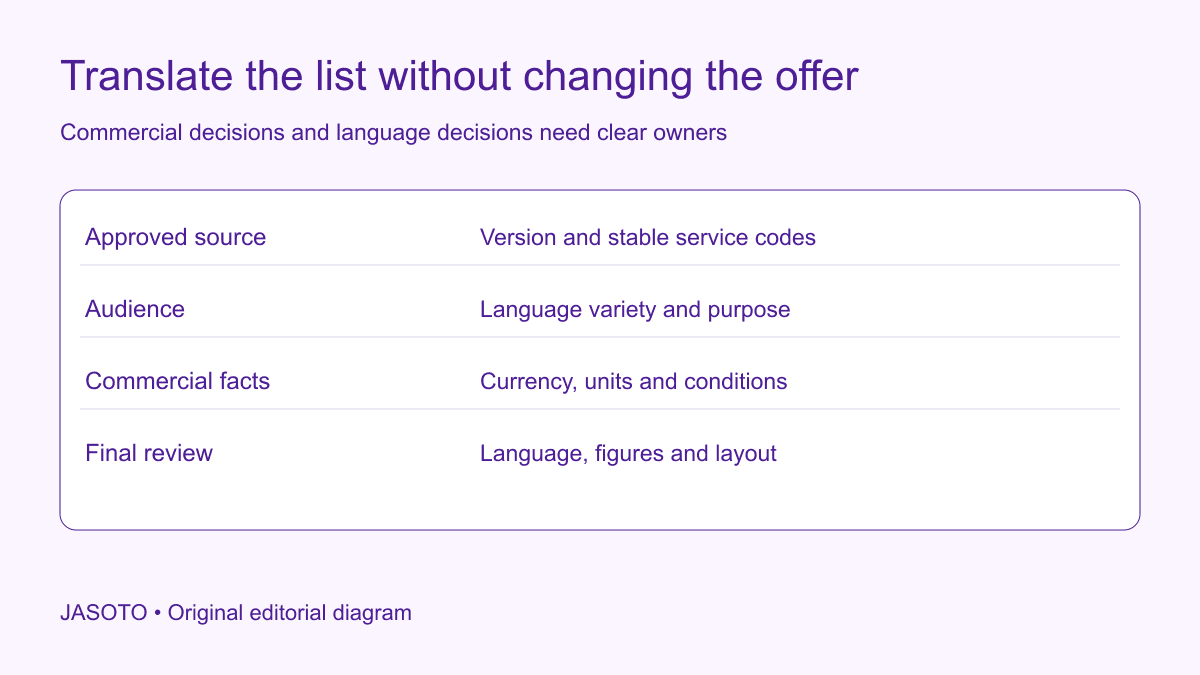
Original JASOTO editorial diagram. Its complete workflow is explained in the article; no actual customer outcome is depicted.
Write a service price-list translation brief by supplying the approved source version, describing the intended audience and identifying which commercial facts must remain unchanged. Specify the language variety, service terminology, output format and reviewers. Treat currency conversion, new-market pricing and changes to terms as separate decisions. The translator needs to understand the offer accurately, rather than infer commercial policy from a compressed table.
For a UK business, a translated list may serve local customers, visiting clients or an overseas market. Those audiences can require different context even when the source language is the same. The workflow below uses fictional service identifiers without invented market prices. Adapt the brief to the actual offer and obtain appropriate specialist review for commercial or regulated terms.
The practical answer
- Approve the source price list before sending it for translation.
- Specify audience, language variety and the role of each commercial field.
- Separate translation from currency conversion or changes to the offer.
- Review the final layout against stable item identifiers and approved facts.
Approve the source before commissioning translation
Identify the source file, version and effective date. Confirm that service descriptions, amounts, units and conditions are current. Resolve contradictory values between the website and printed list before handing the text to a translator. Otherwise the provider must choose between inconsistent instructions or spend time investigating a business decision that should already have an owner.
Assign stable identifiers to service rows. A code such as S14 can remain unchanged when the translated service name uses a different order or length. Those identifiers make review and later updates traceable. Keep a controlled source copy and record who authorizes amendments. Do not quietly edit the original halfway through translation without notifying the provider and identifying the affected rows.
Describe the audience and use
State who will read the list, where it will appear and what customers should be able to decide from it. A reception handout for local customers differs from a downloadable list for buyers in another market. Explain whether the reader already knows the service and which unfamiliar terms need context. Avoid defining the audience solely by a broad language name.
Ask the provider to confirm the appropriate language variety and any writing conventions relevant to the audience. [ITI's translation-buying guide](https://www.iti.org.uk/asset/6A607F17-ACF6-4B14-A5523B218420B860/) emphasizes giving translators context and making considered choices about the material. Use the brief to make your actual purpose explicit, while leaving professional linguistic questions open for the provider to resolve with you.
Explain what each commercial field means
For every column, define its role: service name, description, charging unit, amount, currency, inclusion or condition. A short heading such as “from” may carry a substantial meaning that needs careful handling. Explain the intended offer and point to approved terms rather than expecting a translator to infer it from formatting or previous examples.
Identify conditional prices, variable scope and any required assessment accurately through the responsible commercial owner. Do not invent a universal wording rule for all services. The translator should know which conditions must remain attached to which row and where the customer obtains the full explanation. A translation that reads naturally but separates a material condition from its price can change the apparent offer.
Separate translation from price localization
State whether amounts and currency are fixed or whether the business has approved different values for the target audience. If replacements exist, supply them as controlled data with identifiers. Do not ask a translator to choose an exchange rate or decide a new selling price casually. Those decisions affect the offer and need their own authority and evidence.
Clarify how tax and other commercial statements are to be handled through the appropriate professional process. The linguistic reviewer can flag ambiguity, while the responsible specialist determines the correct underlying statement. Keep unresolved questions visible in the brief. A smoother translated phrase should not disguise a decision the business has not made about what customers will pay or receive.
Supply terminology with practical context
Create a short glossary of service names, components and units whose meaning could be misunderstood. Explain internal abbreviations and distinguish branded labels from ordinary descriptions. Provide a useful example of the activity or relevant product information where needed. A list of words without context may leave several plausible translations unresolved.
Mark terms that must remain unchanged and explain why. Avoid locking every phrase merely because it appears in the current marketing copy. The provider may need to restructure a sentence so the audience understands the service. Agree how terminology questions are raised and who answers them. That creates a controlled route for improvement without letting a language choice silently expand or narrow the service scope.
Identify the full package of text and files
Include headings, notes, footnotes, labels, form links and any text embedded in graphics. Supply editable files in the agreed format and a visual reference showing relationships between items. Confirm who handles layout, export and publication. Do not assume the translation fee or scope automatically includes every design task or final website upload.
Allow room for the translated text to use a different length. A table that barely fits the source may become unreadable if the designer simply shrinks the new language. Ask the provider and designer how they will handle space constraints. Keep the actual amount, unit and condition together in the final presentation even if the layout must change to support clear reading.
Give the provider a question route and change rule
Name a contact who can answer factual questions and obtain decisions from the relevant owner. Distinguish a linguistic query from a commercial query so neither waits indefinitely with someone unable to settle it. Agree how open questions are recorded and when they must be resolved before delivery. A clear query list prevents private assumptions from becoming published text.
If the source changes, issue an amendment with the affected identifiers and approved replacement content. Confirm the effect on the delivery arrangement through the provider's actual terms. Do not send several informal messages that leave the translator unsure which value governs. Keep the source and target versions connected so the final reviewer can compare the same offer rather than mismatched drafts.
Review figures and relationships separately from fluency
Use a factual pass to check every amount, currency label, charging unit, date and row relationship against the approved source or approved replacements. Then use the appropriate linguistic review to assess meaning and usability. A fluent reader may overlook a misplaced amount, while a commercial reviewer may miss a translation that changes the condition's meaning.
Record the reviewers and unresolved issues. Do not treat a quick visual glance as complete approval. Read the final exported or rendered version, since layout can detach a note from its row or hide text. If the list links to booking or quote information, check that the destination supports the same offer and language expectations.
Work through a fictional service-row review
Imagine row S14 describes a consultation priced by session, with scope agreed before confirmation. The translator asks whether “session” means a fixed duration or an individually arranged meeting. The commercial owner clarifies the actual meaning and updates the source explanation. The provider then translates that approved meaning and records the terminology decision.
During layout review, the condition is found below a general note where readers could mistake it for a rule applying to another service. The designer reconnects it to S14 and the reviewers check the result. This fictional example illustrates the value of identifiers, queries and final-layout checking. It provides no recommended price, duration or contractual wording for another business.
Connect the list to the customer's next step
Check whether the customer should request information, ask for a quotation or book under the actual process. Use a maintained contact route and ensure staff understand which translated list the customer has seen. Explore language support where ongoing communication needs it, rather than publishing a list that invites a conversation the business cannot appropriately handle.
If a service includes visits, keep location and availability information accurate before customers research journeys. Do not let a translated list imply broader coverage simply because its audience is international. The offer's operational limits still apply and should be explained at the relevant point. Align the list, service page and response templates through the same factual source.
Set a review trigger for future price changes
Record the source and translated version, effective date, reviewers and publication locations. When a price or service changes, use identifiers to locate every affected version. Retire superseded lists from active customer routes and keep the historical record through the business's process. A translation is maintained content, not a one-time file that remains accurate automatically.
For support, research translation and design providers using the completed brief, or consider language and content roles when recurring updates require dedicated ownership. Keep earlier versions and a rollback path for publishing errors. The practical result is a translated price list whose language, commercial facts and presentation can be traced to approved decisions.
Put the guide into practice
- Freeze the source version and item identifiers.
- Describe audience and intended publication channels.
- Mark prices, units and conditions for controlled factual review.
- Supply context, terminology and editable files.
- Approve language and commercial accuracy through named reviewers.
Frequently asked questions
Should the translator convert the prices?
Treat currency conversion or a new market's pricing as a separate approved commercial decision. Tell the translator whether amounts and currency must remain unchanged or supply the approved replacement values. Do not let a linguistic edit silently change the offer, tax statement, unit or conditions customers will see.
Can we send only a screenshot of the current list?
It may provide useful visual context, but ask the provider which editable source and output files are needed. A screenshot can hide text, make changes harder to track and leave the final layout outside the agreed scope. Confirm who will handle typesetting and check the rendered result.
Who should approve the translated commercial terms?
Use a reviewer with authority over the actual offer, supported by appropriate linguistic and specialist review. The translator can flag unclear source text, but should not have to invent the business's pricing policy. Record unresolved questions and settle them before publishing a customer-facing version.
Explore JASOTO tools
Research translation and design support against a clear brief.
Explore language and content roles →Define review ownership for recurring price-list updates.
Research customer visits →Check service-location information attached to translated prices.
Explore language support →Consider appropriate language services for the intended audience.
Continue with JASOTO
Compare your next step
Discover UK businesses, compare services and request written quotes before making a decision.