
Websites & Ecommerce · UK Guide 2026
Service Pricing Pages When Every Job Has a Different Scope
JASOTO · Updated 5 November 2026 · 1,595 words
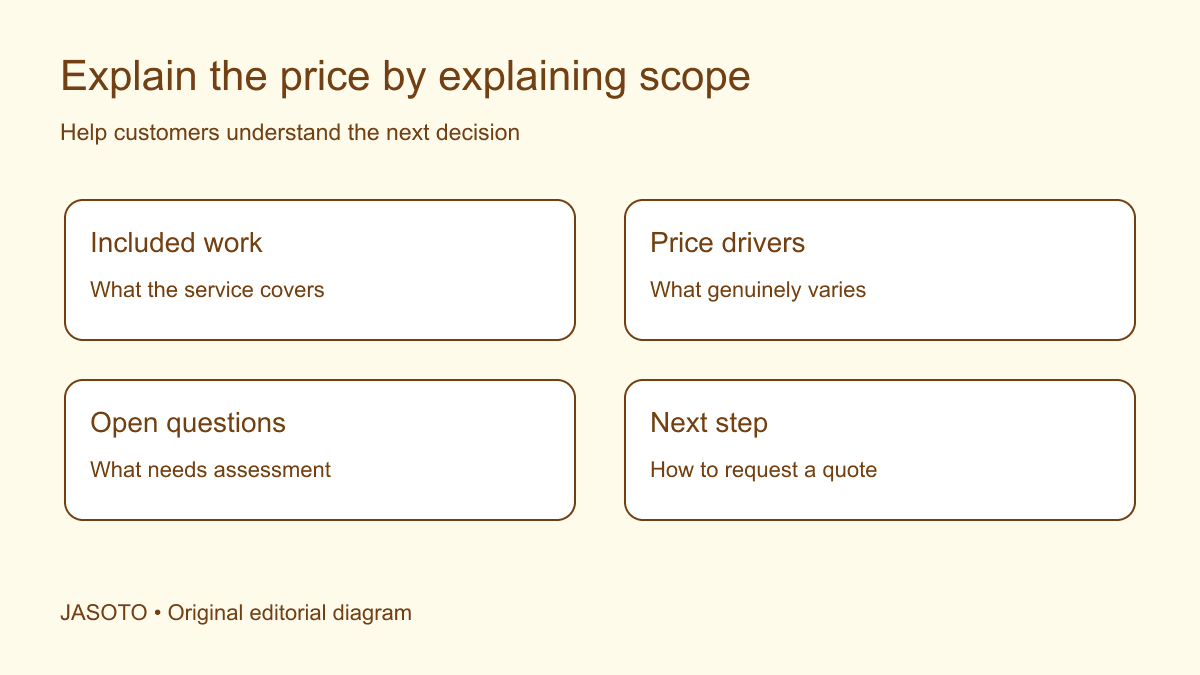
Original JASOTO editorial diagram. Its complete workflow is explained in the article; no actual customer outcome is depicted.
When service prices vary, explain what the customer is buying, which factors change the scope and what information is needed to produce a useful response. Publish only price statements the business can support. If you include an example, show the assumptions and limits clearly. The page should help a customer decide whether to enquire, rather than create an attractive number that becomes unrecognisable once unavoidable charges are added.
This guide focuses on ordinary UK service pages and uses an invented example without a market price. The CMA's price-transparency guidance is the primary reference for the consumer pricing points below. The content structure is an editorial recommendation, not a determination of the rules for every offer. Review the requirements relevant to your actual service and customer.
The practical answer
- Explain what changes the price instead of hiding behind vague wording.
- Define the scope and conditions behind any published example.
- Keep compulsory charges and important limits visible.
- Tell the customer what happens after an enquiry.
Define the service before discussing its price
State the work in language the customer recognises. A broad label such as support package can cover an assessment, a recurring service or a fixed deliverable. Explain which one the page concerns and who it is intended for. If the business offers several service levels, distinguish them by the work and outcome supplied rather than relying only on names such as basic and premium.
Identify the boundaries of the offer. A visit to diagnose a problem is not necessarily a promise to complete a repair during the same appointment. A design consultation may not include final production files. Put important distinctions where a reader makes the decision, not only in a long terms document. Clear scope helps the provider price the right work and helps the customer recognise whether they are comparing genuinely similar offers from different businesses.
List the factors that genuinely change the work
Choose factors the business actually uses when assessing an enquiry: quantity, existing condition, specification, location or the number of people involved, for example. Explain how each factor changes the work rather than adding an impressive-sounding list. If location affects travel arrangements, say what needs checking. If condition cannot be judged remotely, explain the assessment route rather than implying that a photograph always establishes it.
Separate price drivers from optional preferences. A different finish might change materials; a requested extra service might change the deliverable. If a customer can decline an optional item, make that distinction clear. Do not call a necessary part of the described service optional simply to present a lower headline figure. Ask the people preparing quotations to review the page so the published explanation reflects the actual buying process rather than a marketing team's guess.
Treat transparency as a page-wide responsibility
The CMA's guidance says consumer prices should be clear, complete and accurate, including charges the customer cannot avoid. Check the headline, examples, booking steps and confirmation together. A clear paragraph halfway down the page does not necessarily resolve a misleading impression created by a prominent figure or button. Review the actual customer journey rather than approving each sentence in isolation.
Keep local applicability in view. The source is UK guidance, so do not copy its legal wording into an international version without checking the relevant requirements. If your customers or offers differ, obtain appropriate advice. This article deliberately avoids invented universal rules about when an estimate becomes a quotation. The useful editorial task is to label what the business actually offers, explain its conditions and stop unsupported price claims entering the page in the first place.
Use examples with an explicit scope
If you have an approved current example, identify the work it represents and relevant assumptions. A customer should understand whether it concerns one item, a particular size, a specified service area or an ordinary appointment period. Avoid presenting a special historical job as a typical current offer without evidence. Review examples when materials, availability or the service itself changes.
When reliable price records are unavailable, use a hypothetical scope without assigning a fabricated price. You can still show how two jobs differ: one needs only the defined deliverable, while another adds assessment or preparation. Label the scenario clearly. The purpose of the example is to explain the decision, not create the appearance of market research. A made-up figure may look useful in a search result while leaving the business to explain why it cannot honour what readers reasonably inferred.
Explain the information needed for a quote
Ask for details that affect the assessment and explain why they matter. A short form might request the service, location, quantity and a description of the required result. If photographs help, tell customers what views are useful and how to send them appropriately. Avoid requiring extensive personal information or documents merely because the form software offers extra fields.
State what happens when information is missing. The business might ask a follow-up question or offer an assessment visit; it should not pretend to produce a reliable price from an incomplete brief. If the assessment itself has a charge, communicate that through the appropriate process before a customer commits. A pricing page becomes more useful when readers can distinguish the information-gathering step from the later purchase decision, with a clear contact route for uncertainty.
Make the response process concrete
Explain who responds, through which channel and what the customer can expect next, using only commitments the business can support. An automatic acknowledgement is different from an assessed quotation. If availability needs confirming, say so. Do not promise a guaranteed turnaround merely because it sounds competitive; an unmet response promise can create more frustration than an honest description of the process.
Identify any genuine dependencies. A site visit may require access permission or a workshop appointment may require the item to be delivered. Customers can research journeys through JASOTO travel after the destination and appointment are confirmed, checking provider details directly. The page should not create an unnecessary trip by making an unbooked visit sound like the normal next step. Keep contact, assessment and purchase instructions aligned with how the business actually operates.
Worked example: two reception-sign enquiries
Imagine a sign maker receiving two enquiries for reception signage. One customer has approved artwork and a defined mounting arrangement. The other wants design help and has not confirmed the wall or fixing requirements. This is an invented scope example, not a price claim. The page explains that the business needs the artwork status, dimensions, intended location and installation requirement before assessing the work.
Instead of publishing an unsupported typical price, the page shows what information distinguishes the two enquiries. It explains the route for unresolved installation questions and identifies any separately offered design work accurately. Customers can prepare a better brief without being encouraged to assume both jobs cost the same. The useful improvement is not a longer list of disclaimers. It is a clearer description of which work is included, which questions remain and how the business will resolve them.
Check consistency across listings and messages
Compare the service page with directory profiles, advertisements, enquiry acknowledgements and quotation templates. If one channel describes a fixed inclusion and another calls it an extra, investigate before publishing more promotional copy. Keep a current approved source for recurring price statements so colleagues do not copy an outdated number from an old social post or document.
Use JASOTO businesses to research relevant providers, and make your own listing accurate to the services you actually supply. A directory description should help a customer judge fit rather than repeat a lower price with its conditions removed. If the quoting process needs sustained capacity, explore relevant customer service or estimating jobs. Training and authority matter too: the person answering an enquiry should know which statements they can confirm and which require an assessment.
Test the page with realistic customer tasks
Ask a reviewer to describe what the published service includes, identify what changes the price and find the appropriate next step. Use a straightforward enquiry and one with missing information. If the reviewer cannot tell whether the first interaction is free information, a paid assessment or a purchase, the page needs clarification. Do not assume that familiarity with your business makes those distinctions obvious to a new reader.
Check links, forms and mobile presentation as well as wording. Important conditions should remain discoverable when the page is read on a small screen. Preserve the current approved version before making changes so a known problem can be corrected or reversed. This is a practical review, not a guarantee that every customer will interpret every statement identically. Record repeated misunderstandings and improve the explanation using real evidence rather than adding speculative questions indefinitely.
Review prices and examples when the business changes
Give the page a responsible owner and a review trigger: a changed service, revised charge, new area or recurring customer confusion. A date in the footer is not enough if nobody checks the underlying claims. Remove expired offers through the appropriate process and update connected channels rather than allowing several versions of the buying journey to coexist.
Measure whether enquiries contain the details needed and whether customers understand the next step. Do not declare higher conversion from a few anecdotes or treat fewer unsuitable enquiries as a failure without reviewing their relevance. The aim is informed contact: people understand what they can buy, why a particular question matters and how to obtain a response. A variable-scope service can be explained clearly without either inventing a fixed price or hiding the information customers need.
Put the guide into practice
- Identify the service and customer the page addresses.
- State genuine price drivers and the information needed to assess them.
- Check all price statements against current approved details.
- Test the path from price explanation to the right enquiry.
Frequently asked questions
Must I publish one fixed price for every service?
A generic blog cannot determine the right legal treatment for every offer. Explain the actual buying process and consult applicable guidance. If a price cannot be determined in advance, do not use that uncertainty to obscure charges or important information.
Can I use a starting price?
Only publish a price statement that accurately represents a real offer and complies with applicable requirements. Define what it includes and the relevant conditions clearly. Avoid an attractive figure that customers cannot realistically obtain for the described service.
Should I make up a typical example if I have no records?
No. Use a clearly labelled hypothetical scope without an invented market price, or explain the factors qualitatively. A realistic-looking fabricated price can mislead readers about what your business actually offers.
Explore JASOTO tools
Compare actual service descriptions and contact suitable providers directly.
Explore customer service and estimating roles →Research staffing where quoting requires a continuing dedicated role.
Research a service-related journey →Plan travel only after confirming an assessment destination and appointment.
Continue with JASOTO
Compare your next step
Discover UK businesses, compare services and request written quotes before making a decision.