
Business Growth · UK Guide 2026
Spare-Key Handover for a Visiting Service Provider
JASOTO · Updated 5 November 2026 · 1,625 words
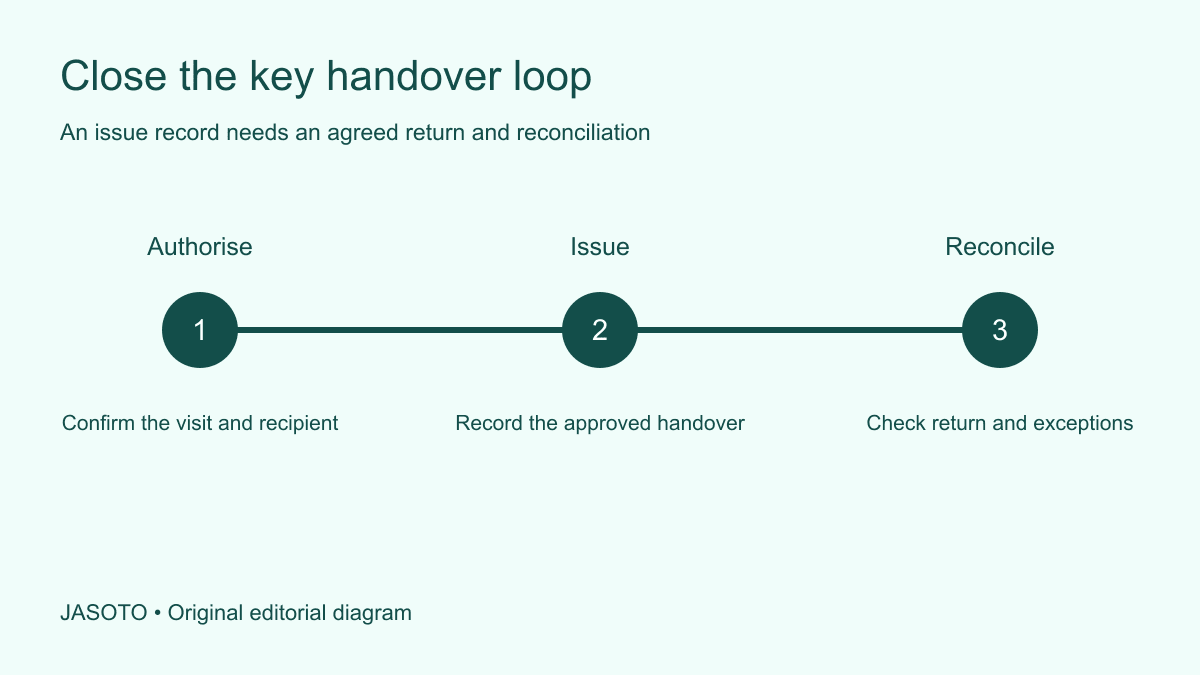
Original JASOTO editorial diagram. Its complete workflow is explained in the article; no actual customer outcome is depicted.
Before handing a spare key to a visiting service provider, confirm that the person issuing it has authority, the recipient is expected and the access is appropriate for the visit. Record the handover through the site's approved process and agree how return will be checked. A key leaving a drawer is an access decision, not merely an item of appointment administration.
This guide provides an original record-and-handover method for UK business premises. It does not design a security system or authorise entry to another person's property. Use the arrangements set by the responsible owner, occupier or security contact. If the premises are shared or tenanted, clarify the relevant permissions before considering how a spare key will physically change hands.
The practical answer
- Confirm authority before treating possession of a key as permission to enter.
- Link a key issue to a named recipient and defined visit.
- Agree the return arrangement before the handover.
- Escalate a missing key through the site's security process.
Ask whether a key is the appropriate access method
Start with the visit's actual needs. A provider attending while a responsible employee is present may not need an issued key. Another visit may require a different controlled arrangement. Ask the authorised person to decide, taking the site and circumstances into account. Avoid allowing a diary conflict to become the sole reason for granting access that has not otherwise been considered.
Record the agreed method in the appointment instructions. “Collect key” should not remain in the calendar after the site decides to provide an escort. Likewise, a provider should not discover at the entrance that an expected access arrangement has changed. Keep the booking record aligned with the authorised plan, and ask the provider to acknowledge practical changes that affect its attendance.
Confirm who may issue the key
Identify the role or named person allowed to approve and carry out the handover. These may be different people. A manager might authorise the issue while reception performs the recorded exchange. Give reception the approved instruction and a contact for uncertainty. Do not expect someone to infer permission from a familiar company name, an old appointment or a visitor's confident explanation.
Define the backup arrangement if the approving person is absent. The backup may be authorised to contact the provider or rearrange the visit without being authorised to issue a particular key. Keep that distinction clear. A process that relies on everyone sharing an unwritten understanding will be least reliable when an unfamiliar colleague covers the desk during a busy period.
Verify the recipient against the expected visit
Use the site's appropriate identity and appointment checks. If a different person attends, contact the authorised site representative and confirm the change through a known channel. Do not treat knowledge of an appointment reference as unlimited proof of authority. Equally, give legitimate providers a clear process so a staffing substitution can be checked without reception improvising personal demands or collecting unnecessary documents.
Record the recipient information needed by the approved issue process. Keep it connected to the provider and visit reference so later queries can be resolved. Avoid copying identity documents or adding personal details just because a form has empty space. The record's purpose is to account for the authorised handover, not to accumulate a dossier about everyone who attends the premises.
Keep the key reference and the access permission distinct
Use the site's existing key identifier rather than inventing a parallel numbering system. Check that the physical item matches the intended issue. If several keys are supplied together, the record should identify what was handed over through the approved method. A vague note saying “spare set” can leave the return checker unable to determine whether every issued item came back.
The key reference should not become a broadly circulated description of sensitive access details. Store the record with access appropriate to its contents and keep security information out of public appointment messages. The authorised recipient still needs suitable instructions about permitted use, but those instructions should travel through the agreed channel rather than appearing in every calendar copy and email forward.
Agree the return before the handover
State who receives the key back, where, and by what agreed point. Check that the receiving person will actually be available. “Leave it with someone” is not a reliable handover plan if the building closes before the provider finishes. If a different approved return method is needed, arrange it in advance rather than letting the visitor invent a convenient place to leave the key.
Tell the provider what to do if the visit overruns or the return contact is unavailable. Use a named contact or defined escalation route. Do not embed hidden storage locations or security workarounds in a generic guide. The correct exception process depends on the site. Your record should show that an arrangement was agreed and where the current authorised instructions are held.
Make issue and return separate recorded events
Record when the key was issued and by whom, then record the actual return when it occurs. Do not pre-complete a return field because the visitor expects to finish that afternoon. A planned return and a checked return are different facts. Keep any correction traceable so a later reviewer can understand what happened without assuming the original entry was always accurate.
[ProtectUK's access-control guidance](https://www.protectuk.police.uk/advice-and-guidance/risk/access-control) highlights records of issued keys and a contingency for an unaccounted key. The local method here adds a practical handover question: who will reconcile this particular issue? A system can contain accurate issue details yet still leave nobody responsible for noticing that the expected return has not been confirmed.
Worked example: a cleaner covering an extra visit
Imagine a small office arranging an additional cleaning visit. Its usual contact is away, and a different member of the provider's team will attend. The office does not rely on the old routine. The authorised site contact confirms the visit, the recipient and the approved access method. Reception receives the specific issue instruction and the person to call if the visitor details differ.
Before the key is handed over, the office confirms who will receive it back and how an overrun will be reported. After the visit, the return is checked against the issue record. This invented example claims no security outcome or reduced risk percentage. It shows how a familiar service can still require a fresh, explicit handover when the people and timing change.
Respond to discrepancies through the proper process
If the wrong key appears to have been returned, or an issued key cannot be accounted for, tell the responsible site or security contact promptly. Record the facts without guessing that the key is probably in a vehicle or that no one could use it. The appropriate response depends on what the key controls and the site's assessed circumstances; a receptionist should not decide that alone.
Preserve relevant communication and the sequence of events. Ask the provider for factual information through the agreed contact, avoiding accusations unsupported by evidence. If a key is later recovered, record the recovery and follow the responsible person's instructions. Recovery does not automatically erase whatever response or assessment was appropriate while its whereabouts were unknown.
Check the process when appointments change
A cancelled or postponed visit should trigger a check of any related key issue. The administrative cancellation might occur before a planned handover, after a collection or during a multi-day arrangement. Ask the authorised person what happens to the existing permission and key. Do not assume that cancelling the diary entry has physically recovered access items or informed every person holding the earlier instruction.
For recurring visits, review whether the current arrangement still matches the work, people and premises. Avoid carrying forward an indefinite issue simply because it began with a legitimate appointment. Keep reviews proportionate and within the site's security policy. The useful question is whether the record accurately represents who currently holds what under which authorised arrangement.
Make the handover understandable to a substitute
Keep the administrative owner distinct from the person carrying the key. The provider can be responsible for returning the item under the agreement, while a site employee is responsible for checking whether the return has occurred. If both assume the other will notice an exception, the issue record may remain unresolved. Put the check into the actual closing routine used by the authorised team, rather than creating a separate reminder that only one absent colleague sees.
When reviewing a past discrepancy, examine the process before adding requirements. Was the recipient different from the appointment? Was the agreed return desk closed? Did the cancellation message fail to reach the person holding the key? Record the evidenced cause where it can be established, and leave uncertainty explicit where it cannot. A practical improvement might be a confirmed return contact or clearer cancellation routing. It should address the actual problem rather than expanding personal data collection or asking staff to make security decisions they are not authorised to make.
Ask an authorised colleague to read the current record and explain the expected recipient, approving contact, return point and exception route. If they cannot do that without calling the usual administrator, clarify the process. Keep detailed security information controlled while ensuring the person performing the handover can access the instructions they need. A process hidden from its own authorised users will invite improvised shortcuts.
Use JASOTO businesses to discover providers and discuss attendance arrangements directly. If ongoing access coordination needs dedicated support, explore facilities administration roles as part of a staffing review. For a confirmed visit requiring travel, research the journey after the reporting point is agreed. Finish every issued-key record with a verified return or a visible exception owned by the responsible person.
Put the guide into practice
- Check the site's authorised key and access arrangements.
- Confirm recipient, visit and permitted access.
- Record issue and agreed return through the approved system.
- Reconcile the return and report unresolved exceptions.
Frequently asked questions
Should every service provider receive a spare key?
No. The responsible person should decide the appropriate access arrangement for the site and visit. An escorted visit or another controlled method may be more suitable. Convenience alone should not determine who receives a key or what access it enables.
Does a signed issue record authorise any use of the key?
A record should reflect the actual authorised arrangement, including its limits. It does not create authority that the issuer does not have or replace the site's security policy. Confirm the particular visit and access permission before handing over the key.
What if the key is not returned when expected?
Notify the responsible security or site contact through the agreed process, record what is known and follow their instructions. Do not treat an unanswered message or a promise to return it later as reconciliation. The appropriate response depends on the key and the site's assessed circumstances.
Explore JASOTO tools
Discuss suitable attendance and access arrangements before booking.
Explore facilities administration roles →Consider ongoing support where visit and access coordination is substantial.
Research a confirmed visit journey →Plan necessary travel once the appointment and reporting point are agreed.
Continue with JASOTO
Compare your next step
Discover UK businesses, compare services and request written quotes before making a decision.