
Business Growth · UK Guide 2026
Shared Inbox Ownership: A Schedule for Small Teams
JASOTO · Updated 5 November 2026 · 1,548 words
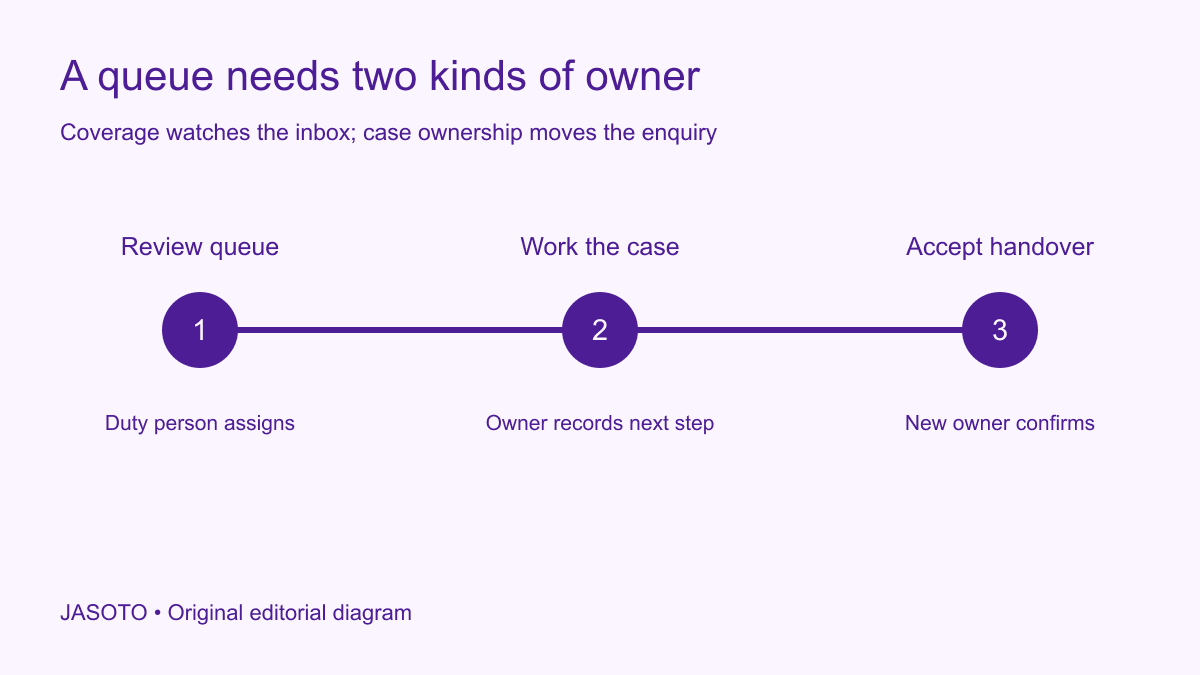
Original JASOTO editorial diagram. Its complete workflow is explained in the article; no actual customer outcome is depicted.
A shared inbox works when someone is responsible for reviewing incoming messages and every open enquiry has a named person responsible for its next action. Those can be different people. Publish a coverage schedule, define a few clear case states and require an explicit handover when ownership changes. Do not rely on the assumption that whoever last opened a message will deal with it.
This guide offers a practical workflow for a small team handling ordinary customer enquiries. It is independent of any particular mailbox product. The examples are invented and the proposed schedule is an editorial method, not a promised service-level benchmark. Match access, retention and customer commitments to your business rather than copying another organisation's response times.
The practical answer
- Separate responsibility for watching the queue from responsibility for a case.
- Give each open enquiry one owner and one next action.
- Hand over explicitly when the owner changes.
- Measure whether customers receive useful progress, not just acknowledgements.
Separate queue coverage from case ownership
The coverage person notices incoming work, recognises urgent issues and makes sure enquiries reach an appropriate owner. The case owner understands what is required, communicates with the customer and records the next step. In a two-person team, one colleague may do both jobs during a shift. The distinction still matters because they may hand one responsibility over while retaining the other.
Write that distinction into the rota. “Morgan covers the inbox until lunchtime” should not mean Morgan silently inherits every unresolved enquiry in the mailbox. Equally, someone who owns a difficult case should not assume another colleague will notice a customer's new reply. Agree who monitors replies and how the owner is notified. A workflow is useful only if the handoff between incoming messages and existing cases is understood by the people actually using it.
Build the rota around real availability
List the periods during which the business promises to review enquiries. Assign a primary person and a backup for each period, taking account of appointments, breaks and other work. Avoid a schedule that names someone who is regularly serving customers away from a computer. If there are uncovered periods, change the promise or arrange cover rather than relying on an optimistic spreadsheet.
Keep the rota somewhere the team can update. State who can change it and how an absence is reported. Before business travel, confirm coverage rather than assuming a colleague will read messages from a train. JASOTO travel can help research journeys, while the rota records the operational consequence of being away. The inbox arrangement should remain dependable even when a journey is delayed or connectivity is unavailable; a traveller should not be the only person able to explain an active case.
Use states that describe what must happen
Choose a small set of states such as new, assigned, waiting for customer, waiting for supplier and ready to close. Define what qualifies for each one. “Waiting” alone is ambiguous: the team needs to know who is expected to act and when the case should be reviewed again. Avoid a complex classification system that takes longer to maintain than the enquiries themselves.
For every open case, record the owner, next action and review point. A review point is not always a customer deadline; it may be when the owner checks whether a supplier has replied. Distinguish an internal target from a promise already made to the customer. This reduces the risk that a colleague sees a date in a list and treats an estimate as a contractual commitment or sends a contradictory update without reading the case history.
Make assignment visible in your actual tools
Use the assignment function provided by your mailbox or helpdesk if it suits the workflow. If you use folders, labels or a separate list, test whether colleagues see changes consistently. A system that depends on one person's private flag or personal calendar will fail when another person covers. Do not assume that the colour or symbol shown on your screen has the same meaning for everyone else.
Keep the case record linked to the original conversation, with a reference that survives forwarding. When a customer sends a second message under a different subject, connect it to the existing case where appropriate instead of creating conflicting owners. This is a process choice, not a requirement to install specialist software. A modest system can work if it records the important decisions reliably; an elaborate system can fail if people never agree what its labels mean.
Protect access without sharing one password
Give colleagues access through the account and mailbox arrangements supported by your provider, with individual identities where available. Ask a competent administrator to configure the setup if you are unsure. An inbox rota is a work-allocation document, so it should not contain passwords, recovery codes or other secrets. Staff leaving the team should not retain access merely because the shared mailbox continues to exist.
The NCSC's small-organisations resource covers secure email, accounts and devices. Use that guidance alongside your provider's instructions for the security configuration. The ownership method here addresses a different problem: whether a legitimate enquiry receives a responsible next action. Security and workflow need to support each other. A broad distribution list that copies every message to everyone may appear convenient but can make both responsibility and appropriate access harder to manage.
Write a handover that another person can use
A useful handover has five parts: the customer question, current position, commitment already made, next action and new owner. Include the conversation reference and any genuine deadline. “Please chase this” is insufficient if the recipient cannot tell what they are chasing, who was contacted or what the customer has been told. Link to relevant records instead of duplicating sensitive information across several messages.
The receiving person should accept ownership through the agreed tool or a clear reply. Until that happens, use the team's escalation arrangement rather than treating a forwarded email as proof that the case has moved. This does not need to be ceremonious: a visible assignment with an accepted status may be enough. The purpose is to prevent a case occupying a gap where one colleague believes they handed it over and another believes they were only copied for information.
Worked example: an enquiry waiting on a delivery answer
Imagine a small office supplies business with two staff sharing customer enquiries. A customer asks whether a desk can arrive before an office move. The duty colleague assigns the case to the person who handles the supplier. That owner requests confirmation and records that the date is unconfirmed. The customer receives an explanation of what is being checked rather than a guessed delivery promise.
When the owner takes leave, the handover identifies the supplier contact, the pending question and the update already promised to the customer. The receiving colleague accepts the case and sets a review point. If the supplier has not replied, they can send a useful progress message or discuss alternatives. This invented scenario does not establish an ideal response time. It demonstrates why ownership, a truthful status and a traceable commitment matter more than the number of messages marked as read.
Measure progress that matters to customers
Review a small sample of completed and overdue cases. Ask whether an owner was visible, the next action made sense and promises matched what happened. An immediate acknowledgement is not the same as resolving a question, so do not judge performance only by time to first reply. Fast empty replies can conceal a growing backlog of unanswered decisions.
Record the starting position before changing the workflow if you want to compare it later. Use similar working periods and note unusual events such as closures or promotions. The first objective is to discover where cases stall, not to manufacture a percentage improvement. If waiting for another department dominates the queue, changing mailbox labels may achieve little. Address the dependency and check again. Keep any measurement proportionate to the business and avoid collecting unrelated customer details for the sake of a dashboard.
Decide whether the workload needs a different arrangement
If coverage repeatedly conflicts with other responsibilities, review staffing and service promises. Explore customer service jobs on JASOTO if the business needs a dedicated role. If configuration or workflow design is the issue, find business support providers and give them the process you are trying to run. Be clear whether you need technical setup, temporary cover or continuing case handling; those are different services.
Keep a short written rule for exceptional cases and nominate someone who can make a decision. Review the rota after absences and busy periods, then change only what the evidence supports. The desired result is straightforward: customers do not have to repeat the same explanation to several people, colleagues can see who will act, and a shared inbox remains shared without becoming ownerless. That outcome depends on daily use of the arrangement, not simply creating a schedule once.
Before adopting the rota, rehearse one awkward handover: a customer replies near closing time while the case owner is absent. Ask the covering colleague to find the current promise and identify the next authorised action. If that requires a private message to the absent person, improve the record before treating the process as ready. This exercise tests discoverability, not just whether a name appears beside a time slot.
Put the guide into practice
- Assign coverage for each working period and an absence backup.
- Define case states using plain language.
- Keep one owner and next action visible for open cases.
- Test the handover with a realistic enquiry.
Frequently asked questions
Does the rota person have to answer every enquiry?
No. They check that incoming work is reviewed and assigned. A colleague with the relevant knowledge can own the response. Keep the distinction visible so the rota person does not become an unintended bottleneck.
Is marking a message unread enough to hand it over?
It leaves too much unexplained. Record the new owner, what has already been promised and the next action. Use the mailbox's assignment features or a simple linked record that the team can access.
Should we buy a helpdesk immediately?
First define the workflow and test whether your existing mailbox supports it. A helpdesk can make assignment and reporting easier, but software will not resolve an unclear agreement about who owns an enquiry.
Explore JASOTO tools
Continue with JASOTO
Compare your next step
Discover UK businesses, compare services and request written quotes before making a decision.