
Building & Home Improvements · UK Guide 2026
Contractor Access on a Shared Site: Agree the Handover
JASOTO · Updated 5 November 2026 · 1,631 words
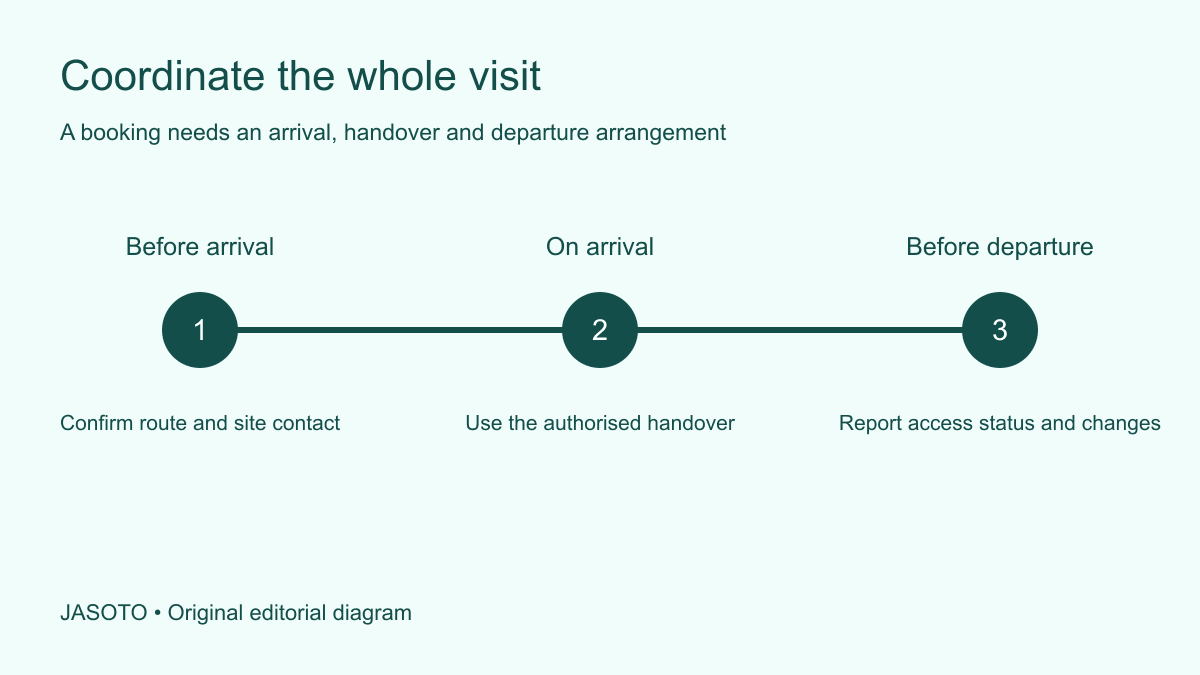
Original JASOTO editorial diagram. Its complete workflow is explained in the article; no actual customer outcome is depicted.
When several contractors share a site, agree who controls access, which routes and spaces each visit needs, and how changes reach everyone affected. An appointment time alone is insufficient. The useful record connects arrival, authorised entry, shared resources and departure so one contractor's booking does not quietly make another contractor's plan impossible.
This guide describes an administrative access plan for a UK business premises. It is not a construction phase plan, traffic assessment or permission to begin work. Where construction duties apply, use the responsible project arrangements. [HSE's site rules and induction guidance](https://www.hse.gov.uk/construction/safetytopics/site-rules-induction.htm) explains that construction site rules and inductions should reflect the particular site. The examples below are original coordination methods to support, rather than replace, that work.
The practical answer
- Access means a usable route and authorised handover, not just an open door.
- Identify shared spaces and dependencies before assigning arrival times.
- Keep the current access plan with the people receiving visitors.
- Refer safety and construction coordination to the responsible competent people.
Identify who can authorise access
Begin by naming the person who can confirm access arrangements for each part of the premises. A landlord, tenant, building manager and project team may have different responsibilities. Do not infer authority from who happens to have a key. If an office occupier can open the front door but cannot authorise use of a shared loading area, record that distinction before sending arrival instructions.
Name a backup contact and define what they can decide. This may include receiving a visitor or contacting the site coordinator, without authorising a changed work method. Keep the access contact separate from the person who approves extra expenditure. A single person can hold both roles, but the record should still make the authority clear so visitors are not passed between colleagues with incompatible assumptions.
Describe the visit rather than only the trade
Ask each contractor what access the particular visit requires. “Electrician attending Tuesday” gives less scheduling information than a description of the rooms, equipment, escort and arrival arrangements needed. The provider should supply the relevant detail through the site's proper process. Your administrative note should point to approved arrangements, without attempting to devise technical methods for the contractor.
Record the expected arrival window, likely duration and any dependency on another visit. Mark provisional information visibly. If a provider cannot yet confirm whether a second person will attend, that may affect reception and escort arrangements even when the work scope is unchanged. Ask for updates by an agreed point rather than pretending that missing details are fixed facts.
Map the shared resources that create conflicts
List the resources that more than one visit needs: a receiving desk, an escort, an agreed unloading point, a corridor or a room that remains in ordinary business use. Check these with the people responsible for the site. A shared resource can become unavailable even when appointment times do not overlap. One delivery may leave the receiving team occupied after the vehicle departs.
Use a simple planning matrix with visits down one side and shared resources across the top. Record confirmed needs and unresolved questions rather than drawing a technically authoritative route map yourself. The matrix reveals where a conversation is required. It does not establish that simultaneous work is safe or suitable; that judgment belongs within the proper site coordination and risk arrangements.
Separate arrival time from permission to start
Tell providers where to report and whom to contact before entering or beginning work. Arrival, check-in, induction, escort and availability of the work area can be separate stages. If a booking says “arrive at nine”, clarify whether that means reporting to reception or being ready to start after earlier arrangements. Otherwise the same phrase may create two different expectations.
Avoid instructing reception to wave through anyone who names the project. Give staff the information needed to recognise the expected visit and contact the authorised person. If identity or appointment details do not match, provide a clear escalation route. The receptionist should not need to decide whether an unfamiliar visitor's explanation overrides the current access plan.
Make delays visible before they spread
Agree how a late arrival or overrun is reported, who assesses its effect and who notifies the other visitors. A contractor delayed in traffic might only need a revised receiving time. A delay that removes the planned separation between activities may require the site coordinator to reconsider the sequence. Do not treat every delay as the same administrative inconvenience.
Record an update as a change to the current plan, with a time and author, rather than adding another message to an unstructured group conversation. Brief the people using the plan, especially reception and escorts. A schedule can be accurate in the coordinator's inbox while the printed copy at the entrance remains wrong. Confirm that the changed instruction has reached the place where someone will act on it.
Keep ordinary occupants in the conversation
Ask which business activities continue while contractors attend. Customer appointments, staff arrivals and routine deliveries may share the same entrance or receiving team. The responsible people should decide appropriate arrangements; the coordinator's role is to ensure the ordinary users are represented. Do not assume that a small job has a small effect simply because only one contractor is attending it.
Give occupants practical information relevant to them: which contact to use, whether an agreed room is unavailable and where current instructions can be found. Avoid circulating detailed security information or technical documents to everyone as a substitute for a clear message. If plans change, tell the affected people what they need to do differently, including when they should seek clarification rather than relying on an older announcement.
Prepare an arrival brief reception can use
A useful reception entry includes the provider name, visit reference, expected contact, reporting point and person to call. Add only the instructions reception is expected and authorised to carry out. Link to the current site arrangements where relevant. Keep sensitive access information in the proper controlled channel rather than embedding it in a broadly shared calendar invitation.
Write an exception instruction in ordinary language: “If the named contact is unavailable, call the backup; do not redirect the visitor through another entrance without confirmation.” Adapt it to your site. The point is to remove the expectation that reception must solve an operational conflict alone. A good brief makes the next authorised action clear even when the visit does not match the plan.
Worked example: three visits at an occupied office
Consider an invented office expecting furniture delivery, a network visit and a decorating contractor. All three initially request the same morning. Their work rooms differ, so the diary appears manageable. The coordinator asks about practical needs and discovers that two visits require the same receiving colleague, while the decorator's access depends on a room being vacated by the occupants.
The responsible people review the arrangements and confirm a revised sequence. Reception receives one current schedule, not three separate provider messages. Each provider knows whom to contact if delayed. This example claims no measured reduction in waiting or incidents. It shows how asking about shared dependencies changes the conversation from “three appointments fit” to “the required handovers can actually happen”.
Confirm the state left at departure
Ask contractors to report through the agreed departure process, including any unfinished work or changed access status. This is particularly important when another visit follows. A diary entry ending at noon does not prove that the area is ready for the next contractor. The relevant authorised person should confirm readiness under the site's arrangements, and the administrative record should reflect that confirmation.
Keep attendance separate from completion. Note who attended, the job reference and what follow-up was reported without converting those facts into a technical sign-off. If an area remains unavailable, make that clear to the next recipient of the plan. Do not let an assumption of normal access spread merely because the visiting team has left the building.
Review recurring coordination needs
Before changing the process, distinguish a missing instruction from an instruction that was never received. If the entrance detail was correct in an attachment but omitted from the confirmation people actually read, the practical fix may be to move it into the appointment message. If two current copies disagree, remove the duplication and identify one authoritative record. Ask the receiving team which information they needed at the moment of the problem rather than assuming that another mandatory field would have prevented it.
Test a revised brief with a colleague who was not involved in writing it. Ask them to explain where the visitor reports, whom they call, what they may authorise and what happens if the expected contact does not answer. Treat any uncertainty as evidence that the brief needs clarification. This is a desk review of communication, not a rehearsal of hazardous activities or a substitute for the site's formal checks. Keep the previous version so the change can be reviewed if the new wording creates confusion.
After a busy period, ask which access problems repeated. Perhaps the site contact was hard to reach, appointment confirmations omitted the entrance, or every provider requested the same escort. Improve the information or schedule that caused the difficulty. Avoid adding paperwork that does not change a decision. A short current plan is more useful than an elaborate log nobody consults during arrivals.
Use JASOTO businesses to discover providers and discuss their actual attendance requirements directly. If managing visits becomes continuing work, explore facilities or coordination roles as part of a realistic staffing review. For a confirmed appointment, research travel options using the correct destination and entrance. Keep provider discovery, travel planning and access authorisation distinct so each decision rests with the appropriate person.
Put the guide into practice
- Confirm the person coordinating the site and access decisions.
- Map arrival points and shared routes with the responsible people.
- Agree the response to delays and unavailable areas.
- Brief reception on the current authorised arrangements.
Frequently asked questions
Can two contractors use the same arrival time?
Only if the people responsible for the site confirm the arrangements are suitable. A calendar can show simultaneous appointments without resolving unloading, escort or work-area conflicts. Check the actual shared resources and any safety coordination before treating the time as available.
Who should tell reception about a change?
Name one coordinator for distributing the current access instructions and a backup if that person is absent. The technical or safety decision may belong to someone else, but reception should receive a clear authorised instruction rather than conflicting messages from individual contractors.
What if a contractor arrives early?
Use the agreed waiting and contact arrangement. Early arrival should not automatically permit entry, unloading or work. The receiving person should check with the authorised site contact and explain the next step without improvising access to a restricted or unavailable area.
Explore JASOTO tools
Continue with JASOTO
Compare your next step
Discover UK businesses, compare services and request written quotes before making a decision.