
Business Growth · UK Guide 2026
Set a Useful Communication Schedule for a Short Contract
JASOTO · Updated 5 November 2026 · 1,611 words
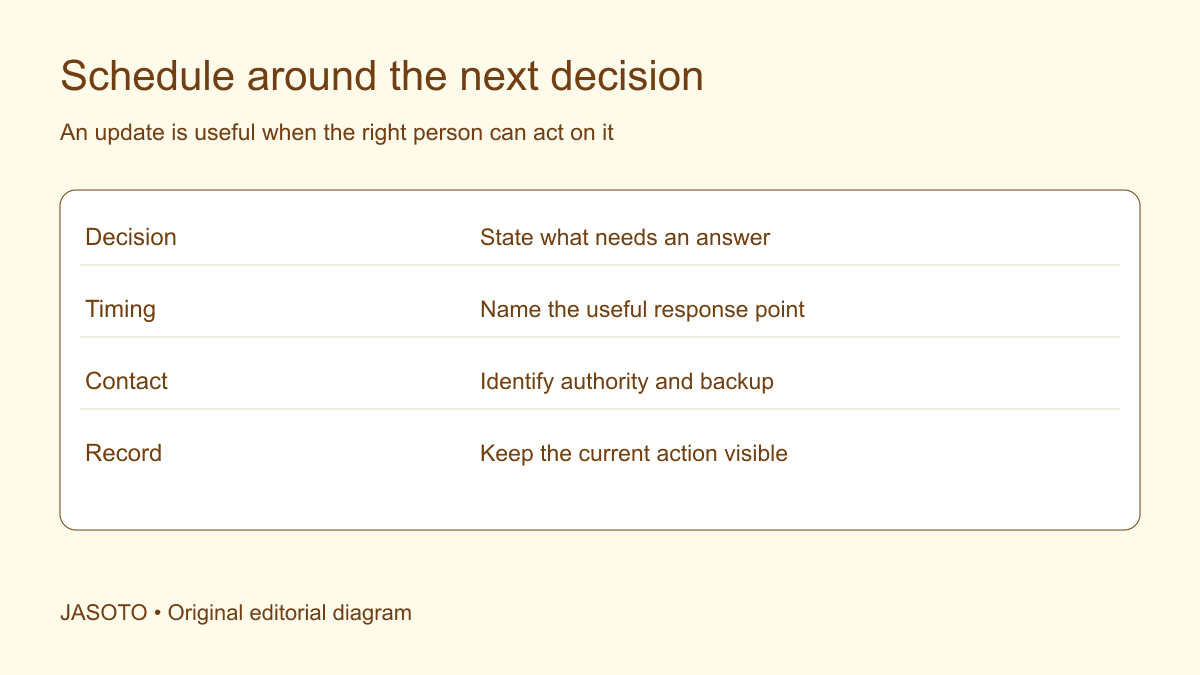
Original JASOTO editorial diagram. Its complete workflow is explained in the article; no actual customer outcome is depicted.
Set a communication schedule for a short contract by identifying the decisions, dependencies and exceptions that need timely attention. Agree who sends each update, who must respond and where the current action is recorded. The right schedule is the one that helps the work progress with clear authority, rather than the one with the most meetings or the longest distribution list.
This guide offers an original planning method for a UK small business and an external service provider working together for a limited period. It does not replace contractual notice requirements or professional project management where those are needed. The example uses an invented records-organising assignment. Use the actual contract for approvals, formal notices and disputes, while keeping practical day-to-day coordination understandable.
The practical answer
- Schedule communication around decisions and dependencies.
- Give routine updates and urgent exceptions different routes.
- Agree who receives information and who can authorise action.
- Review whether updates help people act rather than merely adding meetings.
Start with the short contract's decision points
List the moments when the provider needs information or approval from the business. A records project might require confirmation of the filing categories before work proceeds, access to an approved location and a final review of the handover. These are more useful scheduling anchors than an arbitrary daily meeting. Ask the provider when each response is needed to avoid holding up the next stage.
Distinguish a decision from a progress fact. “The first group is complete” informs the business; “please choose between two naming approaches” requires an answer. An update can contain both, but the response request should be explicit. Do not bury the important question inside a paragraph of completed work and then assume the customer deliberately ignored it when no answer arrives.
Identify the people who need each kind of information
Name the operational contact, authorised approver and appropriate backup. They may be different people, particularly when a staff member coordinates the visit but a manager controls spending. Ask the provider for equivalent contacts on its side. Knowing who can answer a routine question does not necessarily identify who can agree a changed scope or commercial commitment.
Keep the recipient list proportionate. People affected by a room closure may need a practical notice but not the full commercial discussion. The approver may need a concise decision request rather than every task comment. Agree how the team will route each message so broad copying does not replace responsibility. Use restricted channels where the information calls for them.
Choose an update frequency that matches the work
Ask how quickly meaningful changes can occur. A two-day assignment may need a start briefing, a decision check and a final handover. A multiweek assignment may benefit from a regular brief update between milestones. These are examples, not prescribed timings. Choose the cadence with the provider and revisit it if the actual work generates more or fewer useful decisions than expected.
The [government project delivery standard's communications section](https://projectdelivery.gov.uk/library-products/government-functional-standard-govs-002-project-delivery/) discusses matching communication to recipients and assessing effectiveness. It applies in its government context, not automatically to a private supplier contract. The original method here scales the basic question to a small assignment: does this message reach the person who needs it while there is still time to act?
Agree a compact update format
Agree how a telephone decision returns to the written action record. A call may be the quickest way to clarify a question, but the person maintaining the plan still needs an accurate instruction afterwards. Use the appropriate contractual process where required and circulate a concise factual confirmation to the relevant participants. If someone disputes the summary, resolve it visibly rather than continuing on an assumed agreement. This matters particularly in short assignments, where the work can move past a decision point before an unresolved interpretation is noticed in the next scheduled update.
A practical update can state completed work, next work, decisions needed and exceptions. Add the period covered and a clear reference to the current plan. Keep facts and forecasts distinct. “Files received” is a fact; “review expected tomorrow, subject to access” is a qualified forecast. Do not improve an uncertain forecast into a firm promise merely to make the update sound confident.
Use ordinary language and relevant links rather than copying entire documents into every message. A recipient should be able to identify the question and locate supporting detail. If screenshots or attachments are needed, give them meaningful names and check the appropriate sharing arrangements. An update that cannot be opened by its authorised recipient is not functioning simply because it was sent on time.
Put response deadlines in context
State when a response is useful and what depends on it. “Please confirm the category names before the second group is processed” explains the consequence better than an unexplained urgent flag. Where a precise time matters, agree it and use an unambiguous date and time. Do not invent a deadline on the provider's behalf or label every routine query urgent.
Check whether the decision maker can reasonably respond through the proposed schedule. If they are unavailable, agree the backup or an appropriate pause. A short contract can make delays consequential, but that does not create approval authority for whoever is easiest to reach. Keep the dependency visible and use the actual agreed escalation route rather than allowing time pressure to decide the scope.
Separate exceptions from routine reporting
Define what requires attention before the next scheduled update. Examples might include unavailable access, contradictory instructions or a condition that prevents the agreed task. The appropriate categories depend on the work and its proper safety and security arrangements. Do not ask a provider to wait for the next routine email where the business's established urgent process requires immediate contact.
Agree the channel and recipient for exceptions, including a backup. Explain how an unanswered message is escalated. A calendar invitation alone does not establish that someone monitors the inbox continuously. Make the response expectations realistic and accurate. If the business has no out-of-hours monitoring, do not describe it as an available immediate route; use the relevant existing arrangements instead.
Keep a current action record after the conversation
After a check-in, capture the decisions and next actions separately from the discussion notes. State the action, owner, relevant condition and agreed date or next trigger. A conversation can explore several possibilities while approving only one. The action record should not turn every idea into an instruction or leave the provider interpreting a transcript to discover what actually applies.
Preserve the relationship with the actual contract process. If a discussion proposes extra work, use the proper approval route before including it in the current instruction. An operational check-in is not automatically a contract variation. Link the relevant formal record where required, and keep the original plan available so later colleagues can understand what changed and who authorised it.
Worked example: a short records-organising assignment
Imagine a small practice engaging a provider to organize a defined set of non-sensitive reference materials. The first decision is the category structure. The parties schedule a brief review after a representative group, before the remainder is processed. Routine updates show completed groups and open questions. An access problem has a separate named contact route because waiting for the next review would prevent progress.
The category choice is confirmed in the action record, while a suggestion to add unrelated materials remains a proposal. The final handover is planned as its own event. This invented example claims no time saving or improved compliance. It illustrates how a short schedule can connect communication to actual dependencies instead of repeating meetings whose purpose neither party can explain.
Test whether the schedule survives absence
Give an authorised substitute the current update and action record. Ask them to identify the next decision, its owner and the route for an exception. If they need the entire original conversation to answer, clarify the record. This is a communication test rather than an assessment of technical competence. It helps reveal whether the plan depends on one person's memory.
Also check what the provider would do if the usual contact is unexpectedly unavailable. The backup should know the role and have appropriate access to the necessary information. Avoid naming someone who has never agreed to cover. A nominal backup may make the schedule look complete while leaving the attending team with no usable next step when the situation actually arises.
Close the communication loop at handover
Agree the final update's purpose: review the defined deliverables, record outstanding questions and identify who owns any remaining action. Do not treat the last routine check-in as a substitute if it happened before the work was complete. Keep handover, acceptance and invoicing distinct where the agreement does. Save the current record where authorised colleagues can find it after the temporary working group ends.
Review which messages changed a decision or prevented a misunderstanding. Remove unnecessary repetition and improve a missing step based on actual experience. Retain the earlier template so a confusing revision can be reversed. Avoid claiming the new cadence saved effort without comparing evidence from appropriate work. Communication should be evaluated by its usefulness, not just whether every planned meeting occurred.
Use JASOTO businesses to discover providers and discuss the communication approach directly. If contract coordination becomes continuing work, explore relevant roles within a staffing review. For a confirmed review requiring attendance elsewhere, research travel after deciding that an in-person meeting serves a real purpose. The useful result is a small, reliable information flow that leaves decisions and responsibilities visible throughout the contract.
Put the guide into practice
- Identify decisions and the latest useful response point.
- Agree update format, owner and recipients.
- Define the exception and backup contact route.
- Save actions and the final handover separately from discussion notes.
Frequently asked questions
Does a short contract need daily meetings?
Only if that frequency serves the work. Consider the decision points, pace of change and consequences of delayed information. A short written update may be sufficient in one case, while another needs a discussion. Agree a proportionate method rather than copying a fixed meeting cadence.
Should every stakeholder receive every message?
Identify who needs the information to act, decide or remain appropriately informed. Broad copying can obscure responsibility and circulate unnecessary detail. Keep the authorised decision maker visible, and use the proper channel for information that should have restricted access.
What if nobody replies to an update?
Use the agreed response and escalation process where a decision is needed. Do not assume silence approves a change unless the actual agreement and appropriate process establish that position. Mark the unresolved decision and its practical consequence so the next action is clear.
Explore JASOTO tools
Continue with JASOTO
Compare your next step
Discover UK businesses, compare services and request written quotes before making a decision.