
Business Growth · UK Guide 2026
Run a Short Review After a Missed Appointment
JASOTO · Updated November 5, 2026 · 1,602 words
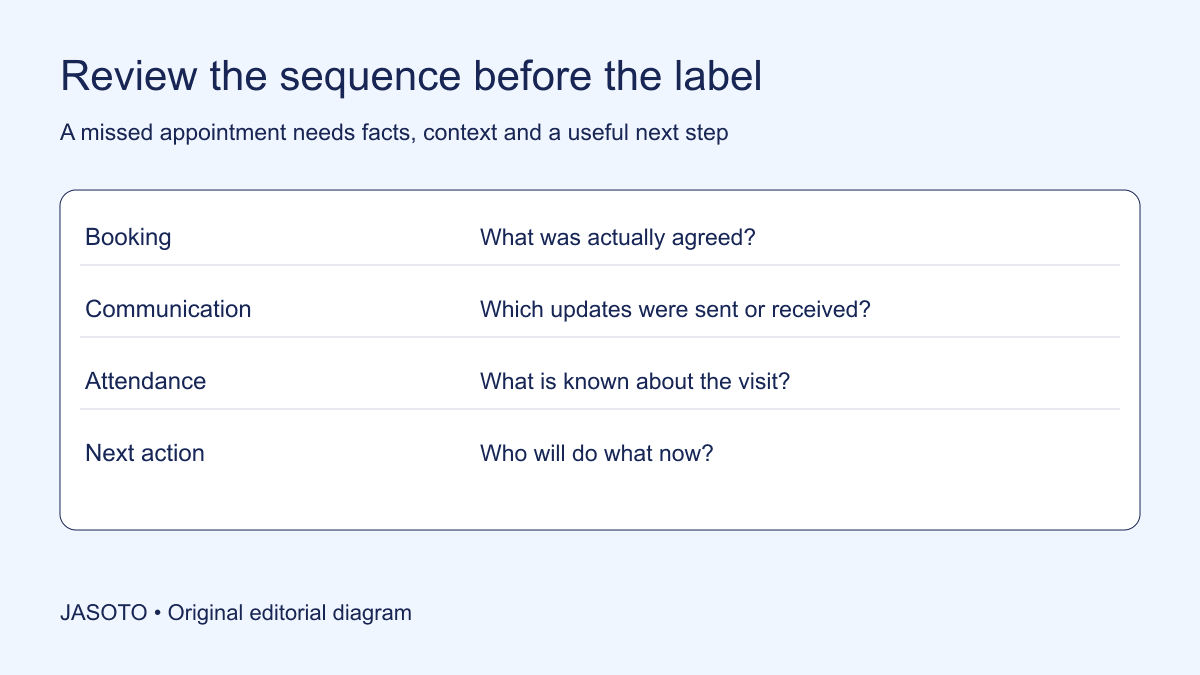
Original JASOTO editorial diagram. Its complete workflow is explained in the article; no actual customer outcome is depicted.
Run a short missed-appointment review by checking what was booked, which information each party received and what is actually known about attendance. Separate the facts from assumptions about why the visit did not happen. Then assign the next customer action and one proportionate process improvement if the evidence supports it. A review should make the situation clearer without turning a calendar label into a finding of fault.
This guide is an original administrative method for small service businesses in the United States. The example concerns an invented showroom consultation that did not proceed as expected. Use the actual booking terms, customer-service process and appropriate advice for charges, disputes or specialist matters. The operational review and any commercial decision should remain clearly connected but distinct.
The practical answer
- Establish what was booked and what each party knew.
- Separate attendance facts from assumptions about the cause.
- Review the actual confirmation and change pathway.
- Choose a focused improvement and preserve the next customer action.
Attend to the current customer situation first
Identify whether the customer still needs a response, clarification or a rebooking discussion through the business's actual process. Do not leave that action unowned while staff debate the cause internally. Give the responsible person the appointment reference and current status. A review can proceed alongside an appropriate factual customer update without promising an outcome that has not been authorised.
Keep communication neutral and specific. Ask a relevant question about the agreed arrangement rather than accusing the person of ignoring it. Preserve what they report and any meaningful limits. The customer's account may clarify the sequence or identify a contradiction, while the business still needs to check its own records. Neither should be rewritten into a stronger conclusion before evidence is reviewed.
Identify the actual appointment record
Check the service, customer reference, location, time and relevant date in the authoritative booking system. Distinguish a request, provisional hold and confirmed appointment according to the business's actual definitions. An internal calendar entry may have been created as a reminder rather than evidence of customer acceptance. Ask what the booking status actually establishes before using it in the review.
Preserve relevant versions if the appointment changed. A staff member may be looking at the latest time while the customer holds an earlier confirmation. Record both and the transition between them. Do not assume the visible current entry tells the complete story of what was communicated. The review needs the actual sequence, including who changed the arrangement and through which appropriate process.
Review the confirmation pathway
Identify which confirmation was generated, where it was sent and what it said. Keep sending, delivery information and customer acknowledgement distinguishable where the available records support those facts. A message existing in the system does not prove every aspect of receipt or understanding. If technical interpretation is needed, ask the appropriate administrator rather than guessing from an icon.
Check whether the practical information was usable. Time, address, reporting point and relevant preparation may have been spread across several messages or omitted from the confirmation. Do not assume an unfamiliar customer knows the entrance staff normally use. The review should examine what the customer could reasonably understand from the actual information, while preserving the limits of the evidence.
Check changes and cancellations separately
Look for reschedule requests, declined proposals or messages sent through another channel. A customer may have requested a change that was never confirmed, while a colleague assumed it had been accepted. Preserve the actual status of the request. Avoid treating every message mentioning another date as an agreed appointment or every cancellation enquiry as a completed cancellation.
Ask who was responsible for updating the authoritative record and notifying affected people. A changed diary entry without the appropriate customer update can create a different problem from a customer missing an unchanged confirmed slot. Keep those categories distinct. A useful review explains the relevant handover rather than grouping every failed visit under one general no-show cause.
Record attendance observations accurately
State what is known: the staff member was available, a customer arrived at a reported time or a call was attempted. Identify the source and any uncertainty. Do not invent an exact timestamp from memory or turn a later report into a contemporaneous record. The sequence may remain incomplete, and that limitation should be visible rather than hidden behind precise-looking entries.
Avoid unsupported motives. A late arrival may have several explanations, while an unanswered call does not establish deliberate refusal. Keep the review focused on relevant facts and appropriate questions. If staff or customer conduct requires another process, route it to the responsible person. A general appointment review is not a substitute for a fair complaint or personnel procedure.
Understand what the software status means
Check the actual system's definitions and controls before changing a status. [Square's appointment settings guidance](https://squareup.com/help/us/en/article/5351-manage-your-square-appointments-account-settings) includes cancellation and no-show handling in its own product. Other systems can behave differently. The operational label should reflect the appropriate process, not be chosen because it makes a report look tidy or seems closest to the staff member's first impression.
Ask the responsible administrator how corrections and associated notifications work where that matters. A status change may affect reporting or another workflow. Do not assume it is a harmless private note. Preserve the reason for a substantive correction through the appropriate record process, especially if later customer communication or a commercial decision relies on the history.
Identify a supported explanation or an open question
Compare the relevant evidence and state the explanation it supports. If the record shows that a changed location was not included in the customer update, identify that actual gap. If the cause remains unknown, say so. Avoid choosing a convenient explanation simply because the team wants to finish the discussion quickly or preserve a reassuring performance report.
Give unresolved questions a proportionate next check and owner. Some uncertainty may not be resolvable without excessive effort. Record that limit and use the actual customer-service process for the next decision. The review can still improve record clarity even when it cannot determine every detail. Honest incompleteness is preferable to a fabricated cause that drives the wrong intervention.
Choose an improvement linked to the finding
Match the change to the specific problem. An unclear reporting point may need a better confirmation sentence. An unconfirmed reschedule may need a clearer status and reply owner. A workload gap may need an operational adjustment. Do not automatically add more reminders when the issue concerns contradictory information or a process that nobody owns.
Define who approves and implements the change and what evidence will be observed afterwards. Keep the earlier version so a confusing revision can be corrected. Avoid claiming a reduced no-show rate without suitable comparable data and a clear denominator. A small targeted review can justify a useful communication correction without proving a general causal effect on attendance.
Worked example: two showroom entrances
Imagine a showroom consultation where the customer reports waiting at the public entrance while the adviser expected arrival through a different agreed reporting point. The review checks the actual confirmation and finds the location information needs clarification. It preserves the customer's account and staff observations without declaring that one party deliberately ignored the appointment.
The business updates the relevant confirmation wording through its appropriate process and handles the customer response separately. This invented example claims no guarantee that a new message prevents every missed visit. It shows why a location-information problem needs a specific clarification, rather than an unsupported conclusion that customers need more reminders or that the appointment simply failed for personal reasons.
Keep the review short enough to use
Use a compact factual example to test the review record: the appointment was confirmed for the showroom, a later message proposed another entrance, and the available evidence does not establish acceptance of that change. Ask a colleague what they can conclude and what remains uncertain. If they describe the customer as refusing the correct entrance, the summary has introduced an unsupported inference. Revise the wording and preserve the underlying references. The purpose is to make a fair operational explanation readable, not to make every reviewer reach a predetermined blame decision or turn an unresolved communication step into a settled fact.
A concise record can contain the appointment reference, factual sequence, explanation or uncertainty, next customer action and chosen process change. Link supporting evidence rather than pasting the whole conversation. Ask a colleague unfamiliar with the case to explain the finding and next step. If they cannot, clarify the relevant sentence instead of extending the record with unrelated history.
Use appropriate access and retention for customer information. Avoid collecting private explanations that are not needed for the actual review. Keep sensitive details in the proper controlled record and share a proportionate summary where the team needs to learn. A useful review improves understanding without becoming a broad file of speculative customer commentary.
Revisit the actual changed step
After an appropriate period or comparable set of appointments, review whether the specific information gap recurs. Check for new confusion introduced by the update. Report the observation honestly, including other changes in service volume or process. Do not turn one successful rebooking into proof that the underlying issue has been eliminated.
Use JASOTO businesses to discover suitable appointment operations support and verify capability directly. If follow-up becomes continuing work, explore scheduling roles within a staffing review. For an agreed rebooking, research travel after time, location and access are checked. A short review is useful when it leaves a fair factual account and a clear next action for both the customer and the business.
Put the guide into practice
- Identify the appointment and current customer status.
- Review relevant booking and communication records.
- Record the supported explanation and unresolved questions.
- Assign one improvement and an appropriate follow-up.
Frequently asked questions
Does a missed appointment prove the customer ignored it?
Check the actual circumstances before reaching that conclusion. Time, location, confirmation, changes or another issue may be relevant. Preserve factual records and ask appropriate questions. A calendar label alone does not establish why attendance did not occur.
Should the review decide a cancellation charge?
Use the actual agreement, applicable requirements and authorised process for any charge or dispute. The operational review can organise relevant facts, but it should not invent a universal fee or use an untested explanation as a legal conclusion.
Should every missed visit trigger a new reminder system?
Choose a change based on the observed problem. An unclear location, unconfirmed reschedule and forgotten appointment may need different responses. A proportionate review should identify the specific gap before adding a tool or more messages.
Explore JASOTO tools
Discuss the actual booking and communication workflow with suitable providers.
Explore scheduling support roles →Consider staffing where appointment follow-up becomes continuing work.
Research a confirmed rebooked journey →Plan travel after time, location and access are checked.
Continue with JASOTO
Compare your next step
Discover UK businesses, compare services and request written quotes before making a decision.