
Business Growth · UK Guide 2026
Plan a Clear Queue for a Short Seasonal Promotion
JASOTO · Updated 5 November 2026 · 1,604 words
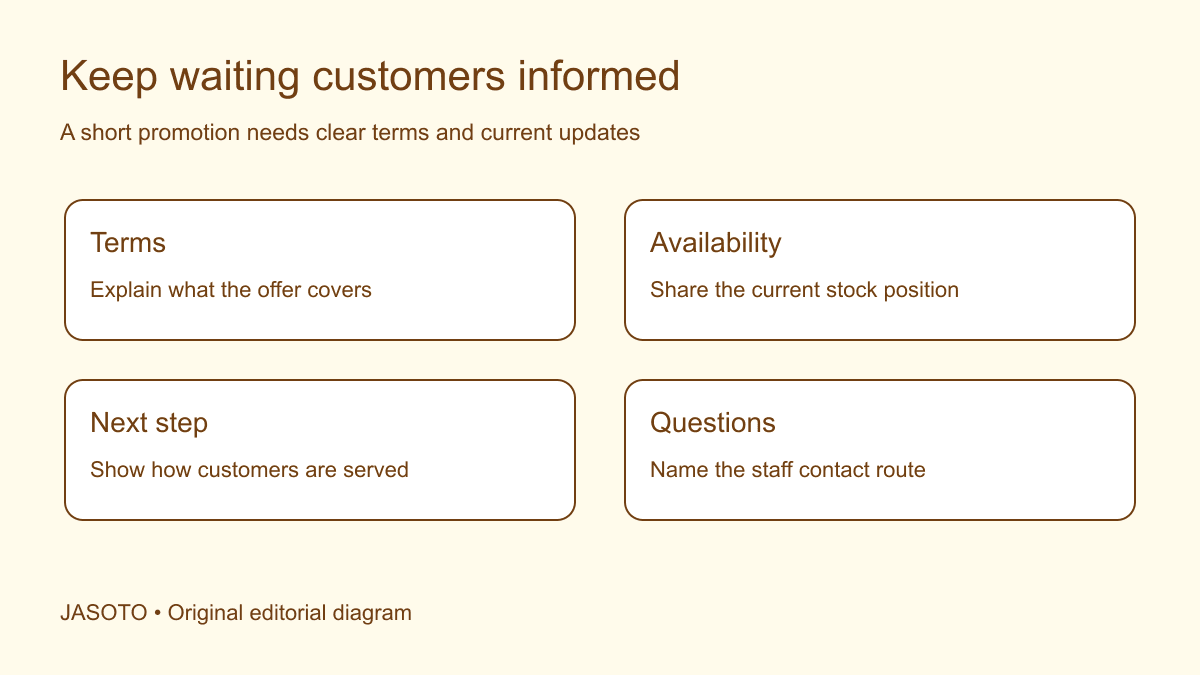
Original JASOTO editorial diagram. Its complete workflow is explained in the article; no actual customer outcome is depicted.
Plan a queue for a short seasonal promotion by making the offer and service sequence clear, assigning staff responsibilities and agreeing how customers receive updates. Review the physical arrangements through the site's proper safety and access process. A customer should understand what joining the queue means, which step comes next and what happens if the promoted stock becomes unavailable.
For a small UK shop, a brief promotion can place unfamiliar demands on ordinary routines. Customers may arrive together while staff still handle collections, returns and normal purchases. This guide provides an original customer-information and staffing worksheet. [HSE's crowd-management guidance](https://www.hse.gov.uk/event-safety/crowd-management.htm) identifies roles, coordination and monitoring as relevant topics; obtain appropriate advice for the actual premises and expected conditions.
The practical answer
- Explain what customers are waiting for and how the promotion works.
- Assign responsibility for customer questions, stock updates and escalation.
- Use the site's proper safety and access arrangements.
- Update the waiting customers when availability or service changes.
Define the promotion before designing the waiting process
Write the offer in terms staff and customers can understand: eligible products, applicable period, any actual quantity limits and how a purchase is completed. Check the wording through the business's appropriate review process. Avoid publishing an enthusiastic headline while leaving the team to invent the detail at opening time. The queue process depends on whether customers choose from a display, request an item or receive an allocation.
Match online announcements, window signs and staff instructions. If a customer sees one rule online and another at the door, the disagreement can slow service and create unnecessary frustration. Give the team one current reference. If a condition changes, identify who approves the update and how every channel is corrected. Do not assume a spoken announcement reaches customers who are still travelling.
Explain what joining the queue actually means
Decide whether joining merely establishes a service order or whether another step allocates stock. Explain the actual arrangement clearly. A customer waiting in line may reasonably want to know whether a particular item remains available. Do not let staff imply that all waiting customers will receive a product unless the business can support that statement under its actual process.
If there are product choices or variants, clarify when selection occurs. A general statement that stock remains may be unhelpful when the requested size is already unavailable. Use accurate current information and a defined source for updates. The team should know who confirms the stock position and what to say when it has not yet been checked, rather than substituting reassurance for evidence.
Review the proposed space with the responsible people
Identify the area the business proposes to use and ask the appropriate premises or event-safety people to assess suitable arrangements. Shared entrances, neighbouring businesses and ordinary access routes may be affected. Do not assume that a small promotion needs no review or that a public pavement is available for private use. Confirm any relevant permissions and requirements for the actual location.
The customer-information plan should reflect the approved arrangement. Staff need to know where to direct questions and whom to contact if the area stops working as intended. This article does not prescribe barrier layouts, crowd capacities or emergency routes. Those require an appropriate assessment. Keep those decisions with the responsible competent people and train staff on the resulting instructions before the promotion begins.
Separate promotion customers from other service needs
List the ordinary activities that continue during the offer: scheduled collections, returns, accessibility requests or customers buying unrelated items. Ask how each is handled within the approved arrangements. Do not leave employees deciding inconsistently whether someone can approach another counter or must join the promotion queue. A clear customer explanation can prevent disagreement about an apparent queue jump.
Keep the language respectful and useful. Explain the appropriate next step for a person's request without asking for unnecessary private details in front of other customers. If a particular assistance need requires discussion, give staff a suitable way to respond through the business's established process. Consistency should support access and service rather than becoming an excuse to ignore a legitimate individual requirement.
Assign roles to actual available staff
Identify who serves transactions, answers waiting customers, confirms stock updates and manages exceptions. In a very small team, one person may hold several roles, but the plan must acknowledge when those tasks compete. A cashier cannot continuously complete transactions and provide detailed updates elsewhere at the same time. Ask which task takes priority and who covers the gap through the agreed arrangement.
Give each role the information and authority it needs. The person answering questions should have a reliable route to the current stock position, while a supervisor handles an unusual complaint or proposed rule change. Avoid placing an unsupported employee at the front with only a promotional slogan. A short role brief should explain the task, current information source and escalation contact.
Prepare a few useful customer messages
Write concise messages for the likely stages: opening, current availability, a changed condition and the end of the offer. Use actual facts and avoid unsupported estimates. A message can say that the requested item is being checked and identify when an update will follow. That is more useful than a confident stock statement based on an old count or a colleague's assumption.
Have staff read the messages aloud during the briefing. Ask whether a customer can tell what action to take. Remove internal jargon and unclear phrases such as processed in the usual way if the promotion uses an unfamiliar sequence. Keep alternative formats or assistance arrangements appropriate to the shop's actual needs and responsibilities. Communication should work for the people receiving it, not only the team that wrote it.
Plan the response to stock changes
Prepare the closing message before the promotion begins. State who decides that the offer has ended, how staff tell people still waiting and which ordinary services remain available. Use the actual terms and appropriate customer-service process. A closing announcement should explain the current situation and next step without blaming customers for arriving later or suggesting an unconfirmed extension. Check any related online message so the business does not continue inviting people to an offer that has already closed at the premises.
Name the person who confirms an item is exhausted and authorises the customer update. Connect the announcement to the actual product or variant so the team does not prematurely declare the entire promotion over. Update the relevant online information where practical and appropriate. A correct message inside the shop can still leave arriving customers relying on a stale availability claim elsewhere.
Decide how staff handle customers who no longer wish to wait or who ask about alternatives. Use the actual offer and customer-service policy. Do not improvise a substitute product claim or promise a future restock date without confirmation. Record meaningful recurring questions for the later review; they may reveal that the original promotion wording left a decision unclear.
Worked example: a weekend gift promotion
Imagine a gift shop promoting a limited selection of seasonal bundles. Customers can choose among several versions, while ordinary click-and-collect orders continue. The team writes a clear explanation that joining the promotion queue establishes service order and that the chosen bundle is confirmed through the actual sales process. A separate role handles collection enquiries according to the shop's approved arrangements.
The stock contact updates staff when one bundle version becomes unavailable, and customer messages identify that version specifically. The team avoids claiming that every waiting person is guaranteed an item. This invented scenario does not establish a safe queue layout or a successful commercial outcome. It illustrates how offer terms, stock information and ordinary service can be coordinated before a short busy period.
Monitor the actual operation and escalate changes
Use the monitoring and escalation arrangements established for the premises and event. Staff should know which observations require the responsible person's attention and how to report them. A customer-information plan needs a live owner while the promotion runs. A written worksheet left in the office cannot respond when circumstances differ from the expectation at opening time.
Keep the responsible person informed about operational problems such as conflicting instructions, unavailable stock information or a service step taking longer than planned. Use the proper safety and emergency process for those matters; they should not wait for a routine debrief. Avoid encouraging staff to alter the physical arrangement independently because a quick adjustment looks convenient. The authorised process should handle changes that affect the site plan.
Review the evidence before the next promotion
Afterwards, record the questions customers repeatedly asked, which updates were difficult to obtain and where staff responsibilities conflicted. Use actual observations rather than declaring success because the day ended. If waiting times were not measured appropriately, do not invent an average. The review can still identify a missing message or an unrealistic role allocation that the next plan should address.
Change the smallest useful part of the process and keep the previous version. A clearer variant-availability message may solve a specific problem without redesigning every transaction. Ask staff to review the revised brief before reuse. Treat each premises and promotion on its actual requirements rather than assuming that one successful arrangement transfers unchanged to another location.
Use JASOTO businesses to discover relevant operational support and verify suitability directly. If the plan requires additional people, explore seasonal retail roles with clear tasks and supervision. Customers planning attendance can research travel after checking current opening and promotion information. A useful queue plan combines accurate customer expectations with assigned responsibilities and the site's appropriate practical arrangements.
Put the guide into practice
- Confirm promotion terms and stock information.
- Review proposed queue arrangements with responsible people.
- Brief staff on roles, updates and exception handling.
- Record actual problems and revise the next promotion.
Frequently asked questions
Should staff promise a waiting time?
Give only information the team can support and explain when it is an estimate. A moving queue does not guarantee a particular wait, especially if transactions vary. Update customers when conditions change and avoid turning an optimistic guess into a commitment.
Does joining the queue reserve promotional stock?
State the actual rule clearly before customers rely on it. Joining, receiving an allocated item and completing a purchase may be different stages. Make the process consistent across signs, online messages and staff explanations, and check the applicable consumer requirements.
Can we place the queue outside the shop?
Confirm the appropriate permissions, access and safety arrangements with the people responsible for the premises and surrounding space. Do not assume a pavement or shared entrance is available. Obtain suitable advice for the actual setting before choosing the arrangement.
Explore JASOTO tools
Discuss relevant event, staffing or operational support needs directly.
Explore seasonal retail roles →Consider staffing based on the real promotion tasks and supervision required.
Research a shopping journey →Check travel after confirming opening times and current promotion information.
Continue with JASOTO
Compare your next step
Discover UK businesses, compare services and request written quotes before making a decision.