
Travel · UK Guide 2026
Plan a Site Visit When Public Transport Ends Early
JASOTO · Updated 5 November 2026 · 1,633 words
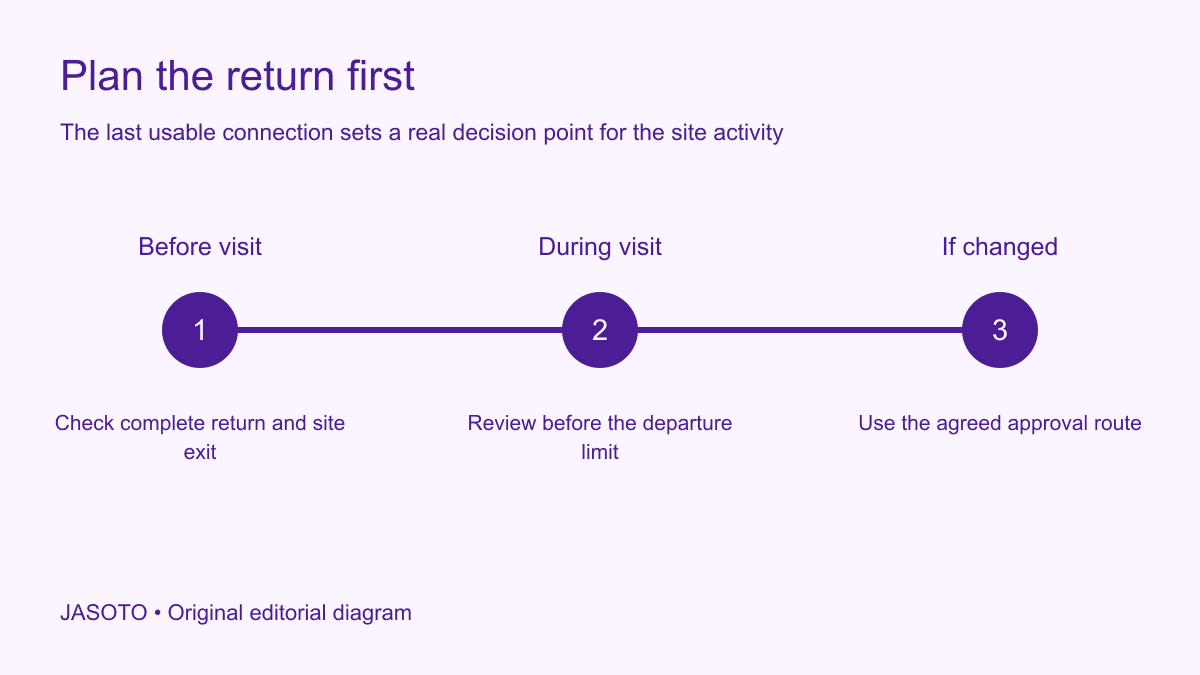
Original JASOTO editorial diagram. Its complete workflow is explained in the article; no actual customer outcome is depicted.
Plan a site visit with an early-ending public-transport service by checking the complete return first. Work backwards from the last usable connection to the site exit, pack-up and visit activity. Confirm who can adjust the visit and what happens if the return becomes unworkable. Reaching a remote site is only half the plan when the ordinary transport route stops before the business day does.
This guide offers an original method for UK work visits. Traveline provides journey, departure and timetable searches that can help identify local connections; confirm the actual dated services with the relevant operator. The planning sequence below makes the return constraint visible to the host and decision owner. It does not promise an alternative vehicle or assume a later service exists because a route appears on a general map.
The practical answer
- Check the complete return combination.
- Work backwards through the real site exit.
- Agree essential activity and departure constraints.
- Confirm any alternative and its authority.
Confirm the exact site exit
Ask the host for the building, entrance and exit used by visitors. A large site can have separate vehicle, staff and visitor access points. The bus stop nearest the map pin may be inconvenient or inaccessible from the actual exit. Check the route through the approved host or site information rather than treating the postal address as the final walking point.
Record any process needed before leaving, such as returning a pass, collecting equipment or waiting for an escort under the site's arrangements. Those steps affect the return departure. Avoid assuming a gate will be available at the end of the visit simply because it was open when you arrived. The host should confirm the relevant arrangement, especially when the visit ends outside the normal reception window or in a different part of the site from where it began.
Research the last usable route home
Check the complete journey from the site to the actual destination on the relevant day. Include local transport, main connections and the final leg. The last bus from the site is not useful if it arrives after the last onward service. Identify the final combination that works under the current timetable, rather than selecting each stage independently and hoping the connection exists.
Use dated journey and operator information and note when it was checked. Traveline can help locate routes and timetables, while the operator provides current service details relevant to the actual journey. Inspect any local notice or variation that affects the day. Avoid turning a saved screenshot into a guarantee of service. The purpose is to establish a practical planning constraint and the route to recheck it before departure and when circumstances change.
Work backwards to a site departure point
Starting from the relevant local service, allow for reaching the stop from the actual site exit. Then include the exit process and any equipment pack-up. Identify the latest practical point to finish the activity and begin leaving. Explain the basis in the itinerary so the host understands why a service departure later in the day may require the visitor to stop work earlier.
Choose an allowance appropriate to the route and circumstances. Do not apply a universal number that ignores an unfamiliar path, equipment or a controlled exit. If a local segment is uncertain, ask the responsible host and preserve the question until resolved. A precise-looking departure time can be misleading when its underlying walking or access assumption has never been checked. The plan should identify both the confirmed route and the point that still needs evidence.
Tell the host what the constraint means
Explain the practical departure requirement before the visit, using a concise statement linked to the purpose of the meeting. Ask whether the intended activity fits within that window. The host may adjust the sequence, clarify the expected duration or identify an existing authorized arrangement. Do not assume the visitor should quietly leave unfinished essential work or that the host should automatically extend transport support.
For an invented equipment assessment, the host confirms that the final discussion can happen before the visitor begins packing. A remaining document review will be handled later by an agreed owner. This preserves the useful site activity while respecting the return constraint. Another visit may genuinely require more time, in which case a different approved itinerary is needed. The value of the conversation is an actual decision, rather than an optimistic reassurance that the day will probably be finished by then.
Separate essential work from optional activity
Agree which site activities must happen in person and which can be moved or omitted through the responsible decision owner. A tour, demonstration, inspection and informal discussion may have different importance. The visitor should understand the minimum useful outcome before choosing travel. Otherwise the plan can preserve a return connection at the cost of missing the very activity that justified the trip.
Keep the distinction current if the agenda changes. A new essential task may require another decision about travel or timing. Do not allow optional activity to expand invisibly until it consumes the return margin. At the same time, avoid treating every unscheduled question as optional simply because the transport plan is tight. The business owner and host should decide priorities with the actual requirements visible, while the traveler explains the practical effect on departure.
Check whether another arrangement genuinely exists
Investigate a plausible alternative if the ordinary return cannot support the visit. It might involve a different dated route, a specifically booked local service or another approved trip arrangement. Confirm availability, route, capacity and relevant conditions directly. An instruction to “get a taxi” is incomplete if no suitable provider has been identified or the journey and cost have not been approved.
Keep any help from the host explicit. A colleague offering a lift may need to confirm timing and suitability through the appropriate arrangements; do not build the whole return around a casual remark. The plan should show whether the alternative is confirmed, requested or only an idea. This prevents an unbooked fallback from being mistaken for a solution when the original transport route is already known to be insufficient.
Establish authority for a changed return
Name who can approve additional travel, an overnight arrangement or a changed appointment where relevant. The traveler may be able to identify options without having authority to commit the business. Agree the contact route and decision point before reaching a place with limited connectivity. A general instruction to use judgement can leave important cost and commitment boundaries unclear.
Record the facts an approver needs: the original constraint, the essential work remaining and the actual alternative being checked. Keep provider availability separate from approval. A room or vehicle being offered does not establish permission to book it. If no authorized alternative is available, make that visible to the host before the visit proceeds. The planning decision may need to change the activity rather than assume an unspecified later rescue will appear.
Prepare an early trigger during the visit
Set a point before the latest practical departure when the host and traveler review whether the plan still works. The trigger should leave time for the approved next action. Do not wait until the final service is impossible to reach before reporting that the agenda has overrun. Keep the reminder connected to the activity, such as beginning pack-up after the final required demonstration.
Use a concise update if the constraint becomes active: what is complete, what remains and which decision is needed. Avoid promising a later arrival until the revised route is confirmed. The host may assign a follow-up or the approver may authorize another actual arrangement. Record that decision and update the current itinerary. A notification of delay does not by itself change a booking or establish that the destination contact now expects a different time.
Make the return information usable onsite
Keep the route, stop details, host contact and decision-owner route available in an appropriate offline form. A live planner may not be available where the visit takes place. Include enough written context to recognize the correct stop and direction. Do not rely only on a map pin or an internal host extension the traveler cannot call from outside the gate.
Use travel research to explore the broader route, then confirm actual services directly. For a local provider found through business listings, agree the specific pickup and response to a changed finish. If site-visit coordination is a recurring responsibility, describe it accurately in relevant roles, including ownership of route checking and authority for changes. The traveler needs a complete handoff from site to transport, with the responsible people knowing what they are expected to do.
Recheck before the visit and learn afterwards
Review the dated service and site details before departure, and recheck material changes through the relevant source. If the final route no longer works, return to the business purpose and obtain a revised plan before relying on the old schedule. Preserve the confirmed elements while removing unsupported assumptions. A changed service may affect the visit timing, not just the last line of the itinerary.
Afterwards, note what the return calculation missed or handled well: the actual exit process, a local connection or an approval gap. Keep the observation specific rather than declaring a whole area unsuitable for public transport from one experience. The rollback for an overloaded visit is to narrow or move the activity through the responsible owner and restore a workable return. A useful plan makes the transport end point a visible constraint from the beginning, so the trip's essential work and safe, appropriate departure arrangements can be considered together.
Put the guide into practice
- Verify dated services and local access.
- Tell the host the practical finish requirement.
- Set an early decision trigger.
- Keep return contacts available offline.
Frequently asked questions
Is the last bus from the site the main constraint?
Check the whole route. That bus may arrive too late for an onward train or final local leg. Identify the last usable combination and work backwards through the actual site exit and walking route before setting the visit’s departure point.
Can I rely on the host arranging a lift?
Use it only when the relevant arrangement is explicitly confirmed and appropriate. A casual suggestion is not a complete return plan. Record timing, contact and any needed approval, and keep an unconfirmed offer visibly separate from a booked or agreed service.
What if the essential activity cannot finish in time?
Raise the conflict before the visit where possible. The host and responsible business owner can decide whether to change timing, divide the work or approve another actual travel arrangement. Do not preserve the appearance of a complete plan by assuming a later service or rescue exists.
Explore JASOTO tools
Discover providers and check support for your specific task.
Explore roles and responsibilities →Consider the practical responsibilities involved when recruiting or joining a team.
Plan work-related travel →Research a journey when joining, training or meeting colleagues in person.
Continue with JASOTO
Compare your next step
Discover UK businesses, compare services and request written quotes before making a decision.