
Jobs & Careers · UK Guide 2026
Find Skills Evidence in Ordinary Work Tasks
JASOTO · Updated 5 November 2026 · 1,643 words
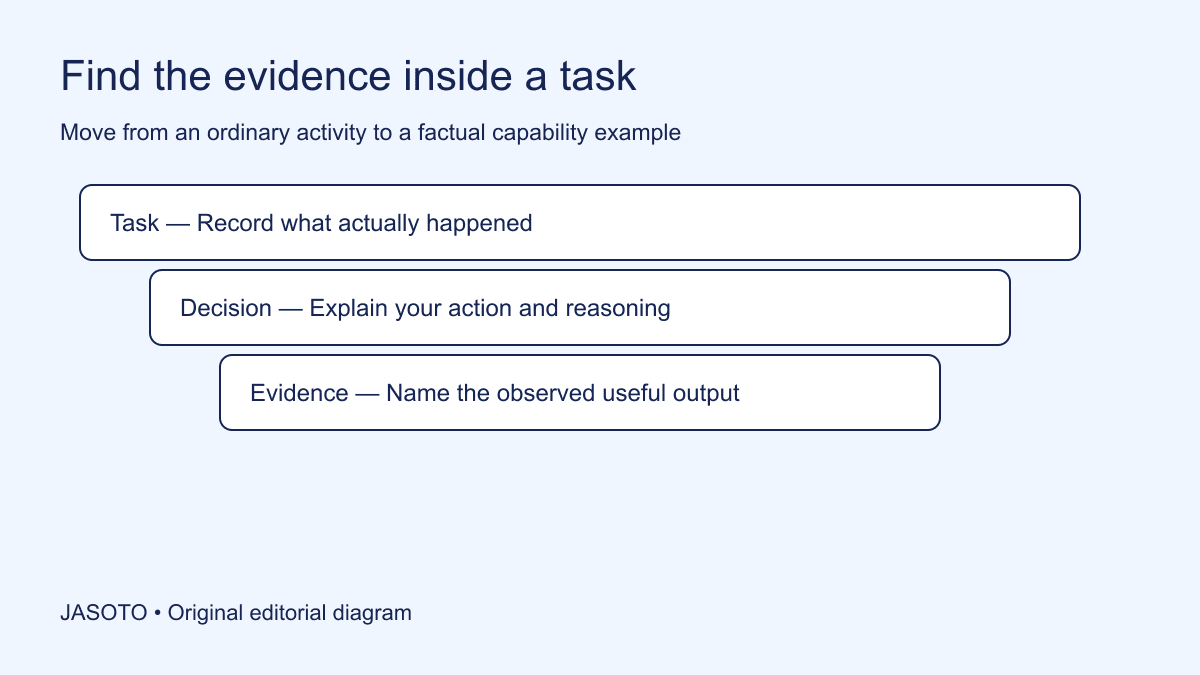
Original JASOTO editorial diagram. Its complete workflow is explained in the article; no actual customer outcome is depicted.
Build a skills evidence list by recording ordinary tasks you have completed, the decisions you made and the result you can honestly describe. Start with concrete activity before choosing a skill label. Checking a delivery record, clarifying an appointment or helping a colleague find the current instruction can provide useful evidence when you explain what you actually did and why it mattered.
This guide presents an original reflection method for UK applicants who feel their experience is too routine to discuss. National Careers Service offers an exploratory skills assessment to help people consider their next steps. The evidence list below serves a different practical purpose: preparing factual examples you can examine and connect to a role. It does not turn a self-assessment result or an ordinary task into proof of a qualification you do not hold.
The practical answer
- Record tasks before choosing skill labels.
- Find the decision inside routine work.
- Keep personal contribution and outcomes accurate.
- Use evidence gaps to plan real development.
Start with a recent working day
Write the activities you actually performed during a representative day or week. Include preparation, checking, communication, handovers and follow-up as well as visible end products. Use ordinary verbs such as checked, explained, arranged, compared and recorded. Avoid beginning with a blank page headed “leadership achievements” if that wording makes it difficult to remember real work.
Look for tasks that required attention or judgement, even when they were expected parts of the role. A receptionist may identify an unclear visitor instruction and obtain the correct entrance details. A stockroom colleague may compare a delivered item with the record and report a discrepancy. These examples are invented prompts, not claims about your experience. Use them to notice similar structures in work you have genuinely done, then record your own facts rather than copying the scenario into an application.
Capture the task before naming the skill
For each promising activity, note the input, the action and the output. What arrived, what did you do and what did the next person receive? This sequence makes the evidence inspectable. “Answered customer messages” is a starting point; “checked the booking record before drafting a reply about the agreed date” gives a clearer view of the work. You can then consider whether the example demonstrates accuracy, communication or another relevant capability.
Keep uncertainty in the record. If you do not remember an exact date, use a reliable approximate period rather than inventing precision. If the output was a draft, label it as a draft. A useful private evidence list does not need to look impressive immediately. Its job is to preserve enough factual context that you can later choose a relevant example without rebuilding the event from a polished but inaccurate summary.
Identify the decision inside the routine
Ask where you had to choose, check or ask for information. Routine work often includes small decisions that are invisible in a task list. You may have noticed that two instructions conflicted, selected the current source or paused before making a commitment outside your authority. Explain the information you used and the reason for the next action. This provides stronger evidence than adding a general adjective about being diligent.
Do not inflate the decision. Choosing the correct approved template is useful work, but it does not mean you designed the organization's communication strategy. A candidate can show sound judgement within a bounded task. In fact, recognizing when to ask an accountable owner can be relevant evidence of responsibility. Keep the scale accurate so follow-up questions lead to details you can explain, rather than exposing a large claim built around a very different action.
Separate your action from the surrounding team
Record which part you personally performed and which part belonged to someone else. A team may have completed a successful event while you maintained the registration list. Your evidence can focus on checking names, resolving duplicate entries and producing a usable list for the desk. You do not need to claim ownership of the whole event to make that contribution worth discussing.
Add the handoff where it matters. Who supplied the information, who approved a change and who used your output? This helps you explain collaboration accurately. If you followed a manager's instruction, say what you did within it. If you proposed an improvement, distinguish the proposal from its approval and implementation. The list becomes a reliable source for applications when it preserves those boundaries instead of merging every team action into a single first-person achievement.
Describe the outcome you actually know
Use the closest observed result. Perhaps the next colleague received the updated schedule, the customer obtained the confirmed address or the reviewer approved the corrected draft. Those are useful factual endpoints. Avoid treating them as proof of a broader business effect you did not measure. An accurate output can demonstrate a capability without an invented claim about revenue, satisfaction or efficiency.
If a meaningful measure is available and appropriate to discuss, record its source and scope. Do not manufacture a percentage because a template says achievements must contain numbers. A statement such as “completed the checked handover before the agreed review” may be the honest evidence. Keep intended benefit separate from measured outcome. You can explain that a clearer note was designed to reduce uncertainty while acknowledging that you did not track whether it changed a wider performance measure.
Look beyond paid employment where relevant
Consider study, volunteering, caring responsibilities, community activity or independent projects when they provide appropriate evidence for the role. Focus on the actual task and capability, and be clear about the setting. A volunteer event record should not become employment experience through ambiguous wording. A self-initiated sample should be labelled as such. The strength of the example comes from relevance and factual detail, not from making its setting sound more commercial.
Choose what you are comfortable and permitted to discuss. You do not need to expose private family information to demonstrate planning or communication. A different example may support the same capability with less personal disclosure. Where an experience involves other people's information, describe the task without unnecessary identifiers. The private reflection process should help you find usable evidence, rather than pressure you into sharing a sensitive story because you believe routine employment tasks are insufficient.
Group examples by specific capability
After recording the facts, add a small number of useful capability tags. Distinguish checking information from explaining it, and coordinating a handoff from authorizing a decision. Broad labels such as “management” can obscure the actual evidence. Use the wording of a role requirement where it accurately describes what the example shows, without copying a phrase that exaggerates the responsibility.
Keep more than one example for an important capability if you have suitable evidence. One may be clearer for a customer-facing question, another for an internal workflow. This gives you choice without inventing a different version of the same event for each application. A simple matrix can show the capability, example name and strongest evidence sentence. Avoid complicated scoring that suggests a level of measurement your private notes do not support.
Test an example through a short explanation
Tell a trusted listener about the task, your action and the observed outcome. Ask them what capability they understood and which fact they still need. If they hear a different story from the one you intended, revise the explanation. Perhaps the context is too long, the personal action is hidden or the result is stated more broadly than the evidence supports.
Practise answering one follow-up question about the decision. Why did you use that source? What did you check before handing the work over? What would you do differently now? The purpose is to see whether the example is grounded in your own work. You do not need a flawless dramatic story. A normal task that you can discuss clearly and honestly is more useful than a memorized claim whose details are unfamiliar because someone else wrote it for you.
Match evidence to the actual vacancy
Read the role requirement and choose the example that addresses it. If the employer asks about accurate records, focus on the checks and correction. If it asks about teamwork, focus on the handoff and shared responsibility. The underlying event should remain factual in both accounts. Tailoring changes the emphasis and selection, rather than changing who did the work or what happened afterwards.
Use job opportunities to compare task language and identify where you have evidence or a genuine development need. If you obtain application support through business providers, review the final wording for factual accuracy. Confirm the interview arrangement before planning travel, and keep a few example names available for preparation. The evidence list should make a later conversation easier to organize without becoming a script you feel compelled to recite regardless of the question.
Use the gaps to choose a practical next step
Notice capabilities for which the list has little evidence. A gap can mean you overlooked an experience, need a clearer explanation or genuinely need learning and practice. Choose an appropriate next step rather than filling the space with a claim you cannot support. You might ask for guidance, undertake a clearly labelled independent exercise or explore suitable training through the relevant route.
Review the list as you gain experience and retire misleading or weak summaries. Preserve accurate facts and correct overstated wording wherever it has been reused. The rollback is to return from an inflated skill label to the actual task, decision and output. An effective evidence list helps you see the value in ordinary work while keeping its scale honest. It gives you specific material for applications and interviews, along with a clear view of what you still want to learn.
Put the guide into practice
- List a representative week of activities.
- Capture action, source and handoff.
- Practise one factual explanation.
- Select examples for the actual role requirement.
Frequently asked questions
Do examples need impressive numerical results?
Use meaningful numbers when they are accurate, relevant and appropriate to share. Otherwise describe the observed output or endpoint clearly. Do not invent percentages or claim a broad business effect from a routine task when that effect was never measured.
Can an ordinary task show a useful skill?
Yes, when you explain the action, decision and relevant outcome. Checking conflicting information or preparing a clear handoff can provide evidence of accuracy and judgement. Keep the scale honest and connect the example to the actual responsibility the employer is assessing.
What if I have little paid work experience?
Consider appropriate evidence from study, volunteering, community activity or independent projects. Label the setting accurately and protect other people’s information. Choose tasks that demonstrate the required capability, and identify genuine gaps where further learning or practice would help.
Explore JASOTO tools
Discover providers and check support for your specific task.
Explore roles and responsibilities →Consider the practical responsibilities involved when recruiting or joining a team.
Plan work-related travel →Research a journey when joining, training or meeting colleagues in person.
Continue with JASOTO
Compare your next step
Discover UK businesses, compare services and request written quotes before making a decision.