
Business Growth · UK Guide 2026
Prepare a Small Office for an Equipment Delivery
JASOTO · Updated 5 November 2026 · 1,615 words
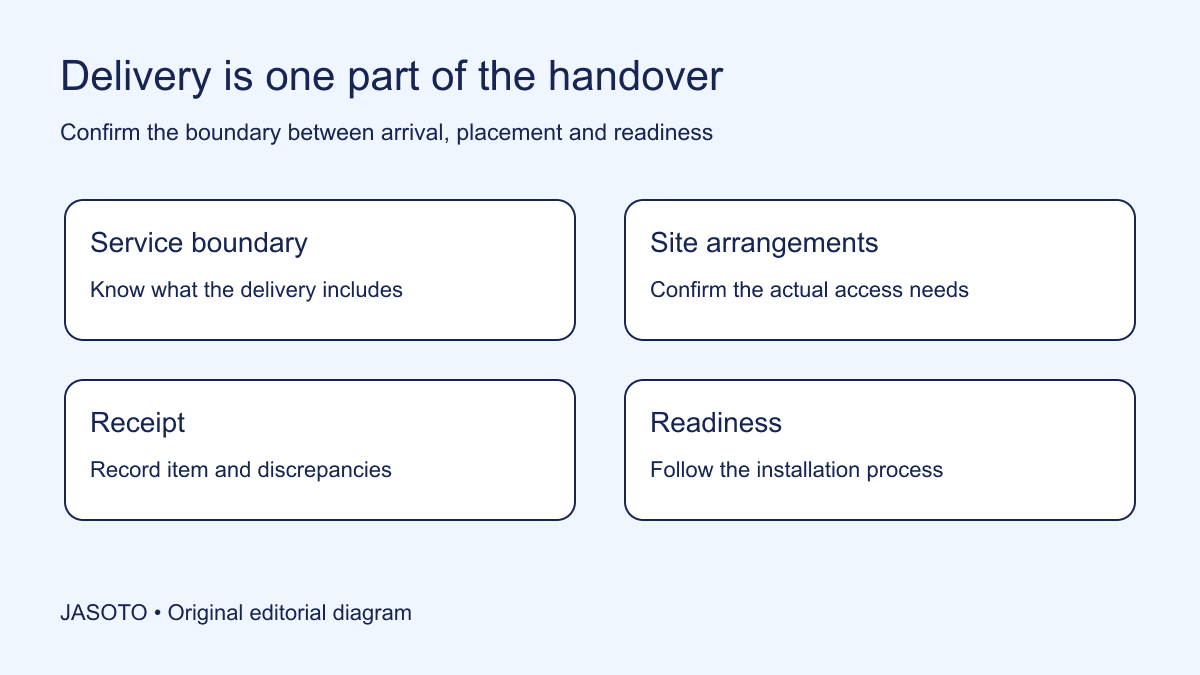
Original JASOTO editorial diagram. Its complete workflow is explained in the article; no actual customer outcome is depicted.
Prepare a small office for an equipment delivery by confirming exactly where the delivery service ends, who will receive it and what site information the supplier and carrier need. Arrange the appropriate next stage before the item arrives. Delivery, placement, assembly, installation and readiness for use are separate questions, even when a sales description groups them under a reassuring headline.
This guide offers an original coordination checklist for UK offices. It does not provide lifting, vehicle movement or installation instructions. [HSE's delivering-safely guidance](https://www.hse.gov.uk/workplacetransport/information/cooperation.htm) emphasises cooperation between the supplier, carrier and recipient. Use competent people and the site's proper arrangements for practical safety decisions, and share accurate information rather than expecting the driver to resolve unexpected conditions at the door.
The practical answer
- Confirm whether the service is delivery, placement, assembly or installation.
- Exchange relevant site information before dispatch.
- Give the receiving contact a clear record and exception route.
- Keep receipt separate from technical readiness and permission to use.
Read the delivery service beside the order
Check the item reference, quantity, delivery address and service description against the accepted order. Ask whether delivery is to a specified handover point or includes movement into the office. Confirm whether assembly, installation, removal of the old item and packaging collection are included or separate. A provider may offer several services, and the one shown in a general advertisement may not be the one you purchased.
Save the confirmation where the receiving contact can find it. If a salesperson explains an inclusion verbally, ask for appropriate confirmation connected to the order. Avoid recording an assumption as an entitlement without checking it. A useful receiving brief says what has actually been agreed and whom to contact if the attending team has different instructions, rather than relying on the receptionist to negotiate a new service on arrival.
Identify the physical item and packaged delivery
Ask for the relevant packaged dimensions, weight information and number of packages through the supplier's process. The dimensions of equipment once assembled may differ from the crate or carton that arrives. Record whether an order consists of one item, several cartons or components delivered separately. This helps the authorised people plan receiving arrangements and prevents an incomplete delivery being mistaken for the complete order.
Do not treat a rough online measurement as a verified fact. If the specification is unclear, ask the supplier to confirm the information needed for this delivery. Likewise, explain the actual site conditions rather than guessing what a driver can accommodate. The goal is to give the responsible parties enough reliable information to determine suitable arrangements, not to devise a handling method from a product photograph.
Confirm the correct reporting point
Give the carrier the proper address, building name and authorised reporting point. A large premises may have a postal address that leads visitors to the wrong entrance. A small office in a shared building may rely on a receiving area controlled by someone else. Check the arrangement with the relevant building contact before telling the provider that a loading point or entrance is available.
Keep sensitive access instructions in the appropriate channel. The driver needs clear arrival information, but security details should not be scattered across broad email lists. Confirm which contact can answer on the day and provide a backup route if they are unavailable. An order confirmation naming an employee who will be on leave is a predictable problem that can be resolved before dispatch.
Exchange site information with the responsible people
Ask the supplier and carrier what information they need about access, restrictions and the receiving location. Bring the relevant site or facilities person into that exchange. Steps, restricted routes, shared spaces or limited receiving hours may affect the service that can be provided. Describe them accurately and ask for confirmation rather than assuming that every delivery vehicle and crew operates in the same way.
Keep the approved arrangement connected to the order. If the provider requests a site assessment or another preparation step, record who owns it and when it will be completed. Do not promise that colleagues will carry, lift or move equipment unless that is part of an appropriate planned arrangement. Enthusiastic help on the day should not replace decisions that require suitable competence and assessment.
Check the room and the sequence of work
Confirm that the intended space will be available when the equipment arrives. Another supplier may be using it, the old item may still occupy it or a separate installation task may be incomplete. Record these dependencies and ask the responsible people to agree the sequence. A delivery date is not a reliable project milestone if the space required for receipt has not actually been released.
Consider whether the item will need appropriate storage before installation and who will decide that arrangement. Do not assume a corridor or spare meeting room is suitable. The relevant people should consider the equipment and premises. Administratively, record where the item is expected to go and whom the receiver should contact if that location is unavailable. Avoid allowing a temporary convenience to become an unreviewed long-term storage decision.
Prepare the receiving contact for a limited role
Give the receiver the order reference, expected package count, provider contact and process for reporting discrepancies. Explain which checks they are expected to make and what they are not authorised to approve. A person able to receive cartons may not be able to assess technical compatibility, accept a changed installation or authorise additional charges. Keep these roles explicit in the handover brief.
Ask what paperwork or electronic acknowledgement will be presented and use the actual agreed receiving process. Do not pre-sign, invent a completed check or assume a generic signature always has the same meaning. If a statement is unclear, the receiving person should contact the responsible colleague. Preserve relevant records accurately so the business can distinguish what was observed on arrival from what was established later.
Plan for missing packages or visible damage
Agree how the receiving person reports a short delivery, unexpected reference or visible damage. Link any evidence to the delivery reference and preserve the information needed for the supplier's process. Describe what can actually be observed. A damaged carton does not by itself establish the condition of every component, while an undamaged carton does not prove that the equipment operates correctly.
Do not ask reception to perform technical tests or dismantle packaging in an unsuitable setting simply to complete an evidence checklist. Ask the provider what appropriate receiving checks are expected, and keep any later unpacking or inspection connected to the record. If the delivery cannot proceed as planned, use the named escalation route rather than improvising an alternative handover that no responsible person has agreed.
Worked example: a printer delivered before installation
Imagine an office replacing a shared printer. The purchase includes delivery to an agreed point, while a separate provider will install and configure it. The office initially expects the delivery team to take away the old printer and set up the new one. Reviewing the service confirmation reveals that neither task is included. The coordinator resolves those questions before confirming the final sequence.
The receiving colleague now knows the expected packages and where to find the order record. Installation remains a separate booking with its own responsible contact. This invented example does not claim a particular supplier's terms or a measured saving. It shows how reading the delivery boundary can reveal missing tasks while there is still time to arrange them through the proper channels.
Keep receipt separate from permission to use
Record the physical arrival and any agreed receiving checks. Then follow the appropriate installation, commissioning or handover process for the actual equipment. Do not change the asset status to ready merely because the delivery record says complete. Ask the responsible provider or competent person to confirm what further steps are needed. Keep instructions and relevant documentation accessible to the authorised users.
Tell colleagues the real status in plain language: received, awaiting installation, awaiting clarification or available under the proper arrangements. Avoid vague messages such as “new equipment sorted” while a dependency remains unresolved. This helps ordinary office users understand what they may expect without asking them to interpret technical paperwork or infer permission from a parcel sitting in the room.
Close the order with a useful record
Review the preparation after the first delivery of a new equipment type. Ask the receiving contact which information was missing and compare that with the questions the carrier actually raised. If a form field never helped anyone act, reconsider it. If the carrier repeatedly called the wrong number, correct the order and supplier record rather than relying on reception to redirect every call. Keep the revision tied to an observed problem. The aim is a better receiving process for a comparable future order, not an unsupported claim that one checklist works for every item and building.
Link the order, delivery record, installation documents and open actions in the relevant asset history. Confirm who owns packaging or old-equipment arrangements and whether those tasks are complete. If a follow-up is needed, name the next action and contact. Review any discrepancy between the promised service and the actual handover before the details disappear from memory or the purchase is treated as administratively finished.
Use JASOTO businesses to discover delivery, installation or equipment providers and verify their actual scope directly. If coordinating purchases and receipt is recurring work, explore office operations roles within a staffing review. For an agreed supplier visit or collection, research travel after confirming the appointment. A prepared office gives the right people reliable information and leaves no assumption that arrival alone completes the job.
Put the guide into practice
- Match the order to the actual delivery service.
- Confirm reporting point and relevant access requirements with responsible people.
- Prepare an authorised receiving contact and discrepancy record.
- Agree packaging, installation and follow-up arrangements.
Frequently asked questions
Will the driver carry the equipment to the room?
Check the specific service rather than assuming it. A delivery may have a defined handover point and exclude room placement, assembly or installation. Describe the site accurately and ask the supplier and carrier to confirm what is included and what preparation is needed.
Does signing for delivery confirm that it works?
Read what the receiving document actually says and use the agreed process. Physical receipt, quantity checks, installation and technical acceptance can be different stages. Do not describe an item as commissioned or ready to use merely because the parcel has arrived.
What if the planned route is unavailable on the day?
Contact the responsible site person and carrier through the agreed exception route. Do not improvise a different unloading or handling method. The appropriate people should reassess the arrangements and agree the next step, which may include postponement.
Explore JASOTO tools
Check the exact service boundary and equipment suitability directly.
Explore office operations roles →Consider support when receiving and coordinating equipment becomes regular work.
Research a supplier visit journey →Plan travel if an agreed demonstration or collection requires attendance elsewhere.
Continue with JASOTO
Compare your next step
Discover UK businesses, compare services and request written quotes before making a decision.