
Business Growth · UK Guide 2026
Create a Useful Product Demo Station in a Small Shop
JASOTO · Updated November 5, 2026 · 1,616 words
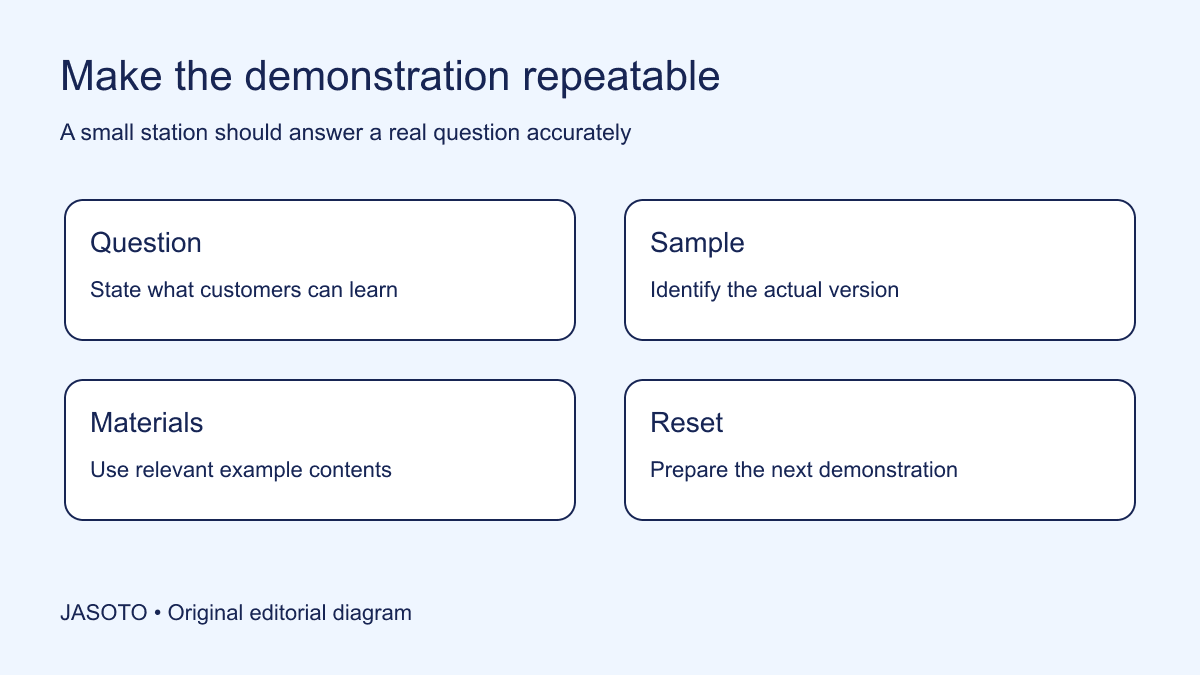
Original JASOTO editorial diagram. Its complete workflow is explained in the article; no actual customer outcome is depicted.
Create a small-shop demonstration station by choosing one useful customer question, identifying the actual sample and giving staff a repeatable way to show and reset it. Check the space and interaction through the business's appropriate access and safety arrangements. The station should help someone understand the product, with clear limits on what the demonstration can establish.
This guide offers an original retail planning worksheet for businesses in the United States. The example is a non-powered travel-bag station where customers compare compartments and ordinary example contents. Products involving heat, electricity, blades, chemicals or other hazards need suitable product-specific arrangements and expertise. Start with the real customer decision rather than copying an impressive display whose interaction does not suit the shop.
The practical answer
- Choose a customer question the station can answer.
- Make the demonstration sample and included accessories identifiable.
- Review access and practical arrangements with responsible people.
- Give staff a clear introduction, reset and escalation process.
Choose the question the station will answer
Collect recurring questions from ordinary customer conversations. A travel-bag customer might ask how the compartments differ, what is included or how two sizes compare. Select a question the station can reasonably demonstrate. Avoid a broad promise such as find your perfect bag when the shop cannot establish every aspect of the customer's intended use from a brief interaction.
Write a short purpose statement that staff can repeat. For example, the station shows the layout of the identified bag and the difference between its compartments. That purpose guides the sample, props and explanation. If another question requires a specification, specialist assessment or personal trial under different conditions, give the customer an appropriate route rather than stretching the demonstration beyond its evidence.
Identify the actual sample
Record the sample's product reference, variant and condition. Keep it connected to the saleable range without assuming it represents every version. A larger sample may show a different pocket arrangement from the smaller item on the shelf. Explain those differences in the station information and staff brief. Do not let a familiar display unit become an unverified reference as the supplier changes the current product.
Decide whether the sample is for demonstration only or can later be sold through the business's appropriate process. Keep its status clear in stock records. A customer should not be promised a boxed item and handed a worn demonstration sample because the team never distinguished them. Review condition through the shop's proper routine and remove or assess an unsuitable sample rather than continuing to use it for convenience.
Select materials that support the explanation
Use simple representative materials relevant to the question. A bag station might include clearly identified example notebooks and ordinary empty organisers to show compartment relationships. Keep the examples consistent so staff can repeat the explanation. Do not imply that the props are included with the product unless they actually are. Put the included-contents statement beside the sample or in the relevant product information.
Avoid creating unsupported capacity or compatibility claims from the props. Showing one named object in a compartment does not prove every similarly described object will fit. Explain the example's limits and provide verified product dimensions where relevant. If customers ask about their own item, use the business's suitable assistance process rather than guaranteeing fit from a generic category name.
Review access and placement before launch
Discuss the proposed location with the people responsible for the premises and customer access. The station should fit the shop's actual arrangements for movement, service and assistance. Do not assume that a spare corner is suitable simply because a table fits there. Consider how customers approach, view and ask for help, while preserving appropriate routes and ordinary use of the space.
[ADA.gov's small-business primer](https://www.ada.gov/resources/title-iii-primer/) covers access to goods and services and effective communication. Use the applicable requirements and appropriate advice for the actual business. This guide does not prescribe counter dimensions or certify a layout. The planning task is to bring access into the decision early and give staff a suitable way to assist customers using the station.
Decide how the interaction begins
Use a clear invitation and explain whether the demonstration is self-guided, staff-led or available on request. The appropriate choice depends on the product and arrangements. A sign should not invite unrestricted use if staff need to perform a preparation or supervision step. Keep the customer-facing message aligned with what the team can actually support during normal opening hours.
Give staff an opening question that helps identify the relevant need. For the bag example, ask which feature the customer wants to understand rather than launching into the same long presentation for everyone. Keep the explanation conversational and accurate. A good station makes it easier to answer a useful question without pressuring the customer to complete a performance or disclose unnecessary personal details.
Write a short demonstration sequence
Describe the steps needed to show the selected feature, using verified product instructions where relevant. For an ordinary bag, this may be identifying compartments, showing the example contents and explaining which accessories are separate. Keep the sequence limited to appropriate intended use. Do not invent a stress test or unusual use to make the display entertaining.
Give staff the actual source for technical questions and an escalation route. A product adviser can show the layout without making unverified claims about durability, protective performance or specialist suitability. If the customer asks beyond the station's scope, record the question and obtain an appropriate answer. The station should make boundaries easier to communicate, rather than encouraging a confident guess to preserve the sales conversation.
Make the comparison fair
If two products are compared, identify the actual differences and use equivalent relevant examples where appropriate. Avoid making one appear better by filling it carefully while presenting the other poorly. Keep a price or availability comparison current through the shop's normal process. A physical station can become misleading when labels remain unchanged after the range or offer changes.
Explain subjective choices as preferences. A customer may prefer a compartment layout for their own routine, but that does not establish universal superiority. Give them the information needed to decide and avoid fictional popularity claims or invented customer results. If the shop cites a verified specification, keep the reference available to staff so the claim can be checked and corrected when the product changes.
Plan the reset as part of the station
List the components that should be present before the next demonstration and who checks them. For the bag station, that may include the identified sample, example contents, current label and relevant product information. Keep the routine proportionate to the actual use. A station that is complete at opening but missing a key prop after the first customer may no longer answer its intended question.
Include an appropriate response to damage, missing items or an unclear condition. Staff should know when to pause the station and whom to notify. Do not ask the next employee to decide from memory whether a broken feature was always present. Record significant changes and use the product's proper assessment process. A quick reset checklist is useful only when it does not conceal a condition requiring attention.
Worked example: comparing bag compartments
Imagine a small shop with two travel-bag sizes. Customers repeatedly ask whether the internal layout differs. The shop identifies one sample of each current version, prepares the same named example contents and provides a clear statement of what is sold separately. Staff show the relevant compartments and use verified dimensions for questions the example alone cannot answer.
After each interaction, the team returns the materials to the agreed state and checks that labels remain with the right samples. This invented example makes no claim about sales or guaranteed fit. It shows how a small station can support a specific product conversation without becoming a general promise about every customer's requirements or every item in the wider range.
Test the station with unfamiliar staff
Include ordinary shift cover in the review. The employee most familiar with the range may deliver a clear demonstration from memory, while another colleague cannot tell which props belong with which sample. Let the cover colleague use the written brief and identify missing information. If the station needs a specialist member of staff, communicate the actual availability rather than presenting it as continuously supported. Customers should know how to request the appropriate session, and other employees should have a useful answer when that person is unavailable. Do not solve a training gap by encouraging unsupported technical explanations.
Ask a colleague who did not design the station to explain its purpose, identify the sample and carry out the appropriate reset. Check whether they can distinguish included accessories from props and know where to send a technical question. If they cannot, improve the label or brief. Avoid measuring success only by whether the display looks attractive from across the shop.
Collect recurring customer questions after launch and review whether the station answers them. A new question may justify a small change, while another belongs in a different product resource. Keep the previous brief so an unhelpful revision can be reversed. Do not claim a sales improvement without suitable evidence. The practical measure is whether the station helps the team give a clear, supported explanation.
Use JASOTO businesses to discover suitable display or retail support and verify relevant capability directly. If demonstrations become continuing work, explore product-adviser roles within a staffing review. For an agreed in-store session, research travel after checking the actual product and appointment. A useful station stays accurate, understandable and ready for the next customer question.
Put the guide into practice
- Define the demonstration's purpose and limits.
- Verify the sample and comparison materials.
- Agree suitable space and customer assistance arrangements.
- Test the demonstration and reset with store staff.
Frequently asked questions
Should customers use every product themselves?
Decide the appropriate interaction for the actual product through the business's proper safety and operating process. Some demonstrations may be staff-led or need specific controls. Do not assume that an item suitable for display is automatically suitable for unrestricted customer use.
Can a display sample stand in for every variant?
Explain which version is shown and which characteristics apply to other versions. A sample may demonstrate a common feature while differing in size, finish or included accessories. Keep those differences visible so the customer does not infer a complete match.
How much space does the station need?
Use the actual premises, product and applicable requirements to determine a suitable arrangement. Consider access, ordinary service and appropriate assistance with the responsible people. A generic floor-space recommendation cannot establish suitability for every shop.
Explore JASOTO tools
Discuss the actual product, space and customer interaction with suitable providers.
Explore retail product-adviser roles →Consider staffing where demonstrations and customer assistance become regular work.
Research a confirmed demonstration visit →Plan travel once the shop confirms the product and any appointment arrangement.
Continue with JASOTO
Compare your next step
Discover UK businesses, compare services and request written quotes before making a decision.