
Business Growth · UK Guide 2026
Prepare a Small Trade Stand Inventory That Comes Home
JASOTO · Updated 5 November 2026 · 1,627 words
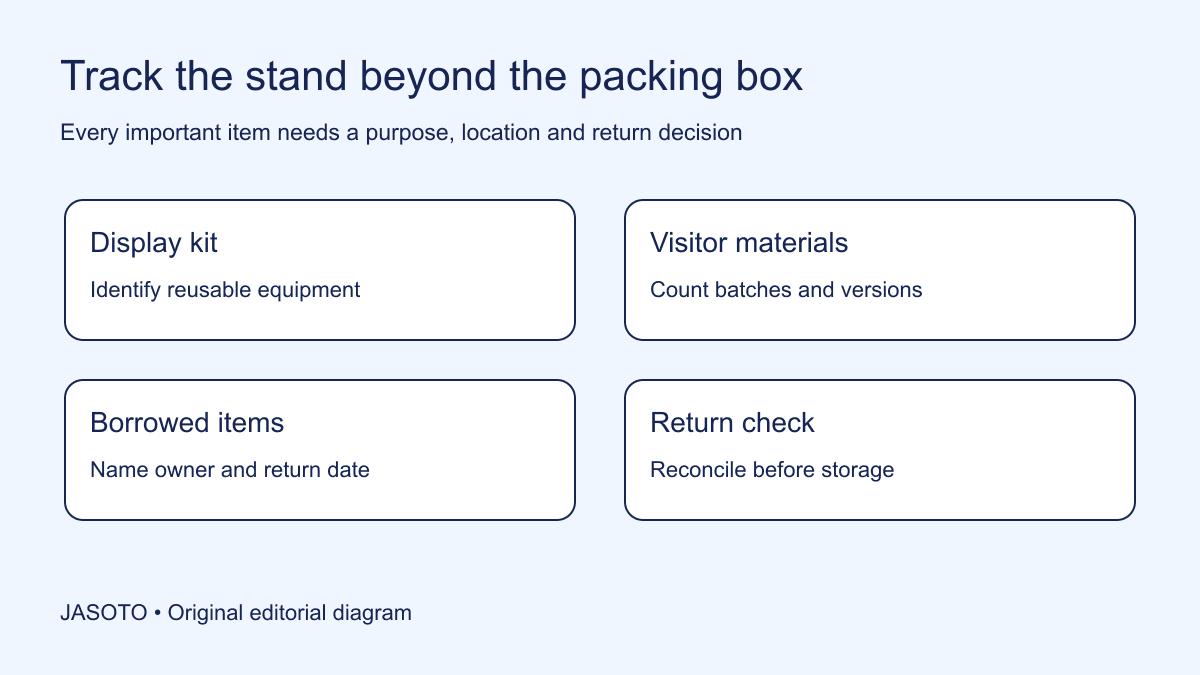
Original JASOTO editorial diagram. Its complete workflow is explained in the article; no actual customer outcome is depicted.
Prepare a small trade stand inventory by listing what each visitor interaction requires, checking what the organiser actually supplies, and assigning every important item a container and a responsible person. Include the return journey from the beginning. A packing list that only says what leaves the office cannot explain whether a borrowed screen came back, which leaflets remain usable or where the demonstration cable disappeared.
This guide focuses on a modest UK business stand with reusable display equipment and a small team. It is a practical stock-control method, rather than a technical specification for stand construction. Quantities and scenarios below are illustrative. Use the organiser's confirmed arrangements and competent advice for equipment, installation and safety decisions.
The practical answer
- Build the inventory around the visitor conversation and confirmed stand facilities.
- Separate reusable equipment, consumables, stock and borrowed items.
- Record a container, owner and return destination for every important item.
- Rehearse assembly and reconcile the return before closing the event record.
Start with what the stand needs to do
Write the visitor journey in ordinary language: notice the stand, understand the service, ask a question, see an example and leave with an agreed next step. For each stage, identify the physical item that makes it possible. A demonstration may need a device, charger, connection method and approved example file; a conversation about appointments may need an accurate availability sheet rather than another decorative banner.
This exercise removes items that are familiar but unnecessary. Ask what the team would do if an item were absent. If nothing changes, it may not deserve limited transport or storage space. If the entire demonstration fails without it, mark it as critical and test an alternative. An inventory becomes useful when it distinguishes essential dependencies from things someone packed because they happened to be in the cupboard.
Confirm the boundary of the stand package
Obtain the latest exhibitor instructions and booking details. Record whether tables, chairs, power, display fixings, internet access and storage are included, optional or unavailable. Keep a reference to the confirmation rather than turning an assumption into an inventory entry. “Table provided” should identify the confirmed provision and any dimensions that affect the display arrangement.
Separate questions for the organiser from purchases the business controls. If the power arrangement is unresolved, buying extra chargers does not settle it. Give each question an owner and a point at which the team must choose a fallback. Find business suppliers on JASOTO once the requirement is clear enough to brief a printer, equipment provider or display company accurately.
Divide the inventory by what happens afterwards
Use four practical classes: reusable equipment, consumables, sale or sample stock, and borrowed or hired items. A reusable stand panel needs an identity and storage location. A box of leaflets needs a version and quantity. Sample products need a record of what was used or given away. Borrowed equipment needs an owner, condition record and return agreement.
Keep those classes visible even if everything travels in the same vehicle. They require different closing decisions. Used consumables do not represent missing assets, and an unopened box of outdated leaflets is not useful stock merely because it returned. Avoid one undifferentiated “returned” tick that conceals these differences. The closing record should explain what is ready for another event, what needs attention and what must leave your custody.
Use an inventory row that can answer a question
A practical row includes item identifier, description, purpose, class, quantity, condition, container, custodian and return destination. Add a source document reference for hired equipment or valuable borrowed items. The identifier can be a short local code; it does not need specialist software. What matters is that a colleague can distinguish two similar screens or identify the exact banner being discussed.
For example, an invented row might read: “D04; demonstration tablet and case; service example; reusable; one; checked; blue crate; stand lead; office equipment shelf.” Record the charger as a linked component or a separate item if it travels separately. Do not rely on “tablet kit” when nobody has agreed what the kit contains. Clear descriptions prevent false confidence during a hurried check.
Build quantities from a realistic service pattern
Estimate printed materials from how the team intends to use them. A leaflet offered after a relevant conversation has a different demand pattern from a freely available stack. Note the basis of the estimate, such as expected demonstration sessions or prior observed usage, and leave uncertainty visible. Attendance advertised by an organiser does not tell you how many visitors will want your particular material.
Separate working stock from reserve stock. Label reserve quantities so the team can replenish the display without opening every box. Choose a simple method for recording additional stock brought in during the event. Otherwise the end count may suggest unusually low usage merely because an unrecorded delivery increased supply. Avoid presenting an invented “ideal leaflet ratio” as established event performance data.
Pack by assembly sequence and retrieval
Group items according to when and where they are needed. Setup tools and the stand plan should be reachable before the display is assembled. Materials used throughout the day should be accessible without dismantling storage. Keep the item list for each container with the inventory and label the physical container consistently. A photograph can help identify contents, but it should supplement a readable list.
Check whether empty packaging can remain onsite and where it will be kept. A protective case left in an unapproved area may not be available when the screen needs packing. Ask the organiser about the storage arrangement and record it. This is particularly important when different colleagues handle setup and collection: the return team needs to know where the protective materials are, not just where the display stands.
Record custody for loans and hires
Before departure, confirm which business owns each borrowed item, who may use it, and how it will be returned. Record existing damage or missing components accurately, using photographs where appropriate and agreed. Link to the actual hire terms rather than paraphrasing payment, damage or late-return conditions from memory. An inventory should help the team find the agreement, not replace it.
Give collection and return appointments to named people. If an event finishes after the supplier closes, settle the practical arrangement before packing. Check whether another event or journey competes for the same equipment. A colleague may have promised the projector elsewhere without realising it remains in your custody overnight. Resolving that conflict early is easier than improvising when the stand is being dismantled.
Rehearse the stand with the actual packed kit
Assemble the display and run the visitor demonstration using the items intended for transport. Open the presentation on the actual device, check that its approved content is available, and verify the accessories listed in the inventory. A rehearsal often reveals a dependency that a desk-based list misses, such as a particular adaptor or a file stored only on somebody's personal computer.
Keep this rehearsal separate from venue approval or technical assurance. [HSE's event management guidance](https://www.hse.gov.uk/event-safety/managing-an-event.htm) treats setup and breakdown as phases needing active management, alongside the public event. Use the organiser's instructions for those phases; an inventory check cannot authorise installation work. Record practical issues found during rehearsal and resolve them before marking the container ready.
Give the travelling team a usable handover
Create a short departure sheet with the container count, critical item identifiers, collection contact, stand location and unresolved issues. Link it to the current inventory version. The driver does not need every editorial note about leaflet design, but does need to know that a second crate must be collected from another office. The stand lead needs to know which equipment remains unconfirmed.
Coordinate team travel research with equipment movement. A person arriving by train may not be able to collect a bulky display case, and an early departure may remove the only colleague familiar with packing it. If extra assistance is needed, describe the actual handling and timing requirements when considering event support roles. Staffing and stock records should describe the same operational plan.
Prepare for an item that fails on the day
For each critical demonstration dependency, write a workable alternative that uses confirmed resources. If the screen fails, the team might use an approved printed example and explain the service through conversation. That is different from promising an untested spare device. Put the alternative material in the inventory and rehearse finding it, so the fallback is usable by whoever is covering the stand.
Keep an incident note for failed or substituted items. Record what happened, the effect on the planned activity and the decision taken. Do not turn every awkward moment into a replacement purchase; a confusing file name may require better organisation rather than new equipment. After the event, use those observations to decide whether the item, packing method or demonstration itself needs to change.
Reconcile before the equipment disappears into storage
At pack-down, record stock used, reusable items present, damage noticed and anything transferred to another person. Do a second check at the return destination, where counts can be reconciled without blocking the venue's departure process. Keep unresolved items open with an owner and next action. A missing component should not vanish from the record because everybody wants to close the event folder.
Finish with three decisions: what is ready to reuse, what needs repair or replacement, and what should not be packed next time. Preserve the observed quantities and explain unusual conditions, such as a cancelled demonstration or an extra delivery. These notes make the next inventory smaller and more accurate. The evidence is the actual movement and condition of items, rather than a claim that a tidy spreadsheet itself improved event results.
Put the guide into practice
- Confirm the organiser supplies what the team expects.
- Allocate an item identifier and container to reusable kit.
- Test the demonstration using the equipment being packed.
- Record borrowed-item condition and return arrangements.
- Count returned equipment before shelving it.
Frequently asked questions
Should every leaflet have its own inventory line?
Usually a counted batch is more useful than individual records. Record the leaflet version, starting quantity and container. Individual identifiers suit reusable or borrowed items whose identity matters, such as a display screen. Match the record to the decision you need to make after the event.
What if equipment is shared between two stands?
Give the shared item one custodian and record its physical location and transfer time. Both stand lists can reference the same identifier, but neither should assume independent access. Test whether the schedule allows transport, setup and checking between uses; otherwise arrange an alternative before departure.
How can a small team estimate sample quantities?
Start with the planned demonstration, the number of sessions you can actually staff and any organiser information about the event. Mark the estimate as uncertain. Pack replenishment separately if practical and record usage afterwards, so the next estimate rests on observed demand rather than an invented conversion rate.
Explore JASOTO tools
Continue with JASOTO
Compare your next step
Discover UK businesses, compare services and request written quotes before making a decision.