
Building & Home Improvements · UK Guide 2026
Snagging or New Work? Record the Difference Clearly
JASOTO · Updated 5 November 2026 · 1,601 words
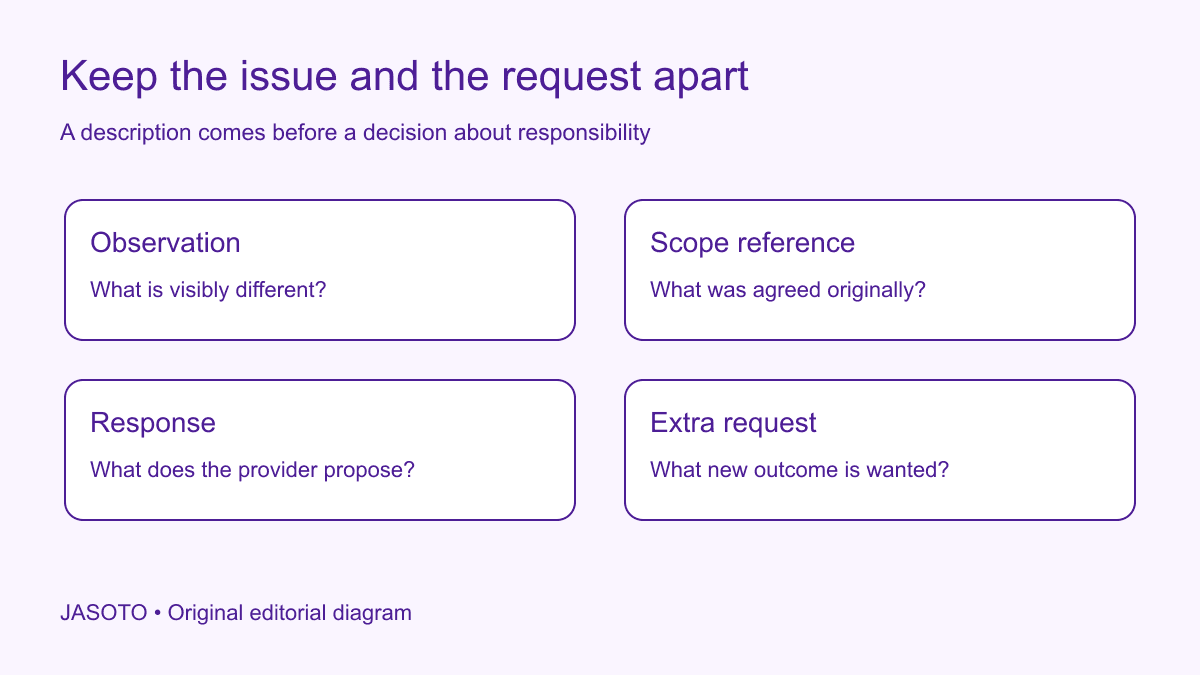
Original JASOTO editorial diagram. Its complete workflow is explained in the article; no actual customer outcome is depicted.
To separate snagging from a new request for work, record the observed issue, identify the original requirement and ask for an explained response. Keep a new preference in a separate proposed-work category. Do not assume that calling something a snag proves responsibility, or that calling it an extra removes any obligation to address the original concern.
This guide gives UK small businesses and customers an administrative method for reviewing recently completed work. It does not decide whether a defect exists, what remedy is due or whether payment may be withheld. Those questions depend on the facts and applicable agreement and law. The examples are invented to show how a clearer list can support a fair discussion without pretending to resolve technical or legal disagreements.
The practical answer
- Describe the observed issue before assigning responsibility.
- Link each item to the scope or evidence that explains the concern.
- Record new preferences as proposed work with separate approval.
- Keep disputed items open for an explained response.
Describe the difference someone can actually inspect
Begin with the location, item and observed condition. “Mark on the front left panel of the reception counter” is more useful than “poor finish everywhere”. State when it was noticed and whether it can currently be inspected. Avoid guessing the cause in the description. A surface mark, a loose fitting and an incorrect dimension may all require different evidence and different people to assess them.
Use one entry for one issue where practical. Combining unrelated concerns into a paragraph makes it difficult to record a partial response. Give each entry a stable reference so photographs and messages can point to it. If several similar items show the same concern, identify the affected locations rather than claiming that every item is defective when only one has been checked.
Find the original requirement before debating the label
Locate the accepted quotation, specification, drawing or other relevant record. Note its date and version. A later sample or conversation may also matter, so preserve the history rather than selecting only the document that supports one position. If the requirement is unclear, record that uncertainty. An incomplete specification is a question to resolve, not a reason to manufacture a precise standard afterwards.
Write a short reference beside the issue: “Accepted drawing B, counter front finish” or “Booking confirmation, removal of packaging”. Keep the original document available. The reference helps the provider understand why the condition is being raised. It is not itself a judgment that the requirement has been breached, especially where technical interpretation or the relationship between several records is disputed.
Keep the desired response distinct from the evidence
Say what you want the provider to do next: inspect, explain, propose a correction or confirm the outstanding task. A request for inspection is different from an instruction to replace an item. Give the provider a reasonable way to review the concern through the agreed process. Do not alter or discard relevant material merely to make the list look complete before the provider has had a chance to respond.
Avoid writing the remedy into the factual description. “Panel must be replaced” may be your preferred outcome, but it does not describe the mark itself. Separate observation, requested outcome and provider response into different fields. This makes it possible to agree that a concern exists while still discussing the appropriate way to address it, without either party being misrepresented.
Identify a new preference honestly
A new preference asks for an outcome beyond, or different from, the agreed work. For example, a customer may now want a second shelf where the accepted layout showed one. Record the new request and ask for its consequences separately. Do not hide it inside an issue about the finish on the original shelf. Both conversations can proceed, but they need different decisions.
Equally, do not accept “new preference” as an unexplained answer to every concern. Ask which part of the original agreement supports that classification. A helpful response explains whether the provider sees an additional requirement, an ambiguity or work that already matches the agreed specification. Record the explanation accurately even when you disagree. The aim is a traceable discussion, not winning an argument through spreadsheet headings.
Understand which guidance fits the customer
[Business Companion's supplying-services guide](https://www.businesscompanion.info/en/quick-guides/services/supplying-services) describes consumer service rights in England and Wales and distinguishes consumers from business buyers. That distinction matters: a business purchasing for its operations should not assume that a consumer guide determines its own position. Check advice relevant to the actual parties, location and contract if the disagreement is consequential.
Keep your practical record useful whichever framework applies. Preserve the agreed scope, dated observations, response and proposed next step. Avoid setting invented legal deadlines or claiming that a particular phrase waives rights. If you ask someone to sign a completion or settlement document, understand what that document means before treating it as a routine administrative step. Seek appropriate advice when its effect is unclear.
Build an evidence pack with enough context
Take or retain evidence only where appropriate and safe. A useful photograph can show the whole item and a closer view of the concern, with a filename matching the issue reference. Record the date and whether anything changed before the photograph was taken. Images may not establish colour, texture, dimensions or causation accurately; say what they show instead of asking them to prove more than they can.
Include relevant messages and inspection notes without overwhelming the recipient with an entire mailbox. Keep originals and make a short index. If a photograph includes unrelated people, customer information or security details, consider a relevant crop or another appropriate way to communicate the issue. Evidence should help someone inspect and respond, not become a broad circulation of everything visible at the premises.
Worked example: a counter finish and an extra shelf
Imagine a shop reviewing a newly installed counter. It reports a visible mark on one front panel and says staff would prefer another internal shelf. The owner creates two entries. The first records the mark, location and finish reference, with a request for inspection. The second records the shelf preference as proposed additional work, with a request for a separate quotation.
The contractor can now respond to the mark without assuming that agreement also includes the extra shelf. The owner can consider the shelf price without losing track of the reported concern. This invented example does not establish who caused the mark or what remedy is owed. It illustrates how distinct records prevent a discussion about improvement from obscuring a discussion about the work already supplied.
Use statuses that reveal the real position
Useful statuses might include reported, awaiting inspection, response received, action agreed, awaiting action and disputed. Define them in ordinary language. “Closed” should say whether the issue was corrected, withdrawn with an explanation or resolved through another agreed outcome. Do not close an entry merely because an email has been sent or a visit has occurred. Those events may leave the underlying question unanswered.
Record who owns the next action and the date agreed for an update. If no date is agreed, show that fact rather than entering a hopeful deadline as a commitment. Keep outstanding items visible when a larger project is otherwise finished. A list can show that most work is complete while honestly retaining the few matters that still require a decision.
Prepare a joint review without turning it into a surprise test
Send the current list and relevant evidence before an agreed review. Explain which areas need to be available and who can discuss the original requirements. Confirm whether the visit is inspection only or includes authorised remedial work. If different trades or specialist advice are needed, let the responsible participants decide the arrangements rather than expecting one attending person to resolve every issue immediately.
Use JASOTO businesses to discover appropriate contractors or advisers and verify suitability directly. If a review requires a journey, research travel after the appointment and access are confirmed. Where managing issues is a continuing workload, explore project administration roles within a staffing review. The role should support clear records and follow-up, while leaving technical assessments and contractual decisions with the appropriate people.
Preserve the final explanation as well as the outcome
Keep a separate count of proposed extras if the list is used for progress reporting. Otherwise adding several optional improvements can make the original work appear less complete, while closing a preference can make a defect list look healthier without addressing a concern. Use counts only where they help a decision, and explain what they represent. An issue count is not a measured quality score: one consequential unresolved item may matter more than several minor entries. Preserve the individual descriptions so a summary does not conceal what still needs attention.
When an entry is resolved, record what happened and link any supporting confirmation. If work was completed, note the relevant visit and what was checked. If the parties agreed another outcome, preserve the actual agreement. If the item remains disputed, record each position fairly and use the applicable complaint or contract process. Do not rewrite the first observation to make the history look simpler.
Review what caused confusion. The next project may need a clearer finish reference, better approval records or a separate route for additional requests. That is a useful operational improvement even when the original disagreement was difficult. A good snagging record gives both parties a stable description of the concern and a visible next step; it does not manufacture certainty where evidence or agreement is still missing.
Put the guide into practice
- Give each issue a location and stable reference.
- Save the relevant specification and evidence.
- Ask for an explained classification and proposed response.
- Record what is resolved and what remains disputed.
Frequently asked questions
Is every item on a snagging list automatically free to fix?
No single label settles that question. The agreed work, circumstances and applicable rights matter. Ask the provider to explain its position against the particular item and obtain suitable advice if a dispute remains. Do not let an administrative category be presented as a final legal conclusion.
Can a new preference be added to the same list?
It can be recorded in the same system if it is clearly marked as proposed additional work and kept out of the unresolved defect count. Ask for its scope, price and timing separately so discussion of a preference does not accidentally authorise it.
What if the provider says the issue was already present?
Ask which evidence supports that explanation and compare it with the dated information available to both parties. Record disagreement fairly, including missing evidence. A clear record helps the discussion, but photographs and notes alone may not determine technical causation or contractual responsibility.
Explore JASOTO tools
Discuss the defined issue with an appropriate contractor or adviser.
Explore project administration roles →Consider staffing when tracking work and follow-up becomes ongoing.
Plan an agreed inspection visit →Research the journey after confirming access and the inspection appointment.
Continue with JASOTO
Compare your next step
Discover UK businesses, compare services and request written quotes before making a decision.