
Business Growth · UK Guide 2026
Keep a Stock Discrepancy Log That Leads to Action
JASOTO · Updated November 5, 2026 · 1,606 words
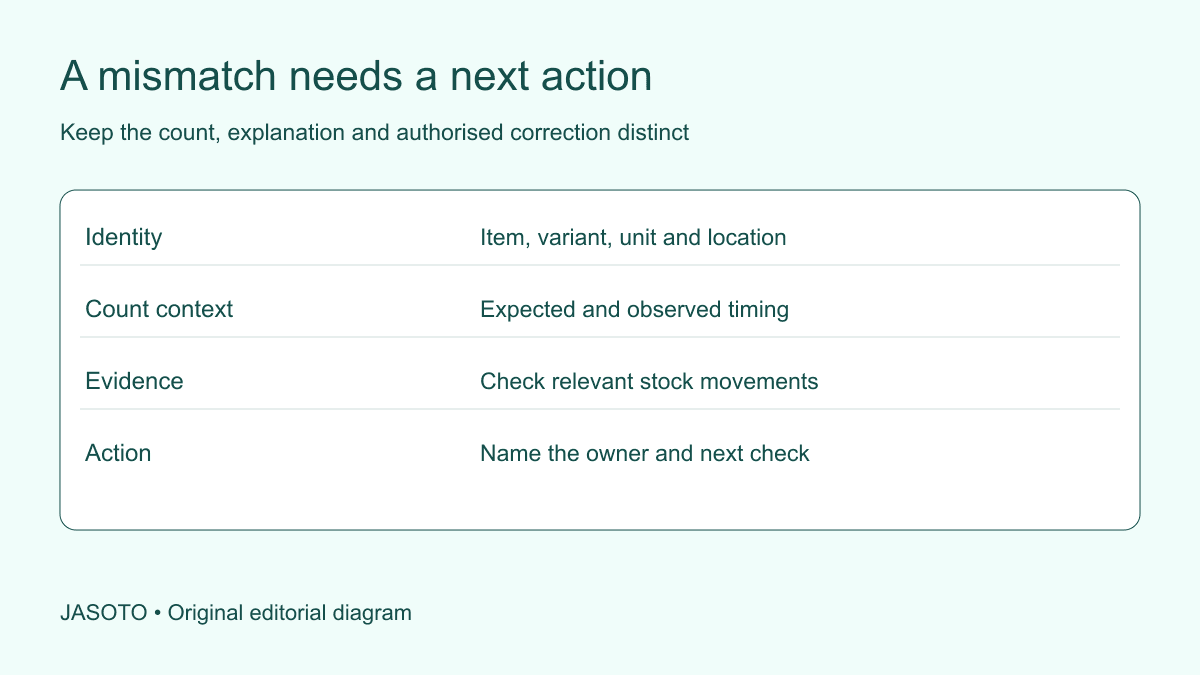
Original JASOTO editorial diagram. Its complete workflow is explained in the article; no actual customer outcome is depicted.
A useful stock discrepancy log records the exact item and location, the expected and observed quantities, the timing of the count and the next investigation action. Keep any inventory correction separate from the explanation of the difference. Updating a number may reconcile the record, but it does not establish why the mismatch happened or prevent the same problem recurring.
For a small retailer in the United States, this method works as an original administrative worksheet alongside the business's inventory system. It covers ordinary stock records and follow-up. Use the appropriate accounting, security or specialist process where the circumstances require it. The example concerns an invented stationery shop whose similar product variants can be confused during receiving and counting.
The practical answer
- Record the expected and observed quantity with their timing.
- Confirm the item, variant, location and unit before looking for a cause.
- Separate reconciliation from an explanation of the difference.
- Give each unresolved issue an owner and a specific next action.
Give the discrepancy its own reference
Create a stable issue reference connected to the item and count event. Record when the discrepancy was noticed and by whom through the normal business process. A separate reference allows later messages, recounts and adjustments to point to the same question. Without one, three employees checking the same mismatch may create three apparent incidents and distort the review.
Keep the first observation intact and add clarifications visibly. A note can become more accurate as the team learns that a quantity referred to cartons rather than individual units. Preserve that correction rather than erasing the history. The original wording may explain why the issue was raised and which communication problem needs improvement, even if the final count turns out to be correct.
Confirm the exact item and variant
Check the stock identifier, relevant variant and description against the physical item. Similar packaging can hide differences in size, color or pack quantity. Do not use a general family name when the system tracks separate units. The investigation should establish whether the discrepancy concerns one variant, the whole group or a mismatch between the physical label and the catalog record.
Record the unit being counted. A quantity of six can mean six individual products, six packs or six cartons. Ask how the relevant receiving and sales processes represent the unit. Avoid correcting the system before resolving that ambiguity. A numerical difference caused by inconsistent units calls for a different response from an item that is genuinely missing from the expected location.
State the location precisely
Identify the store, stockroom area or other location used by the business's actual system. If items can be reserved, returned, displayed or moved to another site, those states may affect what a person expects to find. Record the relevant context without inventing a location category that the system cannot support. Ask the responsible colleague how movement is normally recorded.
Do not assume that an item absent from one shelf is absent from the business. Use the appropriate controlled check for other relevant locations. Avoid encouraging staff to search unsafe areas or interrupt restricted processes. The administrative log should say which locations were checked through the authorised method and which remain unresolved, so a later investigator does not unknowingly repeat the same work.
Capture expected and observed quantities with timing
Record the source and time of the expected quantity, then the observed count and its timing. A live system may change while customers buy items or staff receive deliveries. Comparing a morning count with an afternoon balance can create a difference that reflects intervening events. Preserve enough context to understand whether the two figures describe the same point in the stock flow.
Use the business's appropriate count and reconciliation method. If a recount is required, record who performed it and the result. Do not write independently verified when the same person simply repeats the original entry without the required process. Accurate labels matter because later decision makers may rely on the strength of the check when approving a correction or investigating a recurring issue.
Look for relevant movements before guessing a cause
Check the records that could explain the difference: receiving, sales, returns, transfers, reservations or authorised write-offs, as applicable. Use actual references and preserve the relevant timing. [Square's inventory documentation](https://developer.squareup.com/docs/inventory-api/what-it-does) provides one system-specific example of tracking inventory events and reconciliation. Your business may use another system; investigate its actual records rather than assuming the same fields or processes exist everywhere.
Separate a possible explanation from an evidenced one. A colleague remembering that a carton arrived is a useful lead, while the relevant receiving record may establish what was entered. If evidence is missing, say so. Do not select a convenient adjustment reason merely because the software requires a field. The authorised process should define how uncertainty is recorded without manufacturing a cause.
Make the next action specific
Use the log to prevent repeated checking as well as assign new work. After a colleague reviews a relevant movement record, note its reference and what it established. Another authorised investigator can then see that the delivery quantity was confirmed but the variant mapping remains open. This is more helpful than writing checked delivery, which may conceal the actual result. Keep the evidence accessible through the appropriate system and avoid duplicating whole confidential documents into a general log when a controlled reference serves the purpose.
Assign a person to a defined question, such as checking the receiving reference for a named delivery or confirming whether two variants were grouped together. Add the agreed next update point. A status reading investigate does not explain who should do what. Keep the action small enough to complete and report, especially when the person responsible has other ordinary shop duties.
Record dependencies openly. The next step may require a supplier reply, system administrator or colleague who is absent. Show that dependency and the person following it up. Do not present an internally chosen date as a supplier commitment. If the inquiry is blocked, identify what information would allow progress instead of allowing the entry to remain open indefinitely with no practical movement.
Separate adjustment authority from counting
Identify who may approve and make inventory changes. The person counting may be able to report an observation without being authorised to reconcile the system. Keep that role distinction clear and use the business's actual controls. An employee should not feel obliged to change the balance simply because a discrepancy form has a completed-count checkbox.
When a correction is authorised, record the relevant adjustment reference, date and reason as established through the proper process. Preserve the relationship with the investigation. Do not close the explanation question automatically if the business has corrected the quantity but still needs to understand a recurring pattern. A reconciled balance and a resolved process issue are different outcomes that the log should be able to represent.
Worked example: two similar notebook packs
Imagine a stationery shop finding fewer blue notebook packs than expected while a neighboring green variant appears higher. The log identifies each stock reference, pack unit, shelf location and count time. The assigned colleague checks the relevant receiving record and discovers that an entry needs review against the actual delivery information. The team follows its authorised correction process rather than immediately labeling the difference a loss.
The final record links the approved adjustment and preserves what was learned about the receiving step. This invented scenario does not establish that all paired differences are data-entry mistakes or that a particular inventory system would behave in this way. It shows how item identity, timing and an assigned evidence check can turn a vague mismatch into a question the team can actually resolve.
Keep the log factual and appropriately shared
Use neutral descriptions and limit access according to the contents. A general operations log should not become a place for unsupported allegations about staff or customers. If a case requires a security or personnel investigation, route it through the responsible process and preserve the necessary records appropriately. Avoid circulating sensitive details simply because several colleagues normally help with stock checks.
Write notes that another authorised colleague can understand. Replace shorthand such as same problem again with references to the earlier cases and the specific similarity. Preserve differences too. Two discrepancies may involve the same item but arise under different conditions. A useful pattern review depends on comparable evidence, not a broad label that makes unrelated cases look identical.
Review patterns and test a proportionate improvement
Group cases by a meaningful characteristic: unit confusion, location transfer, unclear label or another evidenced category. Identify which step can be changed and who owns it. A revised receiving label or clearer count instruction may address a specific issue. Do not claim that a new template reduces shrinkage without measuring an appropriate result and considering other changes during the period.
Keep the old instruction and compare later comparable cases. Ask staff whether the revision helps them identify the item, record the right unit and know whom to contact. If it creates extra work without improving decisions, revise it. The log should support action and learning, rather than becoming a growing archive of mismatches whose only outcome is a corrected number.
Use JASOTO businesses to discover suitable inventory support and verify capability directly. If stock operations and follow-up become continuing work, explore relevant roles within a staffing review. For an agreed count or supplier visit at another location, research travel after confirmation. A useful discrepancy record preserves the evidence, identifies authority and leaves a concrete next action whenever the cause remains open.
Put the guide into practice
- Identify the exact stock unit and location.
- Preserve the count context and relevant movement records.
- Verify the mismatch through the approved process.
- Record any authorised correction and its evidenced reason.
Frequently asked questions
Should staff immediately change the system to match a count?
Follow the business's authorised reconciliation process. Confirm the item, unit, location and relevant movement timing first. A physical count can support a correction, but changing a number does not by itself explain why the difference arose.
Does a missing item mean theft?
A discrepancy alone does not establish a cause. Check factual possibilities such as timing, location, variant or recording differences through the appropriate process. Keep allegations and sensitive investigations with the responsible people, and avoid speculative blame in a general stock log.
What should happen to repeated small differences?
Group comparable cases to identify a specific pattern, then investigate the relevant step. Preserve the individual references and avoid assuming every mismatch has the same cause. A useful improvement is based on an evidenced recurring problem, not simply on the total number of adjustments.
Explore JASOTO tools
Discuss the actual counting and reconciliation problem with suitable specialists.
Explore stock operations roles →Consider staffing where counts, receiving and investigation are ongoing responsibilities.
Research a confirmed stock-location journey →Plan travel if an agreed count or supplier visit requires attendance elsewhere.
Continue with JASOTO
Compare your next step
Discover UK businesses, compare services and request written quotes before making a decision.