
Business Growth · UK Guide 2026
Explain Subcontracted Services Clearly to Customers
JASOTO · Updated 5 November 2026 · 1,525 words
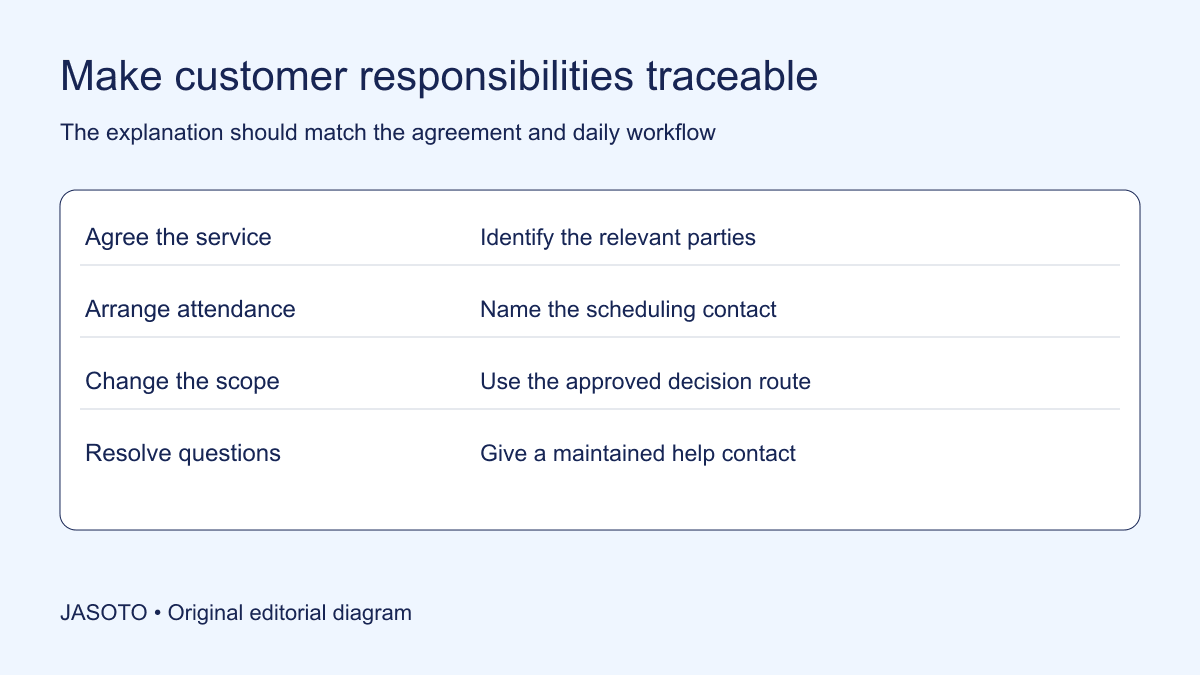
Original JASOTO editorial diagram. Its complete workflow is explained in the article; no actual customer outcome is depicted.
Explain subcontracted services by describing who provides the work, who handles the customer's booking and where questions or changes should go. Match the explanation to the real agreement and operating process. Verify claims about employment, specialist credentials and supervision before publishing them. Customers need a usable understanding of the arrangement, especially when the person attending differs from the person who prepared the quote.
The following workflow helps a small UK business prepare that explanation. Contracting, employment status and legal responsibility need the appropriate professional review for the actual situation. The worked handover is fictional and illustrates communication tasks. It should not be copied as a statement of liability or as terms governing another business's service.
The practical answer
- Describe the real service arrangement and relevant parties accurately.
- Tell customers who handles booking, changes and questions.
- Keep claims about employment, qualifications and oversight supported.
- Check the explanation against the actual agreement and handover.
Confirm the actual arrangement before choosing labels
Ask the responsible owner how the service is contracted and delivered. A subcontracted delivery, an introduction to an independent provider and a customer contracting directly with several suppliers are different arrangements. The website should reflect the settled model. Do not let an editor choose the label based only on which sounds simplest or most reassuring.
Record the relevant parties, their roles and which approved documents explain the arrangement. Identify unresolved questions for the appropriate adviser. A public page may use plain language, but the underlying facts must be clear internally. If colleagues disagree about who accepts the order or provides part of the work, resolve that decision before writing a confident account for customers.
Map the customer's journey across the parties
List the steps from inquiry to completion: assessing scope, issuing the offer, agreeing dates, attending, approving variations and providing follow-up. For each, identify the person or organization responsible for communicating with the customer. Record the route for a question that reaches the wrong party so the customer is not simply told to start again elsewhere.
This map reveals gaps that a general “trusted partners” paragraph conceals. A booking can be clear while change approval is ambiguous. A delivery can be assigned while nobody owns aftercare questions. Give each step a practical contact and internal escalation. The communication arrangement should remain useful when an attending provider is unavailable or the person who originally quoted is away.
Explain the relationship without inflated team claims
Use accurate words for employees, external providers and advisers. Check the impression created by photographs, biographies and collective language. A profile describing a specialist as always available may conflict with an arrangement where they support selected projects. A stock team image may imply a workforce the business does not have. Correct the presentation rather than relying on a distant caveat.
Customers do not need every internal commercial detail, but they should not be misled about a material delivery arrangement. Explain the relevant role and how work is coordinated. Avoid vague claims such as “all work in-house” when external providers perform part of it. If a distinction affects the service the customer receives, make it clear at the appropriate point in their decision.
Review responsibility statements with appropriate advice
Give the factual arrangement and proposed wording to the responsible reviewer where legal or contractual questions arise. [Business Companion's service-supply guidance](https://www.businesscompanion.info/en/quick-guides/services/supplying-services) explains relevant consumer-service responsibilities for England and Wales. Its stated jurisdiction matters; obtain suitable advice for the actual location and customer arrangement rather than generalizing an excerpt across every case.
Keep practical help separate from unsupported liability statements. “Contact our scheduling team about appointment changes” describes an operating route. “We have no responsibility for subcontractors” makes a much broader claim requiring proper review. The page should not attempt to shift obligations through an informal sentence. Publish the approved explanation and make sure staff can follow it when a real question arrives.
Verify qualifications and oversight claims
Identify what the business says about external providers' training, registration, experience or insurance, and ask who verifies those claims. Use the relevant current records and specialist checks. Do not turn a provider's marketing phrase into your own guarantee without review. Keep the scope of each claim clear: a credential held by one person may not apply to every individual who attends.
Describe oversight only as it actually occurs. If the business reviews a handover record, do not imply continuous onsite supervision. If a specialist decides a technical method, explain the coordination at an appropriate level without suggesting the customer must manage that work themselves. Accurate process information can be reassuring because it is specific and supported, rather than because it promises universal control.
Tell customers who agrees dates and arrival details
Choose the maintained scheduling route and explain when a proposed appointment becomes confirmed. If an external provider contacts the customer directly, make that expectation clear through the approved process. Give enough information for the customer to recognize legitimate contact without publishing private personal details or encouraging them to trust any message claiming a connection.
Coordinate site information, access and relevant contact responsibilities before attendance. Research business journeys where useful to planning, while leaving confirmed arrival arrangements with the responsible parties. A provider's travel estimate does not establish a guaranteed visit time. Keep the customer-facing message aligned with what scheduling can actually support and explain how changes should be reported.
Set a clear route for scope changes
Explain who can authorize additional work, revised requirements or a different appointment. Use the actual agreement and internal authority process. A customer discussing an idea with the attending person should not unknowingly create conflicting expectations with the coordinating business. Conversely, an attending provider should know how to raise a legitimate change without improvising commercial terms.
Record approved variations through the appropriate system and communicate the relevant outcome to affected parties. The public explanation can be concise, but the operational path needs detail. Avoid telling customers that all questions must go through one person if that person cannot respond while work is underway. The route should be accurate, staffed and capable of reaching the decision-maker.
Keep documents and messages consistent
Review the service page, quotation, booking message, provider introduction and completion information together. Check that party names and contact routes mean the same thing throughout. A page may say the business coordinates everything while an appointment email tells customers to negotiate directly with an external provider. Identify and resolve the contradiction before treating the explanation as ready.
Use one approved factual source for the arrangement and assign owners to each communication. When a provider changes or a service model is revised, update the affected templates as well as the website. Do not assume a careful paragraph compensates for contradictory terms or an outdated automated message. The customer's understanding develops across the whole journey.
Work through a fictional installation handover
Imagine a business supplying office storage and arranging installation through an external provider. The approved arrangement identifies the supplying business's customer contact and explains the installer's delivery role. The booking message states who confirms the visit and where questions about scope should go. The installer receives the same agreed scope and site information.
If the customer asks for an additional item during attendance, the provider uses the agreed change route rather than promising an unrecorded variation. The coordinating team records the decision and communicates the next step. This fictional example illustrates consistent information flow. It does not establish legal responsibility or a universal contract model, and it does not imply every external installation arrangement should operate identically.
Test a difficult question before publication
Ask a reviewer to follow the journey for a delayed arrival, a request for additional work and an aftercare question. They should identify who to contact and what happens next from the actual materials. If they must infer the answer from knowledge of the business, improve the explanation or resolve the missing operational decision.
Include the external provider in the relevant review where appropriate so the stated route is workable from both sides. Compare service providers using clear role requirements when sourcing support. If coordination needs dedicated capacity, define the responsibility before exploring service coordination roles. Adding a title does not resolve an unassigned decision or an unattended contact channel.
Maintain the explanation when arrangements change
Keep the approved wording, supporting references and earlier version for review and rollback. Recheck material changes to providers, responsibilities or service scope through the appropriate process. Do not leave a named provider on the page after their involvement ends, or continue implying a level of oversight that the operating model no longer supplies.
Review customer questions and handover issues using real records. Look for specific gaps such as unclear change approval or inconsistent aftercare contact. Avoid treating every problem as evidence that subcontracting itself failed; investigate the actual arrangement and communication. A useful explanation makes the current roles understandable and gives customers a dependable next step while staying within the facts and approved commitments.
Put the guide into practice
- Confirm the delivery and contracting arrangement with its owner.
- Map customer-facing responsibilities for each step.
- Verify statements about the people performing the work.
- Align website, quote and appointment information.
- Test a realistic change or complaint route.
Frequently asked questions
Can we call every external provider part of our team?
Check what that wording implies in the actual context. Customers may infer employment, permanent availability or direct supervision. Describe the real relationship and responsibilities accurately, with appropriate review of contractual and employment matters. A friendly collective label should not obscure who delivers the work or handles the customer's questions.
Does naming a subcontractor transfer all responsibility to them?
A website explanation does not decide or rewrite legal responsibility. The actual arrangement and applicable rules need appropriate review. Tell customers the correct practical contact route and ensure it matches the approved terms, rather than inserting an unsupported statement that the business has no responsibility for external work.
What if the subcontractor changes after the customer books?
Use the actual agreement and approval process to determine what must happen. Communicate relevant practical changes accurately and give the customer a maintained route for questions. Do not promise a named specialist if the business cannot support that commitment, or assume a substitution is acceptable without checking the applicable arrangement.
Explore JASOTO tools
Compare potential providers and clarify their role in a delivery arrangement.
Explore service coordination roles →Define ownership for customer communication and supplier handover.
Coordinate agreed visits →Review arrival information when an external provider attends a customer site.
Continue with JASOTO
Compare your next step
Discover UK businesses, compare services and request written quotes before making a decision.