
Business Growth · UK Guide 2026
Supplier Onboarding Checklist UK: From Quote to First Order
JASOTO · Updated 5 November 2026 · 2,055 words
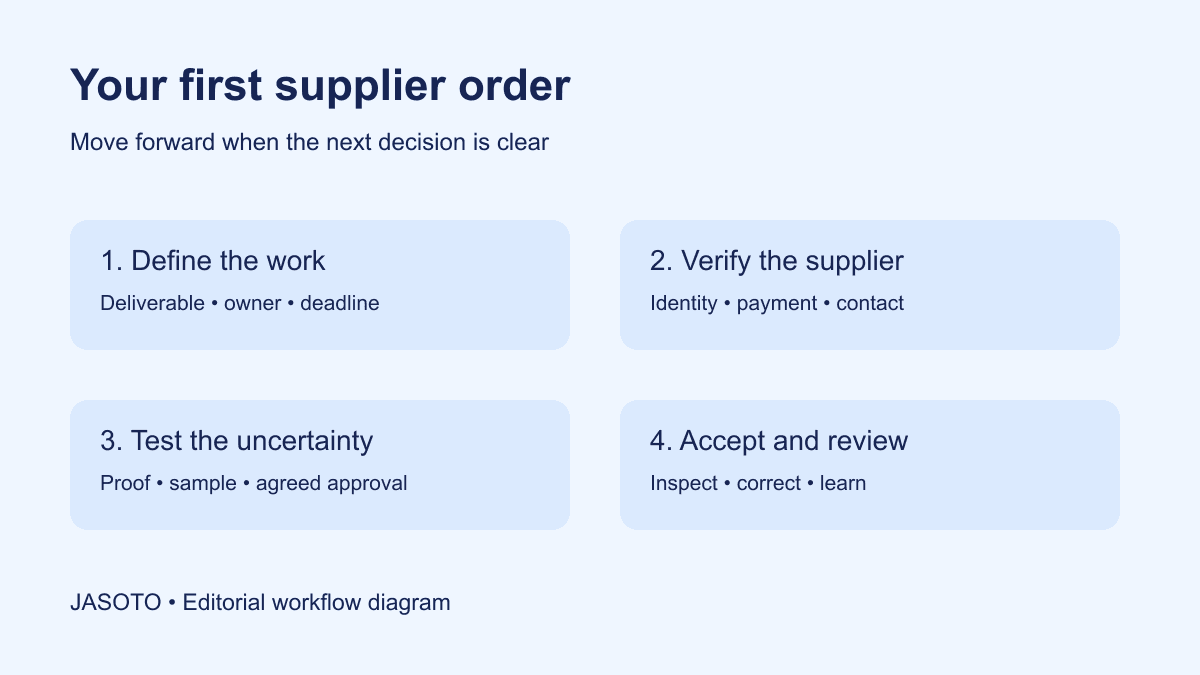
JASOTO editorial diagram. Illustrative workflow; no actual customer or supplier is represented.
Before placing a first order, agree what will be delivered, who can approve changes, how payment details will be checked and what counts as acceptance. Keep those decisions in one order record that both sides can refer to. A supplier onboarding checklist is useful when it prevents a specific misunderstanding; collecting a large folder of documents without reviewing them does not achieve that.
This guide is for a small UK organisation engaging an ordinary goods or services supplier. It sets out a practical first-order process, including an invented print-order example and an editable set of questions. Regulated, safety-critical or unusually valuable work needs additional checks appropriate to that work. The operational sequence can also help international readers, but UK registration checks do not replace the requirements in another country.
The short answer
- Define the deliverable before collecting documents.
- Check identity and payment instructions separately.
- Agree a proof or pilot where it will resolve uncertainty.
- Record acceptance and corrections before repeating the order.
1. Start with the purchase decision, not the supplier form
Write a short explanation of why you need the purchase now. Name the person who will use the result and describe the problem it should solve. For a print order, “we need a readable price card for the reception desk before the new menu starts” is more useful than “marketing materials”. It gives the supplier a way to challenge an unsuitable format before either side spends money.
Separate required features from preferences. Required features might include the finished dimensions, readable type, delivery address and deadline. Preferences might include a particular finish or packaging method. If everything is presented as essential, the supplier cannot suggest a cheaper or faster alternative without appearing to disregard the brief. Give each requirement an owner who can answer questions.
Also decide whether buying from a supplier is the right route. A one-off design task may suit an external provider, while work requiring daily supervision and a continuing internal responsibility may call for recruitment. The JASOTO jobs page can help with the latter route. Do not describe an employment arrangement as a purchase simply because the purchasing process seems easier.
2. Identify the business you are actually buying from
Record the supplier's trading name, the legal entity named on the quotation, its contact details and the person authorised to discuss the order. A brand and an invoicing company can legitimately have different names, but the relationship should be explained before an invoice arrives. If a supplier uses subcontractors, ask who remains responsible for the promised result and who handles corrections.
Companies House makes UK company information available publicly. Use the register as one input when checking a limited company's identity; a register entry is not proof of workmanship, current capacity or financial security. A sole trader will not necessarily have a company registration number. Choose checks that match the provider's actual legal form rather than rejecting a legitimate business for lacking an irrelevant document.
Keep a note of the evidence you checked and the date. If an address, company name or contact person differs between documents, ask for clarification instead of silently choosing whichever version is convenient. An unanswered discrepancy is a reason to pause the order. A clear explanation that you can confirm independently is more useful than a reassuring sentence in an email signature.
3. Turn the quotation into a usable scope
A quotation becomes easier to manage when it states quantities, deliverables, exclusions and dependencies together. For services, identify the work product rather than only the time involved. “Three hours of design” leaves acceptance uncertain; “one agreed artwork file in the named sizes, with two rounds of corrections” describes what the buyer expects to receive. The supplier should confirm whether that description matches the price.
Write down what you must supply and when. Missing copy, inaccessible premises or a late approval can make an otherwise reasonable delivery date impossible. If the deadline depends on receiving final artwork by Tuesday, keep that dependency next to the deadline. Do not bury it in a separate chat thread that the person approving the order never sees.
For a first order, avoid assumptions about taxes, carriage, installation, disposal and ongoing fees. Ask the provider to identify the applicable currency and the total you are being asked to authorise. This is a comparison method, not a statement about which tax treatment applies. Have the relevant person resolve unfamiliar tax or cross-border questions before the order is approved.
4. Verify payment instructions through a separate route
A new supplier record often introduces a new bank account, making it an important moment to slow down. Establish who will check payment instructions and how that person will contact the supplier independently of the message containing the instructions. A familiar-looking email thread alone is weak evidence because an account or conversation can be compromised.
For example, the buyer could call a contact number already established during the purchasing discussion and ask the supplier to confirm the account details. If the bank details subsequently change, repeat the agreed check rather than treating the change as a routine edit. Do not use a replacement phone number supplied only in the same unexpected payment-change message as your independent check.
The NCSC small-organisations guidance covers secure accounts, devices, backups and recognising attacks. Use it to inform the wider process around purchasing accounts and email. The call-back workflow here is an editorial recommendation for separating instructions from verification; it cannot guarantee that a payment is safe. Record who checked the details without distributing bank information more widely than necessary.
5. Collect documents only when someone will use them
It is tempting to send every supplier the same long questionnaire. A better starting point is to list the decisions that need evidence. If the provider will enter your premises, you may need information relevant to that visit. If they will operate a system, access controls and account ownership become central. If they will print publicly available artwork, those same system-access questions may be irrelevant.
Name the reviewer for each requested document and write what the reviewer is checking. Receiving an insurance certificate does not establish that the work you need is covered. A responsible reviewer should understand whether the document is relevant, current and sufficient for the intended job, obtaining specialist advice when needed. Do not turn document collection into an implied endorsement.
Avoid requesting identity documents, customer records or personal information merely because a form has an empty field. Explain the purpose of genuinely necessary information and use an appropriate collection method. Set a review or deletion point for temporary onboarding material. The practical objective is a usable supplier record with controlled access, rather than an indefinitely growing archive.
6. Make the first order small enough to learn from
Where the work allows it, use a sample, proof, pilot or limited first delivery to resolve uncertainty. The test should resemble the real task closely enough to be informative. A beautiful sample on a different material may say little about the item you are ordering. Explain which properties you are assessing and which will remain untested until production.
Agree the cost and consequences of the test. Is a proof included? Can production start only after written approval? If the sample is unsuitable, who pays for a revised version and how does that affect the deadline? A pilot without those decisions can create another dispute rather than reducing uncertainty. Keep approval with the person who understands the intended use.
There are purchases where splitting the work is impractical or expensive. In that case, increase clarity before commitment: use drawings, an agreed specification, a site visit or references relevant to comparable work. Do not describe a test order as a universal safeguard. Its value depends on whether it exposes the uncertainty that matters for this particular purchase.
7. Worked example: reception price cards
Imagine a small salon ordering 100 reception price cards. This is an invented scenario, with no market price or claimed customer outcome. The owner needs the cards ready for a new service menu. The supplier needs final prices, approved wording, a logo file and the delivery address. The receptionist needs to read the finished card easily under the lighting at the desk.
The owner creates a one-page order note: finished size, quantity, material agreed with the printer, artwork version, delivery deadline and the named approver. The note asks for a proof before production. Acceptance checks include correct prices, no missing services, legible small print and the agreed quantity. It also records whom to contact if the box arrives damaged or contains the wrong version.
During proofing, the receptionist notices that the booking number is too small. The owner approves one correction and labels the replacement file clearly. The printer confirms that this is the version going into production and whether the delivery commitment still holds. The value of the process is the traceable decision: both sides can identify the approved artwork instead of reconstructing a sequence of attachments.
8. Plan acceptance and corrections before delivery
Receiving a parcel or attending a handover is different from checking the order. Decide who inspects the result, what evidence they need and how quickly they can report problems. For a digital deliverable, confirm that the files open in the agreed format and that the intended owner can access them. For a physical item, assess it against the specification rather than the memory of a conversation.
Record any discrepancy factually: the order reference, the expected item, the actual issue and supporting photographs or files where appropriate. Separate urgent action from blame. Asking the supplier how a wrong quantity can be corrected before an event is usually more useful than starting with a broad accusation about reliability. Keep the original record intact when a replacement is agreed.
Commercial terms and legal rights differ between business and consumer purchases and across jurisdictions. This guide does not set a universal inspection deadline or cancellation entitlement. Review the terms that apply to your order and seek appropriate advice if a dispute is significant. An internal acceptance checklist should support your position, not be treated as a substitute for the contract.
9. Use a short supplier record you can maintain
A practical record can contain nine fields: entity and trading name; main contact; purchase purpose; specification link; approved quotation version; payment verification owner and date; delivery dependencies; acceptance owner; and next review date. Store the actual documents in a controlled location and link to them. Re-entering the same information in multiple spreadsheets makes inconsistencies harder to spot.
Give each open issue a decision and an owner. “Awaiting details” is too vague if no one knows which detail blocks the order. “Buyer to confirm delivery access by Wednesday before dispatch” is actionable. If a supplier cannot answer a reasonable question, decide whether to reduce the order, use an alternative provider or postpone the purchase. Do not leave the issue open while automatically approving payment.
For a supplier visit, consider travel arrangements separately from the purchase itself. A JASOTO travel search can help explore options, but check fares, locations and cancellation conditions with the booking provider. A route that reaches the town is not necessarily suitable for reaching an industrial estate at the required time. Include the site contact and arrival instructions in the visit confirmation.
10. Review the first result before making the arrangement routine
After the first order, hold a short review with the person who used the result. Ask whether it met the specification, which assumptions caused extra work and whether the communication route functioned. Record observable facts such as a missing file or a corrected delivery address. Avoid turning a single successful order into an unsupported claim that a supplier is always reliable.
Update the brief rather than compensating for the same ambiguity each time. If artwork versions caused confusion, introduce a final-approval field. If deliveries repeatedly reach the wrong entrance, improve the address instructions. If the supplier's work no longer fits the requirement, revisit the buying decision instead of expanding the checklist indefinitely.
Use JASOTO businesses to identify possible providers and compare how clearly they explain their services. Directory discovery is a starting point for a conversation, not a guarantee of suitability. The best outcome from onboarding is that both parties understand what happens next, the buyer knows how to assess the result, and unresolved risks remain visible before the next commitment.
Before you confirm
- Name the deliverable and its approver.
- Resolve identity discrepancies and verify payment instructions.
- Confirm the proof, delivery dependencies and acceptance checks.
- Save the agreed scope and the first-order review.
Frequently asked questions
Can I use this checklist for a sole trader?
Yes. Adapt the identity checks to the legal form. A sole trader may not have a Companies House registration. Confirm the person or business you are contracting with, the work, contact route and payment instructions.
Should every supplier complete a long questionnaire?
No. Match questions to the purchase and assign a reviewer to each requested item. An unused answer or unread certificate adds administration without resolving a decision.
What if the supplier changes bank details?
Pause and repeat your independent verification process. Treat the change as a new instruction to check, even if it appears in an existing email conversation.
Can international buyers use the same workflow?
The sequence of brief, identity, payment, test and acceptance is adaptable. Use the relevant local registers, commercial rules, currencies and contract advice rather than copying UK requirements unchanged.
Explore JASOTO tools
Continue with JASOTO
Compare your next step
Discover UK businesses, compare services and request written quotes before making a decision.