
Websites & Visibility · UK Guide 2026
Turn Support Conversations into a Maintained FAQ
JASOTO · Updated 5 November 2026 · 1,547 words
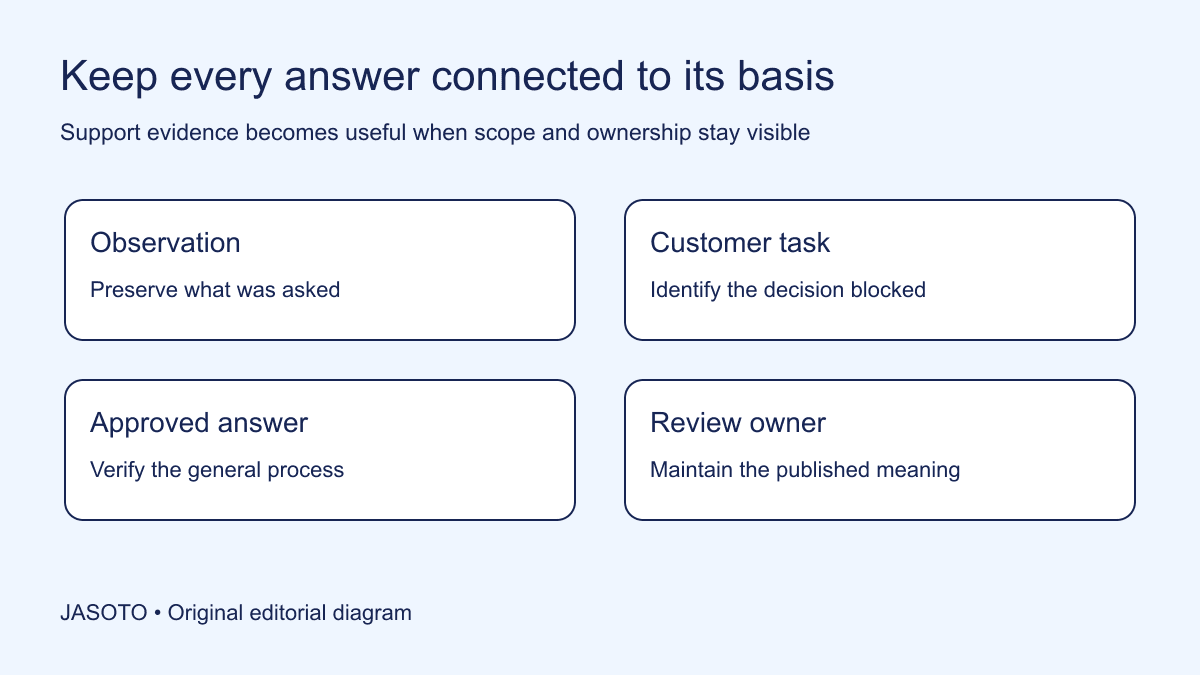
Original JASOTO editorial diagram. Its complete workflow is explained in the article; no actual customer outcome is depicted.
Create a practical FAQ from support conversations by extracting the customer's underlying task, checking the current general answer with its owner and recording where that answer comes from. Keep private case details out of the public version. Build a small answer register so later editors can distinguish a verified policy from a one-off concession, an old process or a plausible answer nobody approved.
This approach focuses on the evidence and maintenance behind an FAQ for a small UK business. It helps when a support team has useful conversations but the website editor cannot tell which details can safely become general guidance. The example records are fictional; use your own appropriately handled evidence and the responsible specialist for policy, legal or technical answers.
The practical answer
- Extract the underlying customer task while protecting private case details.
- Keep the conversation evidence linked to a controlled working record.
- Assign someone to verify each general answer and its limits.
- Publish in the right customer journey and maintain a correction trail.
Define the support material you are reviewing
Choose a relevant service and a practical observation period. Identify the channels included and those absent. A sample drawn from email may miss issues handled only by phone, and a short busy period may overrepresent a temporary disruption. Record those limits before counting topics or calling a question common. The sample can still identify a useful answer without representing every customer.
Agree who may access the conversations and how findings will be shared. Use controlled references where possible instead of copying entire case histories into an editorial document. Keep only the detail needed to understand the task and answer. This makes review easier while reducing unnecessary exposure of names, addresses, private attachments and unrelated information supplied during support.
Extract an observation before drafting an answer
Write down what the customer asked or did, identifying whether the note is verbatim or a summary. Then record your interpretation separately. “Asked where to send a returned item” is an observation. “The returns page is confusing” is a hypothesis requiring a check. Preserving the distinction prevents a support anecdote from becoming an unquestioned diagnosis.
[GOV.UK's research-analysis guidance](https://www.gov.uk/service-manual/user-research/analyse-a-research-session) separates observations, themes, findings and actions. Use that principle to structure the editorial review. A support log is collected for a different purpose from a planned research session, so describe its limitations honestly and avoid presenting a selected group of conversations as a comprehensive study of customer behavior.
Identify the task behind different wording
Group questions by what people need to accomplish. “Where do I send this?”, “Can I bring it back?” and “Which address is for returns?” may involve the same broad task, but the answers could differ for delivery and in-person handover. Preserve distinctions that affect the action. Do not merge every mention of an address into one generic location answer.
Write the proposed FAQ question in natural language that reflects the task. Avoid staff shorthand or internal system names unless customers actually use them. A question such as “How do I arrange an agreed return?” may be clearer than a label based on an internal case code. Keep enough context for the right customers to recognize the answer without reproducing a unique personal story.
Check whether the case supports a general rule
Ask the service owner whether the support reply describes the current normal process, an exception or an error. A helpful colleague may have made a discretionary arrangement to resolve a particular situation. Publishing that reply as a general promise can create a service the business never intended to offer. Record the classification and decision in the working register.
Where several replies conflict, investigate the underlying process before editing the answer. Do not average contradictory instructions into a compromise sentence that nobody operates. The owner should settle the correct general position and identify any conditions. Keep the unresolved question out of publication until the team can give an accurate answer or explain clearly that individual review is required.
Build an answer record with a useful minimum
For each candidate, record an identifier, customer task, evidence references, approved answer, scope, owner, approval date and review trigger. Add the intended page location and relevant links. These fields support real maintenance decisions. Avoid an elaborate taxonomy that takes longer to maintain than the answers and gives no help when a process changes.
Include what the answer does not settle where that matters. An answer explaining how to request a collection may not confirm that collection is available for every address. Preserve that limit in public wording near the relevant action. The register should show why the boundary exists and who can review it, rather than leaving future editors to remove it as apparently unnecessary detail.
Write the direct answer and next action together
Lead with the practical answer, then explain the condition or route needed to act. A customer should not have to read a long background section before learning whether to use a form, contact a team or wait for confirmation. Use the verified process and avoid response or delivery promises that support staff cannot maintain.
Link to the specific next step and check the destination. “Contact us” is less useful if several teams handle different cases. If an individual assessment is needed, explain what information helps and when the customer has a confirmed arrangement. Keep the answer short enough to use while preserving the condition that prevents a request from being mistaken for an accepted commitment.
Decide where the answer belongs
Put the answer where the relevant task occurs. A question about information required for a quote may belong beside the form, while a visit question belongs near the location or appointment instructions. A central FAQ can link to those maintained answers where useful. Avoid creating several independent versions of the same policy that drift apart over time.
Check the existing page before adding a new entry. The answer may already exist but use an unfamiliar heading or sit after the action it explains. In that case, clearer placement or wording may help more than duplication. Record the chosen location and any linked excerpts so a later correction reaches every place customers encounter the answer.
Work through a fictional collection question
Imagine a support log contains several conversations about whether customers can leave equipment at reception without booking. One colleague allowed a special handover during a busy project; the current process otherwise requires an agreed appointment. The editor records the exception separately and asks the service owner to confirm the general answer.
The published question explains how to arrange a handover and states when it becomes confirmed. It appears near the location information, with a link from the FAQ. The register holds the approved process and review owner, not the customer's private details. This fictional example shows how to turn conversation evidence into maintained guidance without turning a one-off favor into an implied entitlement for everyone.
Review privacy and contextual clues
Check whether the public wording, quotation or example could identify a person or organization unnecessarily. Removing a name may leave a distinctive combination of dates, location and circumstances. Use the business's appropriate privacy and permission process, and generalize the task where that provides the same value. Do not invent a replacement testimonial to avoid a permission problem.
Keep sensitive policy or technical answers with their responsible reviewers. The editor's job is to make an approved answer understandable, not to decide a customer's rights or a safety procedure through copywriting. Record who checked the substance and who checked the presentation. This distinction helps future editors find the right person when the underlying answer needs reconsideration.
Test whether the answer resolves a realistic task
Give a colleague unfamiliar with the draft a short scenario and ask what they would do next. Require them to identify the part of the answer supporting their action. If the FAQ concerns a visit, check the linked directions and journey planning information in the actual customer route. An isolated paragraph may appear clear while its destination contradicts it.
Record remaining questions and revise the relevant part. Avoid judging success only by whether readers like the tone. The useful evidence is whether they understand the current process and its limits. Research support or website providers with the same task-based brief if external help is needed, rather than requesting a larger FAQ merely to increase the number of indexed questions.
Maintain corrections and retirement
Set review triggers such as a new booking process, location change, revised service scope or repeated conflicting support reply. Assign the owner who checks the substance and the editor who updates placements. Explore support knowledge roles if the work needs dedicated capacity. A date in a spreadsheet is useful only when someone is responsible for acting on it.
When an answer changes, keep its earlier version and record the reason. Remove obsolete duplicates and test relevant links. Review later clarification patterns with the sample limits visible, rather than declaring that fewer support messages automatically prove the FAQ worked. The maintained register provides a concrete result: each published answer has an understandable task, a verified basis, a clear scope and a person responsible for keeping it accurate.
Put the guide into practice
- Define the support sample and its limits.
- Separate observations, interpretation and proposed answers.
- Check whether each case can support general guidance.
- Assign answer owners and review triggers.
- Test published answers against realistic tasks.
Frequently asked questions
Can we publish the customer's exact question?
Use an appropriate privacy and permission process, and consider whether a generalized version conveys the useful task without exposing identifying detail. Distinctive circumstances can identify a person even after a name is removed. Keep original records controlled and publish only what is necessary and appropriate for the answer.
Should a one-off exception become a general FAQ answer?
Only after the service owner confirms the general policy. A concession or unusual arrangement in one case does not establish what every customer can obtain. Preserve it as context in the working record and write the public answer around the verified current process and any relevant conditions.
Who should own FAQ accuracy?
Assign an owner with access to the relevant operational knowledge and a clear review responsibility. The editor may maintain wording while a service or policy owner verifies the answer. Record both where useful, and define how changes reach the published page when the underlying process changes.
Explore JASOTO tools
Continue with JASOTO
Compare your next step
Discover UK businesses, compare services and request written quotes before making a decision.