
Travel & Local Guides · UK Guide 2026
Review Your Travel Booking Process After a Team Trip
JASOTO · Updated November 5, 2026 · 1,534 words
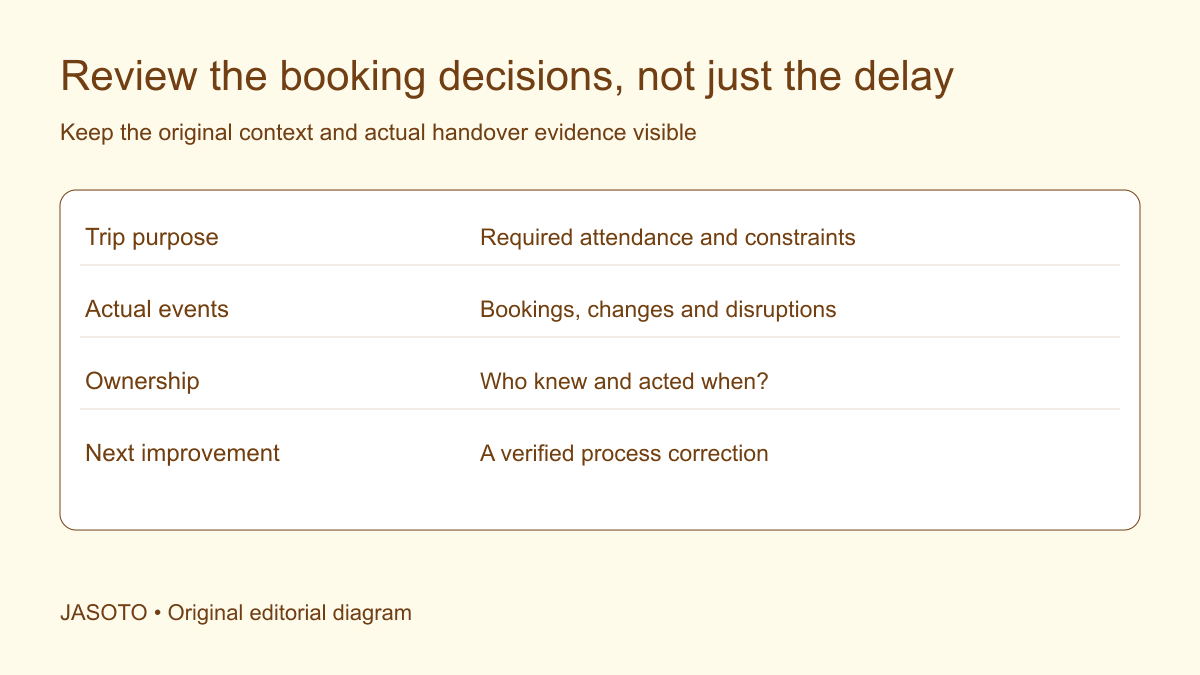
Original JASOTO editorial diagram. Its complete workflow is explained in the article; no actual customer outcome is depicted.
Review a travel booking process after a team trip by comparing the approved brief with the actual bookings, changes and handovers. Ask which decisions supported the trip's purpose, where information or ownership failed and what should change next time. Separate disruption outside the team's control from a verified planning defect. A difficult journey does not automatically prove a poor booking decision, and a smooth trip can still conceal an unreliable process.
This guide concerns a United States business's internal post-trip review, using fictional examples. It provides no fare recommendation, entry advice or determination of passenger rights. Use current provider terms, official information and appropriate advice for those matters. The review should preserve the evidence and assign practical actions rather than inventing savings or guarantees.
The practical answer
- Review the booking process against the trip's actual purpose.
- Separate provider disruption from planning and handover issues.
- Keep costs, effort and traveler experience supported by records.
- Choose specific improvements and verify them on the next relevant trip.
Recover the original trip purpose
Find the approved brief and identify the attendance or work the journey was meant to support. Record relevant timing, destination and constraints. A trip's success cannot be judged solely by the cheapest fare or shortest journey if it needed a particular arrival arrangement. Keep the actual decision context rather than reconstructing an ideal plan with hindsight.
Ask which requirements were firm and which were preferences. Identify unresolved assumptions that existed when bookings were made. The review should explain what the team knew at the time and what it learned later. This distinction helps prevent blame based on information unavailable to the person who made the original decision.
Collect the controlled booking record
Gather approvals, confirmations, provider terms relevant to the review and recorded changes through appropriate access. Keep booking references connected without publishing sensitive traveler details in a broad worksheet. A useful index can identify the document, role, date and owner while the underlying records remain in their proper systems.
Distinguish quoted, reserved, paid and confirmed states where the actual process needs them. An early itinerary draft may not show the final booking. If records conflict, assign clarification before reporting a conclusion. The review should establish what was actually arranged, not simply use the most convenient attachment found in an email search.
Map the journey and change events
Create a factual timeline of meaningful booking and travel events. Include when a change became known, who received it and what action followed. Record source evidence and uncertainty. A broad summary such as travel was chaotic may be understandable but gives little help in choosing a process improvement.
Keep scheduled and actual events distinct. A provider notification, traveler observation and internal update may occur at different times. Do not assume everyone knew about a change as soon as one person received it. The timeline can reveal a handover gap without attributing a motive or making unsupported claims about the provider's cause.
Separate disruption from controllable process issues
Ask what the business could reasonably influence through its actual responsibilities. A canceled service and an unmonitored update address are different issues. The first may be outside the booking team's control; the second can affect how the team responds. Review the evidence for each rather than classifying the whole trip as one failure.
Consider whether a dependency was known and how it was handled. Do not invent a universal buffer or declare that every disruption would have been avoided by an earlier departure. The useful lesson should be specific, supported and applicable to the next relevant journey. Avoid turning one experience into a guaranteed travel rule.
Review approvals and decision authority
Identify who could approve bookings, changes and additional spending under the actual organizational process. Check whether travelers and coordinators understood that route. A person facing disruption may need a clear contact or delegated authority. The review should capture verified gaps without improvising new policy through an informal note.
Record what needs a responsible decision before the next trip. If the existing approval process was clear but not followed, investigate the relevant context. If it was unclear, assign a correction. Keep individual actions and system design distinguishable so the recommendation addresses the observed problem instead of merely telling everyone to communicate better.
Check what travelers could access
Ask whether the relevant people had current confirmations, location details and support contacts when needed. A document existing in a coordinator's private inbox does not establish that the traveler could use it. Review the actual distribution and access path, including reasonable contingencies through the organization's process.
Protect personal information and credentials. The lesson should not be to distribute every booking detail to everyone. Define which roles need which information and use appropriate systems. A reliable handover gives the traveler and responsible support person usable references without creating an uncontrolled shared archive of sensitive documents.
Inspect provider and internal support routes
Check which contact routes were available, used and effective for the actual issue. [US DOT's Airline Customer Service Dashboard](https://www.transportation.gov/airconsumer/airline-customer-service-dashboard) points to airline commitments and related information for its stated scope. Consult current official and provider material when reviewing an applicable event, rather than relying on remembered conditions.
Keep any unresolved claim or provider complaint assigned through the proper process. This internal review should preserve facts and references, not determine every entitlement. Separate the provider action from the business's own coordination task. An outstanding provider response should not prevent the team from correcting a verified internal handover gap.
Review total effort and actual cost carefully
Use documented costs and an approved scope for the review. Keep staff effort, direct charges and estimates distinguishable. A later displayed fare may not be comparable with the original available offer, conditions or timing. Do not report a missed saving unless the evidence supports the actual alternative and decision context.
Consider work shifted to travelers or administrators. A lower booking fee may coexist with substantial manual coordination, while a more convenient arrangement may support the trip's purpose. The review should expose the trade-off without pretending every hour has a known monetary value. Keep financial conclusions with the appropriate owner.
Gather traveler feedback about specific tasks
Ask what information was difficult to find, which decision required help and what would have improved the handover. Use an appropriate process and avoid collecting unrelated personal circumstances. Specific examples are more actionable than a general satisfaction label. Keep direct observations separate from later interpretation.
Distinguish an individual preference from a recurring process defect. A traveler may prefer a different departure time while the booking met the approved constraints. That preference can still inform future planning, but should not be reported as an error automatically. Preserve the purpose and actual requirements when deciding what the feedback means.
Work through a fictional update gap
Imagine a team trip where one coordinator receives a venue change, but the travelers retain an older meeting address. The transport booking remains valid, while the final-arrival information is outdated. The review traces the notification and distribution path, then assigns a maintained itinerary update and confirmation process.
The next relevant trip tests whether the current destination reaches the required people. This fictional example supplies no claim about avoided cost or guaranteed punctuality. It shows how a precise information gap leads to a practical improvement without treating every difficulty as a booking-provider failure.
Choose a small set of verified improvements
Prioritize actions supported by the record, such as clarifying authority, improving update distribution or checking a particular dependency earlier. Give each an owner and evidence of completion. Research travel support providers with the actual need when assistance is appropriate. Avoid replacing the whole booking approach because one element failed.
Keep the proposed benefit distinct from an achieved result. A new checklist is an implemented process change, while better outcomes need later observation. Record which future trip or task can provide useful verification. The improvement should remain proportionate to consequence and frequency rather than become a long list nobody uses.
Apply lessons without assuming every trip is identical
Identify which lesson is general and which depends on the particular destination, provider or purpose. Research the next journey using current information, while checking actual requirements through relevant sources. Do not copy historical conditions as current facts. A sound lesson is to verify a dependency, not assume its answer never changes.
Consider travel coordination roles if recurring responsibility needs capacity. The role should match the actual tasks and authority identified in the review. A title alone does not resolve unclear approval or a support route nobody monitors. Keep the operating process usable during absence and staff changes.
Close the review with evidence and open actions
Save the brief, timeline, findings, decisions and remaining uncertainty in an appropriate concise record. Keep sensitive underlying documents controlled. Preserve the earlier process and a correction route where useful. Assign any unresolved provider or internal actions with review points rather than declaring everything complete because the meeting ended.
Review the changes on a later relevant trip and revise unsupported assumptions. The practical outcome is a booking process informed by the actual journey: the team understands which decisions and handovers worked, what failed within its control and what evidence will show whether the next improvement is useful.
Put the guide into practice
- Collect the approved brief and controlled booking references.
- Map what changed and who acted.
- Review handover, access and support routes.
- Check unresolved provider issues through current channels.
- Record owners and evidence for the next process change.
Frequently asked questions
Does a delayed flight prove the booking process was poor?
A disruption may occur despite reasonable planning. Review what the process controlled, what information was available and how changes were handled. Keep provider events separate from verified planning or handover defects, and avoid judging the entire process from the final outcome alone.
Should we compare the trip with fares available after travel?
Record the actual decision context and suitable evidence. A later displayed fare may have different dates, availability, conditions or timing and may not establish what could have been purchased originally. Avoid inventing a savings claim from an incomparable price found afterwards.
Can the review decide a refund entitlement?
Use the actual booking terms, current official information and appropriate advice or provider process for that question. The internal review should preserve relevant records and assign the issue, rather than improvising legal conclusions or assuming every disruption produces the same remedy.
Explore JASOTO tools
Continue with JASOTO
Compare your next step
Discover UK businesses, compare services and request written quotes before making a decision.