
Business Growth · UK Guide 2026
Write a Useful Page for a Temporarily Unavailable Service
JASOTO · Updated November 5, 2026 · 1,648 words
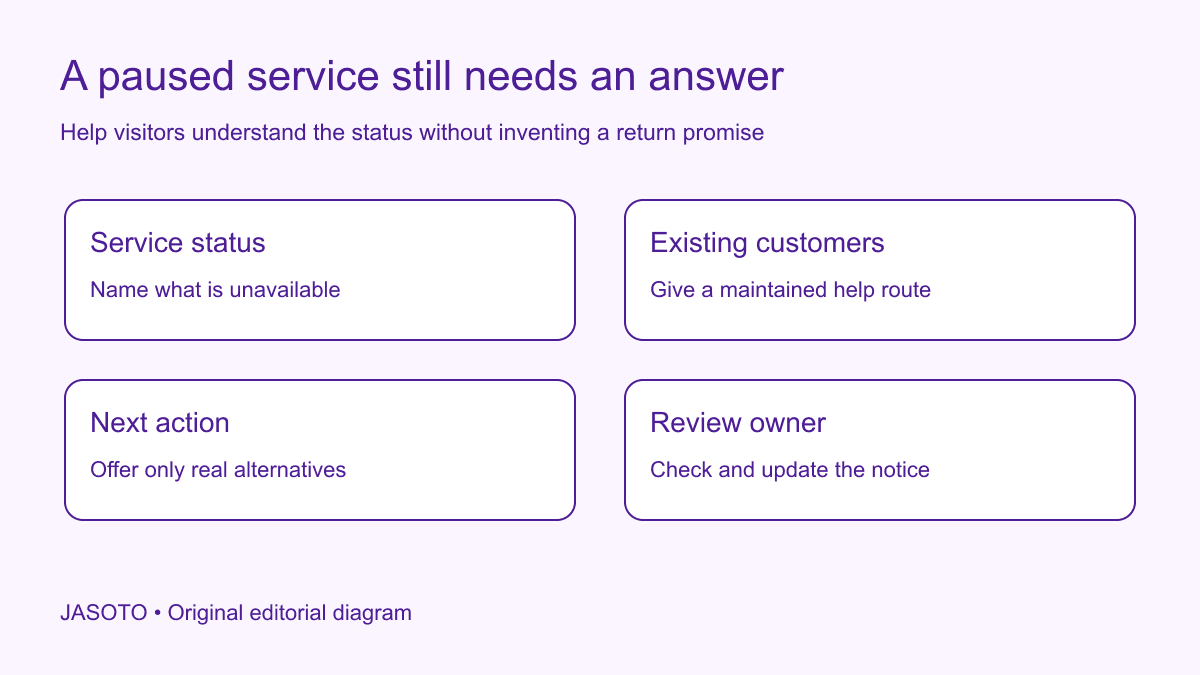
Original JASOTO editorial diagram. Its complete workflow is explained in the article; no actual customer outcome is depicted.
Write a temporarily unavailable service page by stating which service is paused, what happens to existing customers and what a new visitor can do next. Give a return date only when it is confirmed enough to publish accurately. If the date is unknown, say so and maintain a useful status route. A page that still invites bookings for an unavailable service creates work and uncertainty for both the visitor and the business.
This guide focuses on an ordinary small business in the United States pausing one service while other activity may continue. It provides an editorial process, not legal guidance on existing customer obligations or technical instructions for search indexing. The examples are fictional. Decisions about bookings, payments and contracted work should follow the actual agreement and appropriate professional advice.
The practical answer
- State which service is unavailable and what the pause affects.
- Distinguish confirmed return plans from hopes and review dates.
- Give existing customers a separate, reliable support route.
- Remove misleading booking actions and assign a review owner.
Define the pause before drafting the notice
Ask the responsible manager what is unavailable: a service, a particular delivery method, one location, or all operations. Identify whether new requests are paused while existing work continues. Those distinctions change the customer's next step. “We are temporarily closed” can be misleading if only one service is affected and customers can still obtain help with other work.
Record the effective date and what remains undecided. A planned pause can have a start date without a confirmed end. Do not convert an internal target into a public promise because the page looks unfinished without one. Give the writer an approved status statement and an owner for unresolved questions. That separates communication from the business decision about when the service can responsibly return.
Answer the visitor's immediate question first
Put the status near the top of the page, using the service name and a direct explanation. Avoid making people read an apology, promotional introduction or history of the business before discovering they cannot request the service. The original page may still receive visitors through saved links or search, so assume they need the answer without prior context.
For a fictional equipment business: “We are not accepting new calibration appointments for this service. Existing customers can contact the service desk about work already booked. A return date for new appointments has not been confirmed.” Adapt the wording to the actual facts. The important structure is service status, existing-customer distinction and honest return information, rather than a generic “back soon” headline.
Give existing customers their own route
People with bookings or work underway need different information from prospective customers. Identify the maintained contact route for their questions and explain what information helps staff locate the case. Do not publish individual customer details or try to resolve private arrangements through a public notice. The page should help people reach the responsible team without requiring them to submit a new sales request.
Check whether the business must contact affected customers directly through its normal authorized process. A public page update does not establish that everyone with an existing arrangement has been informed. Give those individual actions named owners. If the team handling existing work is different from the general reception team, make the internal handover clear so customers are not repeatedly transferred without a useful answer.
Distinguish return dates from review dates
A return date describes when the service is expected to become available under a supported plan. A review date describes when the business will reassess the position. Label them differently. “Next status review: December 3” should not appear below a “Book from December 3” button unless that booking date is genuinely established through the actual process.
If the return depends on staffing, equipment or another unresolved condition, explain only the detail useful to customers and appropriate to publish. Avoid speculative accounts of supplier problems or private personnel matters. A simple statement that the date is unconfirmed can be more accurate than a long explanation built around changing assumptions. Maintain the notice when the evidence changes rather than letting an expired review date become another unanswered question.
Replace actions that imply unavailable service
Inspect buttons, forms and links across the page. A careful notice conflicts with a prominent “Book now” action that still leads into the old service flow. Decide whether to remove, disable with an explanation or replace the action using the site's design and accessibility approach. Ask the developer to implement the appropriate behavior rather than relying on a visual change that leaves the old action active.
Review related pages and automated messages. A service card, quote acknowledgement or promotional email may still imply immediate availability. Record each affected route and its owner. Do not merely add the notice while leaving the rest of the customer journey unchanged. The status needs to survive the route a visitor actually takes, including a person who reaches the form without reading the service introduction.
Offer alternatives only when they are real
If another service could meet a different need, explain the distinction rather than presenting it as an equivalent substitute. A remote consultation is not the same as an onsite repair, and a general guide is not a booked appointment. State what the alternative provides and let customers decide whether it is relevant. Avoid sending everyone into an unrelated offer simply to keep an active conversion button.
If customers need another provider, research businesses on JASOTO and verify suitability independently. Do not invent partnerships, referrals or availability. The business can also explain that it cannot recommend a specific alternative if that is the honest position. A useful next step may be a clear boundary that prevents wasted effort, rather than a recommendation the team is unable to substantiate.
Design a waiting list around an actual process
Decide whether the business can maintain a list and what subscribers will receive. A status-update list, a cancellation list and a queue for future service are different arrangements. Name the one that exists. Explain how people can change their preference or leave through the normal process, and avoid collecting more information than the defined purpose requires.
Assign ownership before publishing the form. Who reviews entries, sends updates and closes the list if the service does not return? An unattended list gives customers another apparent route with no dependable response. Do not imply priority or a guaranteed place unless there is a real allocation method behind it. Keep the acknowledgement consistent with the public explanation, including the uncertainty about when service may resume.
Check the distinction between service and business status
If the whole location closes, review the relevant public profiles and their current instructions. [Google's closure guidance](https://support.google.com/business/answer/15300196?hl=en) distinguishes temporary and permanent business status. A pause in one service is a separate operational situation; do not treat a whole-business closure field as a universal solution without checking what accurately represents the business.
Keep a list of channels making claims about the affected service and update those that need correction. Include business directories, ads and social descriptions where relevant. Record submitted edits separately from changes visible to customers. Platform configuration and website communication should tell a consistent factual story, while recognizing that different channels provide different fields and may take different paths to publish an update.
Keep travel and appointment information practical
If customers ordinarily visit premises, explain whether visits for the paused service are unavailable and how existing arrangements are handled. Check directions and appointment messages so they do not encourage an unnecessary journey. A person who saved an earlier confirmation needs an individual answer where their booking is affected; the website notice alone may not settle their situation.
Use travel research when planning journeys after verifying the relevant service and appointment status. For business planning, review whether a service return depends on staff being present or equipment arriving from another location. Keep those dependencies in the internal plan. Customers need the current outcome and a reliable contact route, without being expected to interpret an incomplete logistics schedule.
Test the page with three different visitors
Ask a colleague to use the page as a new customer, an existing customer and someone looking for a return date. For each role, ask what is available and what happens next. Require them to point to the words or action supporting the answer. This exposes ambiguity between the main notice, older service copy and the next screen.
Test links and acknowledgements in an appropriate environment. An alternative contact is useful only if it reaches the intended team. Record any issue with a named owner rather than declaring the page ready because the notice itself reads well. This practical exercise checks a limited set of customer tasks; it does not prove every visitor will understand or establish a measured improvement in support demand.
Give restoration and permanent withdrawal separate decisions
Name the person who reviews the pause and the evidence required to announce a return. If staffing is a dependency, explore relevant service roles while keeping recruitment separate from confirmed readiness. Restore booking actions only when the operating team can support them. Retain the previous notice and a change record so an inaccurate return message can be corrected promptly.
If the business decides to withdraw the service permanently, treat that as a new content and operational decision. Review existing commitments, useful information, related links and any technical changes with the appropriate people. Do not let a temporary notice persist indefinitely through inattention. The page should remain an honest answer to the current situation, with uncertainty stated and next actions maintained rather than a stale promise that the business will be back soon.
Put the guide into practice
- Confirm the scope and current status of the pause.
- Explain existing bookings and customer support separately.
- Remove or revise actions that imply availability.
- Check links, profiles and automated messages.
- Assign review, restoration and rollback decisions.
Frequently asked questions
Should we delete the page while the service is paused?
First consider what customers using the existing address need to know. A clear status page may answer their question better than a missing page or unrelated destination. Permanent withdrawal needs a separate content and technical decision. Use a developer for routing and indexing questions rather than assuming deletion is the correct response to every temporary pause.
What if we cannot give a reopening date?
Say that the return date is not confirmed and give a maintained route for checking the status. A dated review point can explain when the business will assess the position again, but should not look like a promised return date. Remove a hopeful estimate if there is no evidence or process to maintain it.
Can we collect names for a waiting list?
Only describe a list the business can actually maintain and explain what joining means. State whether people will receive status updates, an invitation to request service or something else. Do not imply that joining guarantees a slot, priority or a return date unless the real process supports that promise.
Explore JASOTO tools
Continue with JASOTO
Compare your next step
Discover UK businesses, compare services and request written quotes before making a decision.