
Business Growth · UK Guide 2026
Prepare a Temporary Stockroom for a Busy Weekend
JASOTO · Updated 5 November 2026 · 1,620 words
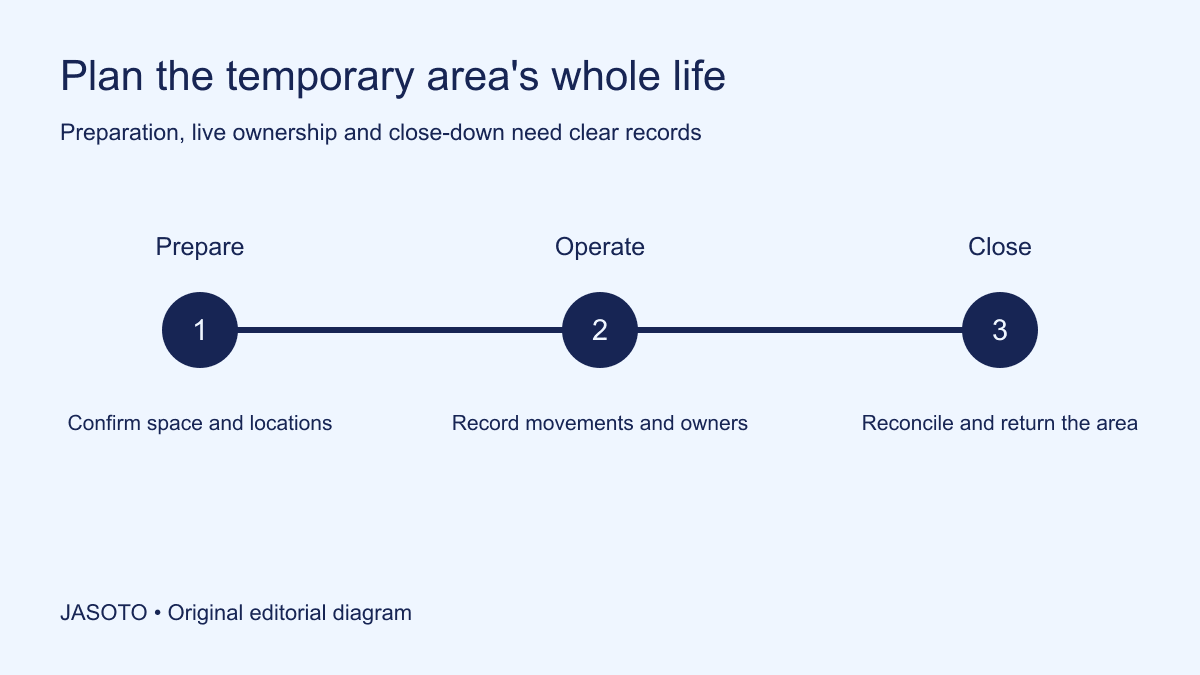
Original JASOTO editorial diagram. Its complete workflow is explained in the article; no actual customer outcome is depicted.
Prepare a temporary stockroom by confirming that the space is appropriate, identifying where each item will be held and assigning responsibility for movements during the busy period. Keep the temporary locations connected to the actual inventory process. Plan how the area closes and remaining stock returns to its proper place before the first carton is moved.
This guide is an original coordination worksheet for UK retailers preparing for a short busy weekend. It does not design racking, prescribe storage capacities or provide handling instructions. The people responsible for the premises, safety and relevant goods should determine suitable arrangements. The example uses an invented gift shop temporarily holding additional boxed stationery in an approved area.
The practical answer
- Confirm the space is appropriate before moving stock.
- Keep temporary locations visible in the actual inventory process.
- Brief replenishment and receiving staff on current responsibilities.
- Plan the return to ordinary storage and reconcile remaining stock.
Confirm suitability before planning the labels
Ask the responsible premises and safety people to assess the proposed space and use. They need the actual goods, likely quantities, access arrangements and work involved. A room being empty does not establish that it is suitable for storage. Do not move stock first and treat a later review as a formality, particularly where ordinary access or another activity could be affected.
[HSE's retail manual-handling guidance](https://www.hse.gov.uk/retail/manual-handling.htm) considers tasks, loads, people and the work environment in risk assessment. Use the appropriate process for the actual arrangement. This administrative plan should record the authorised decision and relevant instructions, while leaving capacity, handling and other technical judgments with the competent people responsible for them.
Define the temporary area's purpose and dates
State which event or trading period the area supports, when it becomes available and when it should close. Identify the normal use of the space and who authorises the handback. Without an end point, a short-term overflow arrangement can persist after its original conditions have changed. Keep the relevant review date and responsible owner visible.
Describe what the area is intended to hold and what is outside scope. A space approved for a defined group of goods should not quietly absorb unrelated deliveries because it appears convenient. If the requirement changes, refer it to the appropriate people before treating the new use as authorised. The temporary plan needs a clear route for change, not an assumption that every spare corner remains available.
Choose the stock based on the actual weekend plan
List the items and quantities proposed for the area using verified stock and trading information. Keep the purpose of each allocation clear. The extra stock may support a promotion, scheduled collections or ordinary replenishment, and those uses can have different operational needs. Avoid an indiscriminate transfer of slow-moving items that makes the area harder to use during the intended busy period.
Label estimates as estimates and preserve the source of the decision. Do not invent a precise sales forecast to justify a convenient quantity. Ask the relevant commercial and inventory owners to confirm the plan. A useful administrative record can state the planned stock and the next review trigger without pretending that demand is known in advance.
Create temporary locations staff can identify
Use location references compatible with the business's actual inventory and receiving process. Give each approved position a clear identity and provide a concise map or index where suitable. Do not introduce a parallel naming system that only the organiser understands. Staff should be able to find the intended item and report a location accurately during a busy shift.
Keep labels connected to the exact product and variant where relevant. Similar-looking cartons may contain different finishes or pack sizes. Preserve the difference between the storage location and item identity; one tells staff where to look, while the other tells them what they have found. A label reading promotion stock is unlikely to be sufficient for several distinct products.
Connect movements to the inventory record
Ask the responsible inventory person how transfers into, within and out of the temporary area should be recorded. A physical move without a corresponding appropriate record can make items appear missing from ordinary storage or available in the wrong place. Follow the actual system's process rather than assuming a handwritten tally will reconcile automatically afterwards.
Make the movement owner clear. If one colleague brings stock in and another updates the record, specify how the handover occurs and what confirms completion. Avoid leaving both assuming the other has done the administrative step. Record meaningful exceptions and use the proper reconciliation process when quantities differ. Do not change balances simply to make a temporary sheet match an unexplained count.
Assign receiving and replenishment roles
Identify who accepts planned deliveries, who replenishes the sales area and who handles questions. In a small team, the same person may cover several tasks, but the plan should acknowledge when those demands compete. A cashier cannot continuously serve customers while also monitoring an off-floor stock area. Ask what support or schedule is realistically needed.
Give cover staff the current instructions and an appropriate contact. They should know where to find the location index, which movements they may make and when to escalate. Do not rely on the usual stockroom employee being present for every enquiry. A temporary area often introduces unfamiliar routines just when the shop is busiest, making a concise briefing more important than an elaborate folder nobody can consult.
Plan for packaging and ordinary housekeeping
Use the site's appropriate arrangements for packaging, waste and keeping the working area in suitable condition. [HSE's logistics guidance](https://www.hse.gov.uk/logistics/slips-trips.htm) identifies housekeeping as relevant to slips and trips. The responsible people should determine the actual controls for the premises. This worksheet should identify who follows the agreed process and how an issue is reported.
Avoid assuming that a temporary stock area can also hold any empty cartons or returned goods without review. Those may affect the agreed use and stock identity. Keep their authorised locations and statuses distinct. If the area becomes difficult to use as intended, staff need a clear contact route rather than improvising new storage positions that the rest of the team cannot find.
Keep exceptions visible during the weekend
Define the information staff should report through the appropriate operational and safety processes. Examples include a product in the wrong recorded location, an unplanned delivery or an unavailable replenishment contact. Use the relevant urgent process for safety matters. Do not leave a significant issue waiting for a routine end-of-day stock update.
For ordinary stock questions, record the item, location, observation and next action. Keep the report factual. A missing carton may have moved through an unrecorded transfer rather than disappeared from the business. Use the proper investigation and reconciliation route. The temporary area should not become a separate world in which ordinary stock controls are suspended because the weekend is short.
Worked example: boxed stationery for a gift weekend
Imagine a gift shop expecting additional stationery sales during a planned weekend promotion. The responsible people approve a defined temporary area and its intended use. The inventory owner creates appropriate location references, while the operations contact assigns receiving and replenishment tasks. Staff receive a short current index and know how to report an unplanned item or unclear movement.
The team records stock transfers through its actual process and keeps packaging arrangements separate. At the end, remaining items are reconciled and returned through the authorised plan. This invented example claims no sales uplift or safety certification. It shows how a temporary space can remain connected to ordinary responsibilities instead of becoming a collection of cartons that only one employee understands.
Test the briefing before the busy period
Ask an authorised colleague unfamiliar with the setup to locate a named item from the record and explain the replenishment handover. Use the appropriate site arrangements for any physical activity. Check whether they can identify the item, relevant unit, movement record and exception contact. If the information is unclear, revise the specific label or instruction before live use.
Test the administrative close-down too. Can the owner identify which stock must return, where it goes and who confirms the area is handed back? A setup plan can look complete while leaving no practical ending. Keep the previous briefing and record substantive changes so staff do not follow conflicting versions during the event.
Close the area and review the evidence
Check unopened delivery cartons against the recorded locations before concluding that remaining stock has been reconciled. A temporary label may describe a planned allocation that changed during the weekend. Preserve the actual movement history and resolve a mismatch through the proper process rather than returning cartons under an assumed product description.
Follow the appropriate reconciliation and handback process. Record outstanding differences, retained items and any authorised continuation of the use. Do not mark the temporary area closed simply because the promotion ended. Confirm the physical and administrative state through the responsible people, including any actions needed before the space returns to its ordinary purpose.
Review repeated difficulties such as unclear labels or competing staff tasks. Use actual observations and comparable evidence before claiming the arrangement saved effort. Make a focused improvement for the next event and preserve a rollback path through the earlier instructions. A useful temporary stockroom plan serves the whole period, from preparation to a clear, accountable ending.
Use JASOTO businesses to discover relevant logistics support and verify capability directly. If the weekend requires additional people, explore stock and replenishment roles with clear tasks and supervision. For a confirmed transfer or count elsewhere, research travel after the appointment is agreed. The practical result is a temporary area whose stock, ownership and close-down remain understandable to the whole authorised team.
Put the guide into practice
- Obtain the appropriate premises and safety review.
- List the items and approved temporary locations.
- Assign receiving, replenishment and exception ownership.
- Set a close-down and stock-reconciliation plan.
Frequently asked questions
Can any unused room become a stockroom?
Have the responsible people assess the actual space, goods, access and applicable requirements. Spare floor space alone does not establish suitability. Use appropriate premises and safety advice before moving stock, and avoid treating a temporary arrangement as exempt from the business's normal responsibilities.
Should temporary stock stay outside the inventory system?
Use the business's actual process to keep location and movement information accurate. An informal overflow area can make stock appear missing or available in the wrong place. Ask the responsible inventory person how temporary locations should be represented and reconciled.
What happens to remaining stock after the weekend?
Plan the return or other authorised route before the area opens. Record movements, reconcile quantities through the proper process and confirm the space has been handed back appropriately. Do not let an unreviewed temporary arrangement become permanent by default.
Explore JASOTO tools
Discuss the actual goods, premises and service requirements with suitable providers.
Explore stock and replenishment roles →Consider staffing based on the actual weekend tasks and supervision required.
Research a confirmed stock-location journey →Plan travel if an agreed transfer or count requires attendance elsewhere.
Continue with JASOTO
Compare your next step
Discover UK businesses, compare services and request written quotes before making a decision.