
Business Growth · UK Guide 2026
Test Whether Customers Can Answer Your Form Questions
JASOTO · Updated 5 November 2026 · 1,615 words
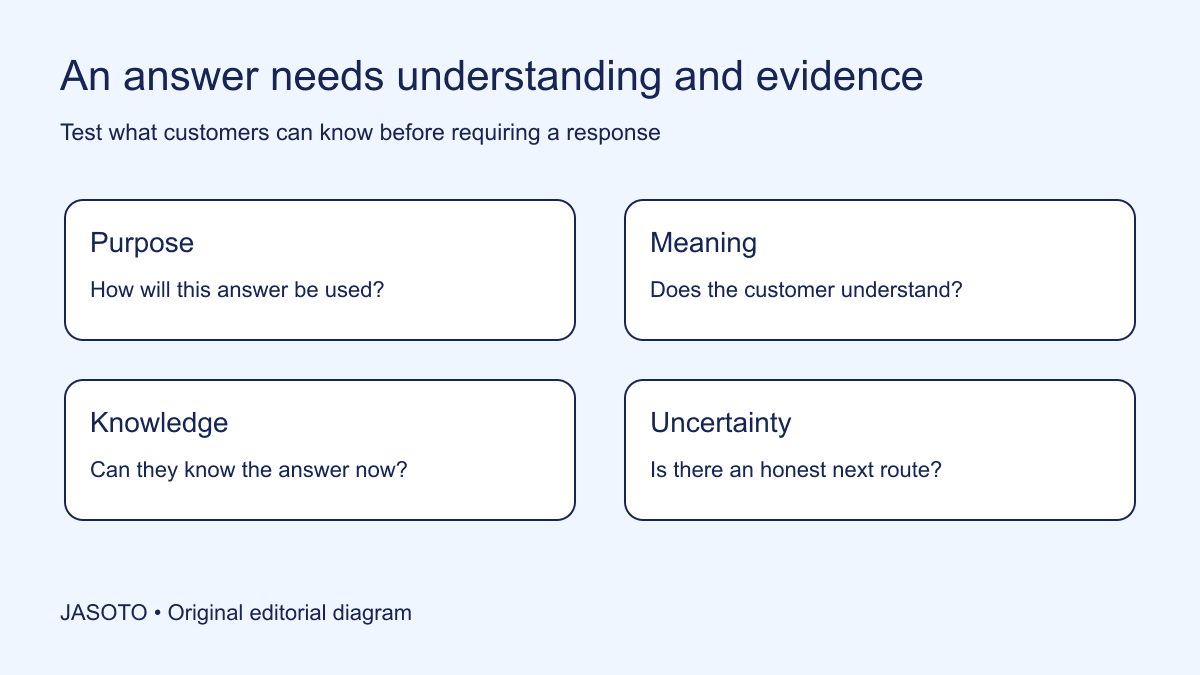
Original JASOTO editorial diagram. Its complete workflow is explained in the article; no actual customer outcome is depicted.
Test a customer form by checking whether intended users understand each question, have the information needed and can respond honestly when they are uncertain. Observe realistic tasks without coaching the answers. Then check whether the receiving team can use the result. A successful submission does not prove that a forced answer means what the business assumes it means.
This guide is an original practical test method for UK small businesses reviewing an enquiry or booking form. The example uses an invented venue enquiry where customers may know a guest estimate but not the provider's internal event category. Accessibility, privacy and technical implementation also need appropriate review. Here the focus is the answerability of the actual questions at the stage where they appear.
The practical answer
- Explain why each question is needed and how its answer is used.
- Check whether customers understand the terms and possess the information.
- Provide an appropriate route for uncertainty rather than forcing guesses.
- Test realistic tasks and review what reaches the receiving team.
Write the purpose of every question
List each field and the decision or action its answer supports. Ask the receiving staff how they use it. A question may determine whether the enquiry fits the service, help prepare a reply or belong to a later stage. If nobody can explain its purpose, investigate before keeping it merely because it appeared in an older paper form or a competitor's page.
The [GOV.UK Service Manual's form guidance](https://www.gov.uk/service-manual/design/form-structure) describes a question protocol that examines why information is requested and how it is used. It applies within its government-service context. The original small-business worksheet here uses a narrow version: record the purpose, intended respondent, source of their knowledge and appropriate handling of uncertainty before deciding the wording and required status.
Identify who is expected to answer
Different customers may have different knowledge. An experienced event organiser may know a provider's terminology while someone making a first enquiry does not. A person asking on behalf of a group may have estimates rather than confirmed details. State the intended audience and task instead of testing only with employees who already understand the business's internal language.
Include meaningful variations in the review. A repeat customer, first-time customer and authorised representative can encounter different information gaps. Do not assume every difference requires a separate form, but preserve the evidence. The appropriate question may need clearer context, a conditional route or a later clarification rather than one universal field that treats all respondents as equally informed.
Check the terms customers must interpret
Identify words that carry a specific internal meaning: event type, capacity, specification or reference. Ask a test participant what they think the question means before focusing on the answer. If several reasonable interpretations exist, clarify the wording. Avoid treating a participant's uncertainty as a failure to pay attention when the form has not supplied the necessary context.
Keep precision where it matters. Replacing a technical term with a vague everyday phrase may create a different ambiguity. Explain the relevant meaning and provide an appropriate example if useful. Check that the example does not imply a required answer or narrow the actual service incorrectly. The goal is a shared understanding, not a friendlier-looking label that still asks an unclear question.
Ask whether the information exists at this stage
A customer may understand the question but not yet know the answer. A first enquiry might contain a guest estimate, while the final number depends on invitations or another decision. Determine whether the business needs a confirmed value now or whether an appropriate estimate is sufficient. Keep those response types distinguishable so staff do not treat a provisional figure as a commitment.
If the information must be obtained elsewhere, explain the appropriate source and next step. Do not force a customer to invent a model number, technical diagnosis or exact date merely to contact the business. Where a specific answer is genuinely essential, provide a suitable clarification route rather than disguising the requirement behind a field the user cannot reasonably complete.
Define how uncertainty should be handled
Consider an honest response such as not yet confirmed or need help identifying this, where appropriate to the actual service. Explain what happens next. An unknown option is useful only if the receiving workflow handles it. Do not add one that submits successfully while leaving staff with no way to progress the enquiry or the customer believing a booking is confirmed.
Keep uncertainty separate from omission. A blank field may mean the customer overlooked it, chose not to respond or did not know. A clear appropriate route can preserve more useful meaning. Ask the business owner and receiving staff which distinction matters and how it affects the next action. Avoid collecting extra detail simply to compensate for a question whose purpose remains unclear.
Prepare realistic scenarios for the test
Write short fictional tasks with the information a customer would reasonably have. For a venue enquiry, the scenario may include a preferred period, an estimated group size and an undecided room arrangement. Do not give the participant the provider's internal category if the real customer would not know it. The test should expose the actual knowledge demand rather than remove it in the instructions.
Include one relevant uncertainty and one ordinary case. Keep the scenarios proportionate and avoid unnecessary personal information. If actual customers participate, use the business's appropriate research and privacy arrangements. This article does not prescribe a recruitment or consent process for every setting; the responsible team should arrange the activity suitably and explain the task honestly.
Observe without supplying the answer
Ask the participant to work through the form and explain their interpretation where appropriate. Watch where they hesitate, guess or search elsewhere. Avoid immediately teaching the internal terminology, because that can hide the question's weakness. Record the observed issue and relevant field rather than a broad judgment that the participant struggled with forms.
Distinguish a wording problem from a technical or access problem. Someone may understand the question but be unable to select the appropriate option. Another may choose an option easily while interpreting it incorrectly. Both matter, but need different fixes. A useful observation record identifies what happened and what evidence supports the interpretation, without inventing the cause prematurely.
Review the submitted information with receiving staff
Ask the team that handles enquiries what the test answers mean to them. Can they identify estimates, unknowns and the next question? An answer can look acceptable on the screen while creating an unsupported assumption downstream. If staff automatically treat an approximate guest number as final, the form and receiving workflow need a shared definition.
Check notifications, exported records and any appropriate handover. Useful context can disappear between the form and the inbox. A field label may be clear to the customer but abbreviated beyond recognition in the staff message. Ask the responsible technical person to review the actual flow rather than assuming a successful front-end test verifies the information staff receive.
Worked example: an early venue enquiry
Imagine a venue form requiring a first-time customer to choose an internal event package before explaining what each package means. Customers know their estimated group size and preferred period but not the category. The business reviews the actual decision the category supports and tests a revised early question with understandable context and a suitable route for an undecided enquiry.
Receiving staff can now see what is provisional and which clarification is needed. This invented example claims no conversion uplift or universal design solution. It shows how the task can be made more answerable by respecting the customer's available knowledge, while keeping the provider's actual eligibility and booking decisions under its appropriate process.
Change the smallest meaningful part and retest
Use the evidence to revise wording, timing, options or required status as appropriate. Keep the business purpose constant while evaluating whether the change helps. Do not remove a necessary question simply because one participant disliked it, or add several new fields to solve a problem better addressed by one explanation. Ask the responsible owner to approve any change affecting the service arrangement.
Retest the relevant task and preserve the earlier version. Record what improved and what remains uncertain. Avoid claiming the revised form works for every customer from a small review. The result can still justify a limited useful change, with an explicit next observation or appropriate broader review where the consequences warrant it.
Maintain the question protocol with the service
Review answers that look unusually exact for an early enquiry. A required field may encourage customers to choose a number or date simply because the form will not proceed otherwise. Ask receiving staff whether later conversations repeatedly replace those values. Treat that as a question to investigate, not proof that customers deliberately supplied false information. A clearer estimate label or appropriate uncertainty route may preserve more useful meaning. Test the revised interpretation with the actual receiving workflow so a provisional response is not still converted into a firm commitment downstream.
Assign ownership when the service changes. A field can remain technically functional after its purpose disappears, or become misleading when a new option is introduced. Review recurring clarification requests and examples of guessed answers through the appropriate records process. Keep observations relevant and personal information controlled. The form should evolve with actual customer tasks and receiving needs.
Use JASOTO businesses to discover suitable form or service-design support and verify capability directly. If enquiry review becomes continuing work, explore service administration roles within a staffing review. For a confirmed appointment, research travel after the provider checks the visit details. An answerable form respects what customers can understand and know, while giving the business a clear route to resolve what remains uncertain.
Put the guide into practice
- List the purpose and user group for every question.
- Prepare realistic scenarios with known and unknown information.
- Observe interpretation without coaching the answer.
- Review downstream usefulness and preserve a rollback version.
Frequently asked questions
Should every field be required?
Require information only where the actual service and appropriate process justify it at that stage. A required field can force a guess if customers do not know the answer. Consider whether a later clarification, conditional question or honest unknown response serves the task better.
Is a familiar business term clear to customers?
Test it with the intended users. Staff may understand a term through daily experience while customers interpret it differently. Keep the precise meaning where needed, but explain it in language and context the customer can reasonably use.
Does a completed form prove the questions worked?
Completion can conceal guesses, borrowed answers or misunderstood terms. Review how people interpreted questions and whether the receiving team can use the information. A realistic test should examine the answer's meaning as well as whether submission succeeded.
Explore JASOTO tools
Discuss the actual customer task and receiving workflow with suitable providers.
Explore service administration roles →Consider staffing where reviewing enquiries and improving information is ongoing work.
Research a confirmed service appointment →Plan travel after the provider confirms the relevant visit details.
Continue with JASOTO
Compare your next step
Discover UK businesses, compare services and request written quotes before making a decision.