
Business Growth · UK Guide 2026
Track an Inquiry to an Agreed Next Step
JASOTO · Updated November 5, 2026 · 1,613 words
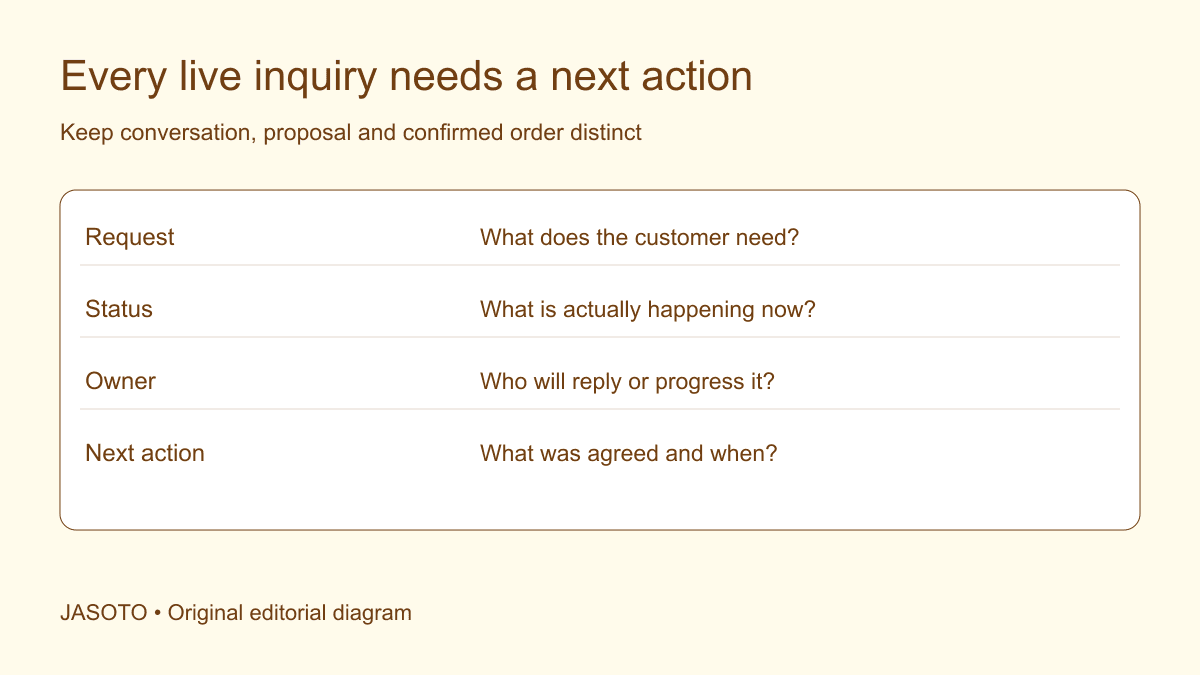
Original JASOTO editorial diagram. Its complete workflow is explained in the article; no actual customer outcome is depicted.
Track an inquiry by recording the customer's actual request, the current information gap, one responsible reply owner and the next action agreed. Keep conversation, quotation and confirmed order distinct. The record should help an authorised colleague pick up the work and understand what happens next without treating every message as either a sale or an abandoned lead.
This guide is an original administrative method for small businesses in the United States. The example uses an invented event-services enquiry about a proposed date and scope. Use the actual commercial, privacy and communication processes for the business. The aim is reliable follow-through on a real request, with an honest record of uncertainty and commitments.
The practical answer
- Give the inquiry a stable identity and preserve the actual request.
- Use statuses that explain the next work rather than imply a sale.
- Record who will act, what they agreed and the relevant timing.
- Keep customer information relevant and appropriately shared.
Preserve the initial request with a stable reference
Give the inquiry an identifier connected to the original message or appropriate case record. Record the contact route and what the customer wants to decide. A request for availability differs from a request for a final quote, even when both mention the same event date. Keep the actual wording accessible so later summaries do not transform the customer's question.
Check for an existing inquiry before creating another case. A customer may call after submitting a form or reply from another channel. Connect relevant records through the proper process rather than counting each contact as a separate opportunity. Preserve the sequence and source so the team can understand what information the customer has already supplied and which question remains unanswered.
Identify the current question, not just the product
Write the uncertainty the next action must resolve. For an event service, it might be whether the proposed date can be considered with the requested scope, rather than a general label such as party booking. A precise question gives the owner a useful task and helps the customer avoid repeating the whole story whenever another colleague becomes involved.
Separate multiple questions when they need different evidence. Availability, price and the suitability of a particular service can involve different responsible people. Keep the overall inquiry connected, while showing which answer is pending. Do not mark the case answered because one easy part was addressed if the customer still needs another response to make their decision.
Capture only information needed for the next stage
Ask which details support the actual response and which can wait. An early inquiry may need a preferred date and approximate requirements without requiring every detail of a final order. The [FTC's business data guide](https://www.ftc.gov/business-guidance/resources/protecting-personal-information-guide-business) advises understanding and limiting retained personal information. Use the business's appropriate privacy process for the actual case and audience.
Keep sensitive material in the proper controlled record rather than copying it into a broad tracker. A concise operational summary can point authorised staff to relevant detail. Avoid using a customer-tracking sheet as a place for speculative personal commentary or unrelated private information. The purpose is to progress the inquiry, not accumulate a profile that the next action does not require.
Assign a reply owner who knows the role
Name one person responsible for the customer-facing next step, with an appropriate backup. Collaborators may provide facts, but ownership should remain visible. Do not assume that copying several colleagues into an email establishes who will respond. A tracker can show a message reached the business while still leaving the customer unanswered if everyone expects another person to act.
Agree the owner's authority. They may be able to acknowledge a request or gather information without confirming a booking, changing terms or reserving capacity. Keep those boundaries clear and use the actual approval process. The owner should know whom to ask when a customer needs a decision beyond their role, rather than smoothing the uncertainty into an unsupported promise.
Use statuses that describe real work
Choose a small set of understandable states such as new, clarification requested, internal answer pending, proposal sent or agreed next step recorded. Define them in the team's actual workflow. Avoid labels that imply an order exists before the relevant acceptance process. A request for a date should not silently become booked because someone entered it into a calendar as a reminder.
Distinguish who is expected to act next. Awaiting customer and awaiting provider information create different follow-up tasks. Keep an explanation beside a blocked status rather than using one broad waiting category for everything. The status should help a colleague decide what to do, not merely produce a colourful report whose categories require the original author to interpret them.
Write the next action as a specific commitment
Record what will be done, by whom and at the agreed date or trigger. Ask supplier availability for the named date is clearer than follow up. Keep a target chosen internally distinct from a commitment accepted by another person. Do not add a precise deadline to make a row look complete if nobody has agreed or can reasonably meet it.
Where the next step depends on information, identify the missing item and the route for obtaining it. A customer may be unable to confirm a final number at first contact. Preserve that uncertainty and explain what can be considered meanwhile under the actual service process. Do not force a guessed answer into the record and later treat it as the customer's firm requirement.
Link proposals and approvals appropriately
Keep the relevant proposal version and any actual response connected to the inquiry. If the offer changes, preserve the distinction rather than overwriting the earlier terms without explanation. The person reviewing progress should be able to see what the customer has received and which questions are still open. Use the actual contract and approval process for any order or commitment.
Do not turn enthusiasm into acceptance. A customer saying an option looks interesting may still need internal approval or clarification. Record the actual next step in ordinary language. Likewise, an employee's acknowledgment of a request is not automatically a confirmed service. Accurate stage labels protect the usefulness of the record for both the customer response and internal planning.
Make handovers concise and actionable
When another colleague takes over, provide the request, relevant evidence, current position and next action. Link the authoritative record rather than forwarding an entire unrelated conversation. Explain important qualifications, such as the date remaining provisional. A handover that removes uncertainty from the summary can cause the next person to make a stronger promise than anyone intended.
Ask the recipient to confirm the action through the team's appropriate process. Do not assume a reassigned name means the colleague has seen the case or has the access needed. Check practical availability where timing matters. A small team may need a deliberate handover when shifts change or someone is absent, rather than relying on the tracker being noticed eventually.
Worked example: an event-service availability inquiry
Imagine a customer asking whether a provider can consider a proposed event date with a broad service requirement. The owner records the date as provisional, asks one relevant clarification and assigns an internal availability check. The next action identifies who will update the customer and what remains unconfirmed. The inquiry does not become an order merely because a staff member has placed a reminder in the calendar.
After the information arrives, the customer receives an appropriately scoped proposal and the record preserves the actual review step. This invented example claims no booking or revenue outcome. It shows how a tracker can maintain a useful conversation without inventing certainty about capacity, commercial acceptance or the customer's intention to proceed.
Use a short review question for each live case
At a routine review, ask what this customer is waiting for and who owns the next meaningful action. If the answer is unclear, clarify the record rather than sending a generic reminder automatically. A case may need a provider answer, a customer decision or a closure note. Those routes should not all receive the same chase message simply because a certain number of days has passed.
Keep the review proportionate and respectful of actual preferences and requirements. Do not claim that silence proves rejection or agreement. Preserve the outcome the business can support, including no further action agreed or customer declined where appropriate. The tracker should help the team honour commitments while avoiding an endless cycle of unnecessary contacts that serves neither party.
Close with a traceable outcome
Use a factual closure reason that the record supports. Customer declined is different from no further response received, and duplicate inquiry is different from an unsuitable service request. Preserve the relevant next commitment even when no order results. Clear categories help the team review its actual work later without inventing a reason for every silent case. Avoid interpreting a closed administrative record as permission to remove information that should be retained under the appropriate business, privacy or dispute process.
Record whether the inquiry became an order through the actual process, ended without one or moved to another appropriate route. Keep the relevant references and outstanding commitments. A closed row should not conceal a promised reply that has never been sent. Review retention and access through the business's appropriate policy rather than keeping every inquiry detail indefinitely by default.
Use JASOTO businesses to discover suitable customer operations support and verify capability directly. If inquiry coordination becomes continuing work, explore relevant roles within a staffing review. For an agreed customer meeting, research travel after confirmation. A useful inquiry record makes the current question and next commitment visible while preserving the difference between interest, discussion and an actual agreement.
Put the guide into practice
- Identify the request and current information gap.
- Assign one reply owner and a specific next action.
- Preserve approvals and commitments in the proper process.
- Close or hand over the inquiry with a traceable outcome.
Frequently asked questions
Does sending a quote mean the inquiry is complete?
Record the actual agreed next step. The customer may be reviewing the proposal, waiting for clarification or choosing not to proceed. A quote sent is a useful event, but it should not automatically become evidence of an order or a resolved customer question.
Should every inquiry receive repeated follow-ups?
Use the actual agreed communication and applicable preference process. Record the useful next contact rather than treating silence as unlimited permission to chase. Some inquiries may appropriately close with no order, while another requires a specific response the business has promised.
Can a spreadsheet work for a small team?
A suitable controlled record can work if ownership, access and updates are clear. The tool alone does not create a process. Test whether the team can identify the current question and next action without relying on one person's memory.
Explore JASOTO tools
Discuss the actual inquiry and handover tasks with suitable providers.
Explore customer coordination roles →Consider staffing where inquiry ownership becomes continuing work.
Research a confirmed customer meeting →Plan travel after the appointment and destination are agreed.
Continue with JASOTO
Compare your next step
Discover UK businesses, compare services and request written quotes before making a decision.