
Jobs & Careers · UK Guide 2026
Training Need or Missing Instruction? How to Tell
JASOTO · Updated 5 November 2026 · 1,720 words
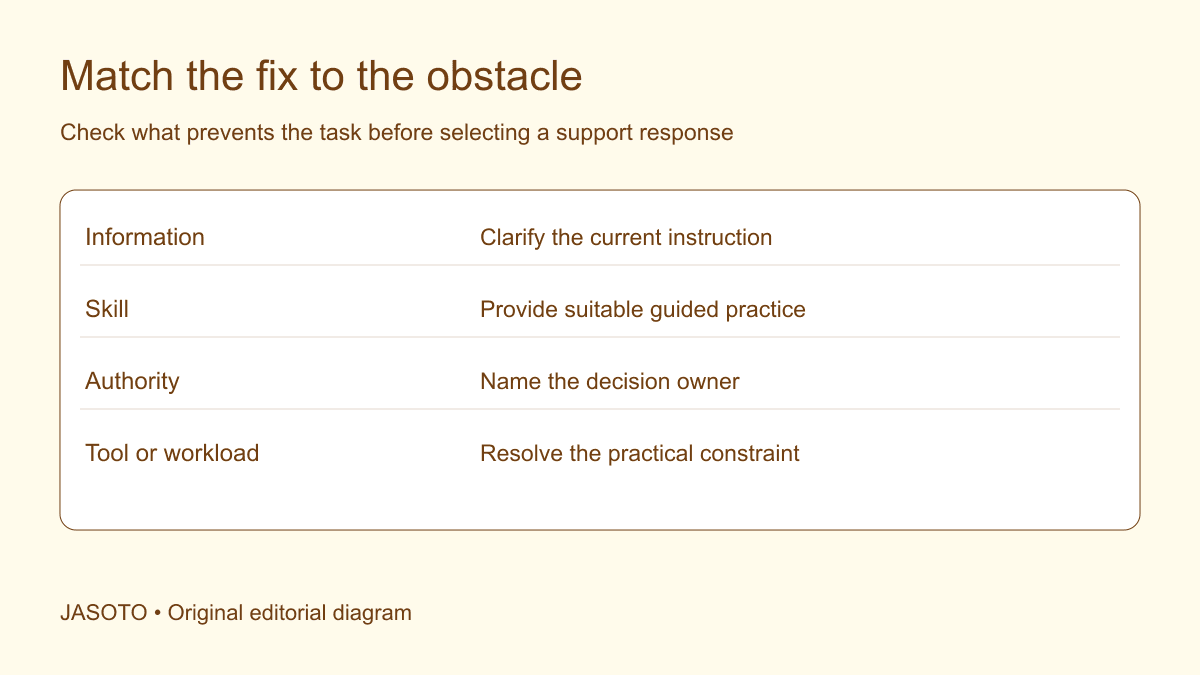
Original JASOTO editorial diagram. Its complete workflow is explained in the article; no actual customer outcome is depicted.
Before booking training for a task that keeps going wrong, check whether the person has a clear current instruction, the right access and a defined decision boundary. Then observe an appropriate example of the work and ask where they become uncertain. A missing process instruction and a genuine learning need can look similar in a results report, but they call for different support.
This original guide is for UK small teams reviewing routine administrative and service workflows. It does not authorise a manager to waive required training or competence arrangements. HSE explains that workers need clear information and instructions alongside adequate training and supervision for safe work. Keep safety-related decisions with the responsible competent people. The method below helps identify an ordinary process problem without assuming that every difficulty is an individual's skills gap.
The practical answer
- Describe the observed task failure first.
- Check the instruction and actual access route.
- Separate skill from authority and information.
- Test whether the chosen response helps.
Describe the outcome that is going wrong
Start with the expected result and a specific observed difference. “The booking handover lacks the agreed access time” is more useful than “staff need communication training”. Record which task was affected, what information was available and what consequence followed. Avoid deciding the cause in the problem statement. Calling something a training failure before investigating makes it harder to notice an outdated form or an unclear responsibility.
Use an appropriate example with unnecessary personal information removed. If several incidents appear similar, compare their actual circumstances rather than treating them as identical. One missing field may result from an instruction nobody can find, while another occurs because the customer has not supplied the information. A useful review begins with evidence of the process as it happened, including uncertainties. It should not assemble examples selectively to support a conclusion already reached about an employee.
Check whether a current instruction exists
Ask the person to find the instruction they would normally use, without first giving them the link. Observe where they look and which version they choose. This is a test of the information route as much as of the task. A document may exist on a manager's desktop without functioning as an available instruction for the team. Record the actual access path and whether an ordinary user can open it.
Read the instruction against the example. Does it explain the input, required action, expected output and exceptions? Does it refer to fields that no longer exist? A screenshot from an older system can make a written instruction appear complete while leaving the user to guess each mapping. If the source is missing or obsolete, assign a process owner to correct it. Repeating a training session around an unreliable source can simply teach people to work around the document in different ways.
Ask the person to explain the decision point
Invite a plain-language walkthrough of a suitable sample: what would they do first, what would make them stop and whom would they ask? Use an agreed low-impact example rather than surprising someone with a live customer issue. Listen for the point where they must infer a rule that has never been stated. “I do not know which address counts as the site entrance” suggests a different problem from “I cannot use the mapping tool”.
Keep the conversation respectful and factual. A person may know the rule but not feel authorised to act on it, or may have received conflicting answers from two managers. Ask what instruction or experience shaped their choice. Do not turn a useful diagnostic conversation into an improvised disciplinary judgement. Where individual performance issues require a formal process, use the organisation's appropriate arrangements and keep that separate from improving the shared workflow.
Separate information, skill and authority
Classify the immediate obstacle in ordinary terms. An information gap means the person lacks a fact or instruction. A skill gap means they need to learn or practise how to perform the task. An authority gap means the decision belongs to someone else or the boundary has not been defined. These categories are editorial prompts, not a formal assessment standard, and more than one may apply to the same situation.
For an invented purchasing task, an employee may understand how to prepare a request but not know who approves a particular exception. Sending them on spreadsheet training will not settle that authority question. Conversely, a clear approval chart will not teach someone how to use an unfamiliar calculation tool. Identify the missing element before selecting the response. When the task affects safety, compliance or specialist competence, involve the relevant owner rather than relying solely on this informal categorisation.
Look for tool and workload problems
Check whether the person can perform the task under the conditions the team expects. Missing permissions, a slow device, conflicting templates and incomplete source information can all interrupt a familiar process. Observe the relevant step and capture a precise symptom. “Cannot save the draft in the approved folder” gives a support owner something to investigate, while “needs confidence” can obscure a straightforward access problem.
Consider timing and interruptions without assuming a universal explanation. A task completed correctly in a quiet practice session may fail during a crowded handover because the process requires several unrecorded facts to be remembered. The response may involve changing the handover record or work allocation, alongside support for the person. Do not promise that a shorter instruction will solve an unrealistic workload. Document the observed constraint and involve the manager who can decide how the work is organised.
Choose the smallest response that addresses the cause
If the issue is a missing rule, write the rule with the accountable process owner and test whether people can use it. If the issue is unfamiliar technique, arrange suitable demonstration and practice. If the issue is unclear authority, publish the approved decision route. If a tool fails, send a precise report to its owner. A single problem can require a combined response, but every action should connect to an identified cause.
Avoid selecting a course simply because it is easy to purchase or produces an attendance certificate. Ask what behaviour or outcome the learning should enable and how that will be checked appropriately. When considering external business support, provide a task-specific brief and ask what the provider needs to assess suitability. Confirm the scope, format and prerequisites directly. A broad course title is not evidence that it addresses the particular difficulty your team observed.
Rewrite instructions around the next action
A revised instruction should state when the process applies, what information is needed, what to do and where to stop or escalate. Use the labels that appear in the actual tool or form. Include a short approved example for a common uncertainty. Avoid lengthening the document with background material that does not help the user make the relevant decision. Link specialist detail where needed instead of expecting the user to search through it during a routine task.
Give the instruction an owner and a visible version or update date. Remove or label outdated copies through the organisation's process so users do not have to choose between competing versions. A correction is not fully implemented while an old template remains easier to find. For a change that proves unhelpful, retain enough version history to restore the earlier arrangement while the owner revises the fix. Rollback should not depend on somebody remembering how the previous process worked.
Plan practice when the person needs to learn
Where practice is appropriate, define a representative task and the support available. Explain what a good result looks like and give feedback on specific steps. A demonstration alone may not establish that the person can perform the task, particularly when the instructor completes the difficult parts. Use suitable sample information and the level of supervision required for the work. Do not transfer responsibility before the authorised owner is satisfied with the arrangements.
Ask the learner to explain the next decision in their own words. This can reveal a misunderstood boundary without requiring a large test. If the task cannot safely be simulated, seek the appropriate training and assessment route. Keep the record precise: “practised completing the sample handover with a reviewer” is different from “fully competent in operations”. Attendance, practice, assessment and authorisation describe different things and should not be treated as interchangeable completion statuses.
Compare a before-and-after task fairly
Choose a practical follow-up that checks the identified problem. If the change was a clearer address instruction, review whether the next suitable handover identifies the entrance correctly and whether the user can explain the source. Do not claim a measured productivity improvement from one successful sample. The point is to determine whether the correction works well enough to continue observing it in ordinary use.
Ask what new friction the change introduced. A compulsory field might prevent incomplete records while forcing users to enter guesses when information is unavailable. Improve the design so uncertainty can be recorded honestly and routed to an owner. A useful process should distinguish missing information from incorrect information. If the initial fix creates worse confusion, restore the previous working arrangement where appropriate and revise the change with the people who actually perform the task.
Build the finding into future role support
Store the corrected instruction where new colleagues will encounter it, and include the relevant practice in induction where needed. When defining or recruiting for a role, distinguish expected experience from training the organisation will provide. If support requires an in-person visit, confirm the host, task and equipment before planning travel. The practical arrangements should follow the learning need rather than becoming another avoidable obstacle.
Review recurring issues at the process level without erasing individual support needs. A team can have both an unclear instruction and a colleague who benefits from additional practice. Record the evidence, chosen response, responsible owner and next review. Success is a more usable task with suitable support, rather than proving that the original problem belonged entirely to either the person or the document. The most useful diagnosis makes the next action specific enough to test and revise.
Put the guide into practice
- Review a suitable specific example.
- Ask where the user becomes uncertain.
- Assign the correction to an owner.
- Check outcomes and revise regressions.
Frequently asked questions
Can a written instruction replace training?
Not automatically. Some tasks need demonstration, practice, supervision, assessment or formal authorisation. A clearer instruction can support that learning, but the responsible owner should determine what the work requires. Do not use this diagnostic method to remove required safety or specialist training.
What if experienced staff use different methods?
Ask which differences are approved and whether the output and boundaries are consistent. Variation may reveal undocumented knowledge, conflicting instructions or legitimate alternatives. Have the process owner clarify the acceptable approach before asking a new colleague to copy whichever person they happened to observe first.
How do we know the chosen fix helped?
Check a suitable example against the specific issue you identified, ask the user where uncertainty remains and review ordinary work over an appropriate period. Describe what was actually observed. A successful sample supports continuing the change, while broader claims need meaningful evidence beyond attendance or one completed task.
Explore JASOTO tools
Discover providers and check support for your specific task.
Explore roles and responsibilities →Consider the practical responsibilities involved when recruiting or joining a team.
Plan work-related travel →Research a journey when joining, training or meeting colleagues in person.
Continue with JASOTO
Compare your next step
Discover UK businesses, compare services and request written quotes before making a decision.