
Travel · UK Guide 2026
Choose a Transfer Meeting Point People Can Find
JASOTO · Updated 5 November 2026 · 1,625 words
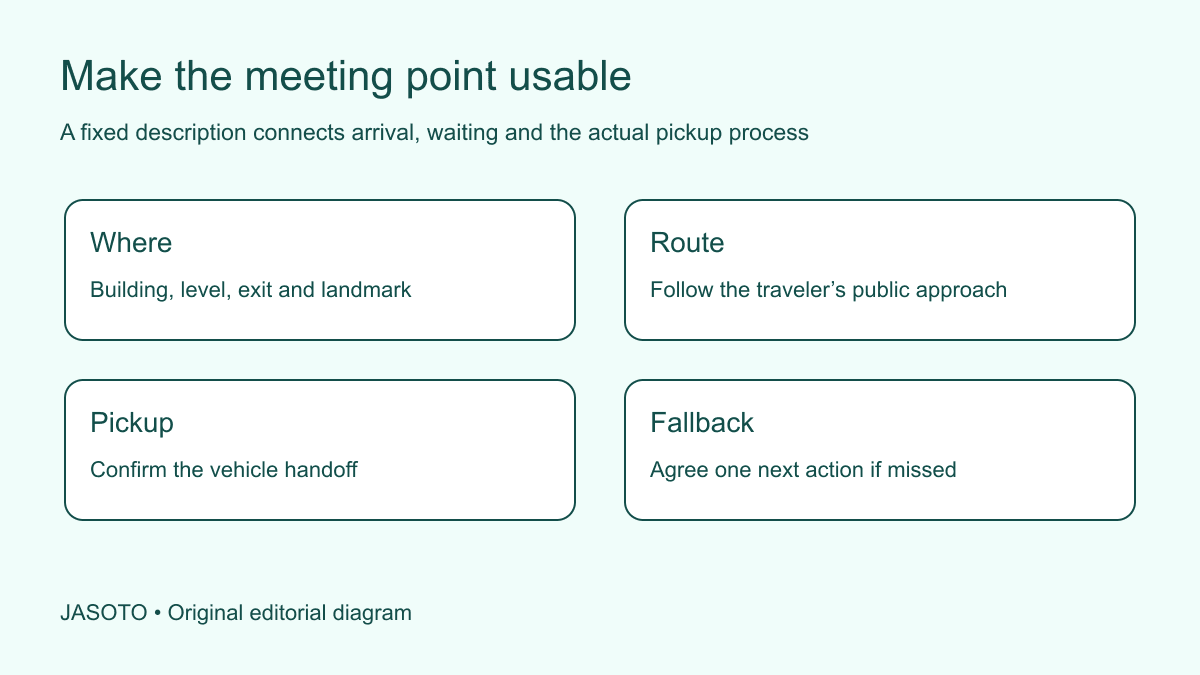
Original JASOTO editorial diagram. Its complete workflow is explained in the article; no actual customer outcome is depicted.
Choose a transfer meeting point by describing a fixed location that both traveler and receiving person can reach and recognize. Include the terminal or building, level, relevant exit and a clear landmark, then confirm how that point connects to the actual vehicle pickup. A description such as “outside arrivals” can leave two people waiting at different doors while both believe they followed the instruction.
This guide offers an original findability check for UK transfers. Heathrow publishes terminal meeting-point information, illustrating the value of using a location-specific operator source. Use the actual airport, station, venue and transfer provider's current instructions for your trip. The examples below help you test a description; they do not authorize waiting, parking or collecting passengers at a place merely because it looks convenient on a map.
The practical answer
- Separate the people’s meeting point from pickup.
- Use a specific fixed reference.
- Test directions from the traveler’s approach.
- Give both parties one agreed fallback.
Distinguish meeting from vehicle pickup
Ask where people should first find each other and where the vehicle will actually receive passengers. These can be separate points with a walk between them. A signposted passenger meeting point does not establish that a driver can stop beside it. Confirm the provider's process and the site's current arrangements before writing one location into the itinerary for both purposes.
Describe the handoff explicitly. The traveler may meet a representative inside and be escorted to the vehicle, or may follow a provider's instruction to a designated pickup area. Use the real arrangement rather than inventing one that sounds simpler. If the traveler must move independently between the two points, check the route and relevant access needs. The plan should make that transition understandable, especially for someone arriving with bags in an unfamiliar building.
Identify the exact arrival building
Confirm the terminal, station or venue building associated with the actual service. Similar names and connected complexes can create a misleading sense that one meeting-point instruction covers the whole site. Check the current operator information and the traveler's actual arrival details. A person should not have to decide which of several buildings the coordinator meant after a long journey.
Keep a material change connected to the meeting instruction. If an arrival moves to another terminal or station, review the point and the vehicle arrangement rather than changing only the service line in the itinerary. Ask the provider whether its process changes. The route may require a different representative or pickup area. A correct service update can still leave the transfer plan wrong when the location dependency has not been carried through.
Choose a stable recognizable reference
Prefer a fixed, appropriately permitted reference that remains identifiable at the time of arrival. A named information point or official meeting area may be easier to describe than a temporary stall or a person standing somewhere near a café. Check that the landmark can be seen from the approach the traveler will use. A location obvious from one side of a hall can be hidden from another exit.
Avoid relying on color or a photograph alone. Add the words needed to recognize the point and distinguish it from similar places. A large station may contain several coffee counters with the same brand. Include the relevant level or exit and a clear direction from a known arrival point. Keep the description concise: the goal is an instruction someone can follow while carrying luggage, rather than a detailed architectural tour that hides the final location in several paragraphs.
Write the route from the traveler's perspective
Start at the point where the traveler can legitimately begin following the instruction, such as the public arrivals area or station concourse. Use the actual sequence of decisions: which exit, which level and what they should see next. Do not give directions from the driver's route or assume knowledge of staff-only shortcuts. The traveler needs an independent usable path through the public area.
Check unfamiliar terms. A local colleague may know what “the old entrance” means, while a visitor cannot. Replace it with the current sign or a clearer reference. If the route depends on a lift, escalator or other facility, confirm the relevant arrangement and what to do if it is unavailable. Keep access questions specific to the route and handle individual needs through an appropriate contact, without publishing unnecessary personal details in a group instruction.
Confirm waiting is appropriate
Ask the relevant operator, venue or provider about any restriction that affects waiting or pickup. A wide pavement or convenient curb does not establish permission to gather or stop there. Keep the passenger instruction consistent with the actual operating arrangement. If a provider says the traveler should contact it only after reaching a particular stage, explain that step clearly rather than encouraging the driver to wait somewhere unsuitable.
Check whether the point works at the arrival time and for the expected group. A location that is easy to identify when quiet may be crowded during an event. The plan may need a precise secondary reference or a different confirmed arrangement. Avoid suggesting that the coordinator can solve every crowding issue by placing an unapproved sign or blocking a walkway. Findability and permission both matter, and the final choice should respect the site's actual use.
Make contact information usable before connection
Provide the provider's established contact method and explain which name or booking reference the traveler should give. Keep private reference details appropriately protected. Ensure the route works before the traveler has access to a vehicle's network or another unavailable system. A contact method that depends entirely on the same failed data connection as the live map may not provide a useful fallback.
Agree who initiates contact and at what point. For an invented airport transfer, the traveler will message the established provider after reaching the confirmed public meeting area. The provider will then follow its actual pickup process. The example does not assume every airport or service uses that method. The useful feature is that each side knows when the other's status becomes relevant, rather than both repeatedly waiting for an unassigned first call.
Verify the person and service through the booking
Tell the traveler how the actual provider identifies its representative or vehicle through the confirmed process. Do not rely only on someone displaying a familiar name or approaching confidently. If the traveler is unsure, they should use the established provider contact to verify the arrangement. Keep the instruction proportionate and practical, avoiding an elaborate new verification ritual that the provider has never agreed to use.
Likewise, the coordinator should not circulate unnecessary personal information to everyone near the pickup. Share what the appropriate provider needs for the service through its agreed route. If the representative or vehicle changes, confirm the update with the established contact and tell the traveler which detail is current. A findable meeting point solves the location problem, while the booking process establishes that the traveler has connected with the intended service.
Test the description with an unfamiliar reader
Ask someone who did not write the instruction to explain where they would go. If feasible, have them follow the public route or examine the operator's map from the relevant arrival point. Note each place where they need a guess. An instruction can look precise to its author because the author supplies missing local knowledge without noticing it.
Use the result to revise the specific gap. Perhaps the level is missing, two exits have similar names or the photograph faces the opposite direction. Add the useful detail and remove redundant text. Test the text without the image as well as with it. Essential location information should survive a printed sheet or a poor connection. This review establishes that the instruction is clearer to that reader; it does not guarantee every future arrival will be free of confusion.
Prepare one clear fallback point or action
Agree what happens if the traveler cannot find the receiving person. A fallback might be remaining at a confirmed recognizable point and calling the provider, rather than wandering between several doors. Check what is appropriate for the actual site and service. Tell both parties the same action so a traveler does not move to a new area just as the representative reaches the old one.
Use travel research to investigate the wider route, while official site and provider information governs the pickup arrangement. For a transfer discovered through business listings, confirm the specific meeting and vehicle process directly. When this coordination forms part of a recurring position, describe it accurately in relevant roles. The person drafting directions may not control parking, access or provider changes, so the handoff needs named contacts rather than assumptions about authority.
Keep the point current when circumstances change
Store the confirmed instruction with a visible date or version and update all affected parties if the arrival or pickup changes. Mark the old description replaced. A changed calendar map with an old text message still active can recreate the original ambiguity. Ask for a simple confirmation when a material change affects where someone should wait, using the communication route agreed for the trip.
After the transfer, record the detail that caused or prevented confusion and revise the reusable instruction through the appropriate owner. Remove unverified shortcuts and restore the official or provider-confirmed route if an improvised edit fails. A usable meeting point is more than a pin: it is a shared understanding of where each person can stand, how they reach it and what they do if the intended connection has not yet happened.
Put the guide into practice
- Confirm the actual arrival building.
- Check waiting and pickup arrangements.
- Verify contact and provider identification routes.
- Replace old instructions after a change.
Frequently asked questions
Is “outside arrivals” a sufficient instruction?
Usually add the actual terminal or building, relevant level or exit and a fixed recognizable point. Confirm how it connects to vehicle pickup. Large sites can have several plausible outside areas, and a passenger meeting point may differ from the place a vehicle can use.
Should I choose a café as the landmark?
Use a landmark only when it is specific, stable, visible from the relevant route and appropriate for waiting. A brand name alone can be ambiguous where several outlets exist. Add the level, exit or other detail that distinguishes the intended location.
What should happen if the two people miss each other?
Use one agreed fallback action, such as remaining at a confirmed recognizable point and contacting the provider through the established route. Give both parties the same instruction. Uncoordinated movement between doors can make an otherwise simple location problem harder to resolve.
Explore JASOTO tools
Discover providers and check support for your specific task.
Explore roles and responsibilities →Consider the practical responsibilities involved when recruiting or joining a team.
Plan work-related travel →Research a journey when joining, training or meeting colleagues in person.
Continue with JASOTO
Compare your next step
Discover UK businesses, compare services and request written quotes before making a decision.