
Business Operations · UK Guide 2026
Organise Translated Documents by Version and Approval
JASOTO · Updated 5 November 2026 · 1,527 words
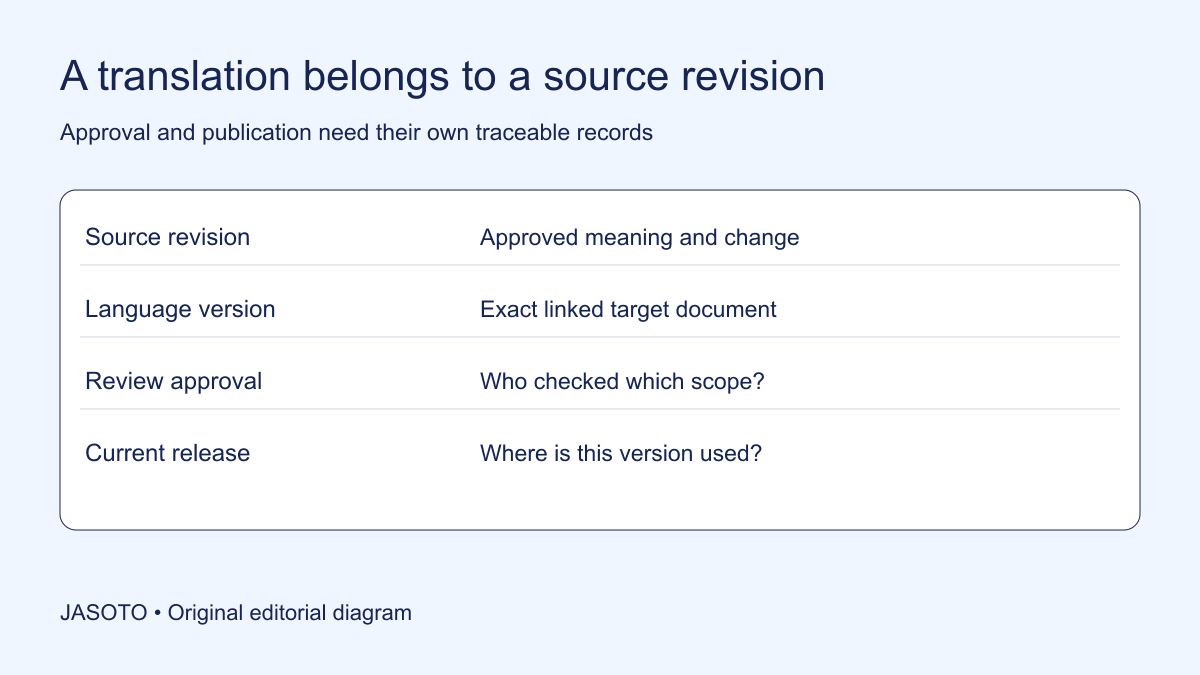
Original JASOTO editorial diagram. Its complete workflow is explained in the article; no actual customer outcome is depicted.
Organise translated documents by linking each language version to its exact source revision, recording the scope of approval and tracking where the current release is used. Keep drafts, approved content and published exports distinguishable. A folder full of files called final cannot tell a colleague whether the translation reflects the latest service decision or whether the approved document is the one customers actually receive.
Start with one document family and a controlled register suited to the business's tools. The workflow below uses fictional identifiers for a UK organization. It supports editorial coordination while retention, permissions and specialist approval follow the organization's actual requirements. The system should help people make correct decisions rather than add labels that nobody maintains.
The practical answer
- Link every translation to its exact source revision and intended use.
- Separate working drafts, approved content and published releases.
- Record reviewers and the scope of their approval.
- Track distribution so corrections reach active versions.
Define the document family and intended use
Identify the source document, related language versions and the task they serve. A service leaflet, customer instruction and visitor sheet may need different review arrangements. Keep separate families when their meanings or release processes differ. A common logo does not make every document one interchangeable set.
Record the content owner and publication locations. The owner should be able to settle source questions or obtain the appropriate decision. Without that connection, a document coordinator may keep files organized while nobody can approve a factual change. Define the scope before reorganizing folders so important relationships are preserved rather than inferred from existing filenames.
Assign stable identifiers and readable names
Give the family and each language version a stable identifier. Pair it with a readable title, language variety and revision reference. Avoid making the file name carry every approval detail; the register can hold fuller information. The identifier should remain useful when a document is exported or moved through the authorized workflow.
Agree naming rules with the people who use the documents. A technically precise code may be difficult for reception or support staff to recognize without a title. Keep the current release discoverable and make test or working copies obvious. Consistent naming helps retrieval, while explicit records establish authority and status.
Map every target to its exact source
Record the source identifier and revision used to create or review the translation. Do not link only to a live source that may change without leaving the relationship clear. Preserve an appropriate snapshot or version reference through the organization's process. A reviewer should be able to understand which approved meaning the target was checked against.
If the translation includes authorized localization differences, identify them and their owners. Otherwise a future reviewer may remove a legitimate variation or excuse an accidental mismatch. Keep the distinction between language adaptation and a changed offer visible. The mapping should explain equivalence and approved differences without requiring a colleague to reconstruct months of correspondence.
Define states that describe actual decisions
Use a small set such as draft, in review, approved for stated use, released and superseded. Define who may change each state and what evidence is required. A document can be linguistically reviewed while still awaiting a factual decision. Avoid a single approved tick that hides material conditions.
Keep release separate from approval. An approved file may not yet be published, and a published export may differ from the approved draft. Give each stage an owner. If publication is automated, ask the technical team how the actual version is identified. The record should describe what happened rather than assume the workflow follows its intended sequence perfectly.
Record reviewers and their scope
Identify who checked language, subject meaning, commercial facts, visual layout and final output as appropriate. One person may cover several tasks when competent and authorized. Keep that scope explicit. An approval saying “looks fine” does not establish which substantive questions were reviewed or whether the reviewer saw the final rendered document.
Record unresolved conditions with owners and next actions. A reply to a comment is not necessarily closure of the issue. Verify the implemented correction where material. If the source owner changes a fact during review, identify affected versions and update the approval basis. Do not let a target retain an approval that referred to a meaning it no longer contains.
Check what the storage tool actually preserves
Review version-history, permissions and recovery behavior in the actual platform and file types used. [Google Drive's official guidance](https://support.google.com/drive/answer/2409045?hl=en) distinguishes activity and version behavior across native documents and other files. Follow current tool instructions and the organization's retention arrangements rather than assuming every cloud file retains the same history indefinitely.
Ask the technical owner to verify important settings and access. A folder structure does not prove that only appropriate people can publish or that older evidence remains recoverable. Keep sensitive material controlled and avoid sharing entire project folders merely because an external reviewer needs one document. The version system should support appropriate access as well as editorial traceability.
Assess source changes before updating targets
When the source changes, record the affected sections and meanings. Ask the owner whether the change concerns facts, terms, layout or an editorial improvement with no meaning change. Use suitable language review to assess target impact. Do not decide solely from the number of words edited; a single changed condition can matter more than a rewritten introduction.
Assign each affected version an action and status. It may need revision, confirmation of no impact or a new approval. Keep pending updates visible so staff do not treat an older translation as current without understanding its limits. If an interim communication is needed, approve it through the responsible process rather than silently leaving contradictory versions in active use.
Track published and distributed copies
List website locations, active templates, printed stock and other release channels. Record the version used and the owner who can replace it. A corrected master file does not update a PDF attached to future appointment messages or a stack of printed handouts. Distribution tracking turns a theoretical correction into an actionable replacement plan.
For visitor or travel-related documents, review which upcoming arrangements rely on the earlier information. Individual communication may be needed through the normal authorized process. Avoid assuming that updating a public page informs everyone holding a previous copy. Keep those operational actions linked to the change without exposing private appointment details in the general register.
Work through a fictional source update
Imagine source document V10 changes a customer contact route. The register links three language versions and two active release channels. The coordinator identifies the affected section, obtains the approved new fact and arranges suitable language review. Each target's status shows whether the update is pending or approved.
After publication, the website and automated attachment are checked against the released version. Old printed copies are withdrawn through the assigned owner. This fictional example shows how a small source change can require several coordinated actions. It does not prescribe a particular storage product or establish that every source revision should follow the same approval hierarchy.
Test retrieval with a colleague unfamiliar with the system
Ask them to find the current approved language version for a specific task, identify its source revision and locate the owner. Then ask where that version is distributed. Record hesitation and ambiguity. A register that only its creator understands is not dependable absence cover.
Use the findings to simplify fields and navigation. Do not respond to every retrieval problem by adding more columns. Research document support providers with the actual task if needed, and explore coordination roles where continuing work requires capacity. The responsible person needs a route to factual and language decisions, not merely permission to rename files.
Keep a correction and withdrawal process
Define how a reported error is assessed, who authorizes the correction and how affected releases are located. Preserve relevant evidence and earlier versions through the organization's process. Mark superseded material clearly so it is not casually selected again. An archive should remain interpretable without looking like a second current publication folder.
Use language review support where a correction changes target meaning. Verify the final export and active links after replacement. Keep a rollback path for a mistaken update, while recognizing that restoring a file does not automatically reverse communications or other actions already taken. The release record should explain the actual current position.
Review the system against real maintenance work
Look at recent updates and ask whether the register helped identify affected targets, reviewers and distribution points. Record missed copies or ambiguous approvals as specific issues. Avoid claiming efficiency gains from the existence of a structured folder alone. Measured outcomes need appropriate evidence and comparable work.
Adjust the workflow when languages, tools or document responsibilities change. Keep the minimum information needed to answer practical questions accurately: which source, which target, who approved what, and where is it used now? That traceability makes translated documents maintainable and gives the next colleague a reliable starting point for review, correction or release.
Put the guide into practice
- Assign stable document and language identifiers.
- Map source-to-target revision relationships.
- Define draft, approval and release states.
- Test permissions and version-history behavior in the actual tool.
- Verify current publication and obsolete-copy handling.
Frequently asked questions
Is naming a file final enough to show approval?
Use an explicit state and approval record linked to the exact version. A filename can be changed by anyone with appropriate access and does not explain who checked the content or what their review covered. Keep the current release easy to find while preserving relevant history through the organization's process.
Does a source update automatically invalidate every translation?
Assess which meanings and documents are affected through the responsible process. A change may affect one section or the whole offer. Record the impact decision and reviewers, and do not assume either that every version needs a complete rewrite or that a small source edit has no consequences.
Can cloud version history replace the approval register?
It can support traceability, but check what the actual tool records and retains for each file type. Editing history does not necessarily establish the scope of a review or which export was published. Link the relevant history to an explicit approval and distribution record suited to the task.
Explore JASOTO tools
Brief providers with the actual multilingual release workflow.
Explore document coordination roles →Define ownership for approvals, updates and distribution.
Check distributed visit documents →Keep active visitor and travel information connected to current versions.
Explore language review →Consider appropriate reviewers for affected translation changes.
Continue with JASOTO
Compare your next step
Discover UK businesses, compare services and request written quotes before making a decision.