
Global Business · UK Guide 2026
Check Translated Opening Hours and Date Formats
JASOTO · Updated November 5, 2026 · 1,603 words
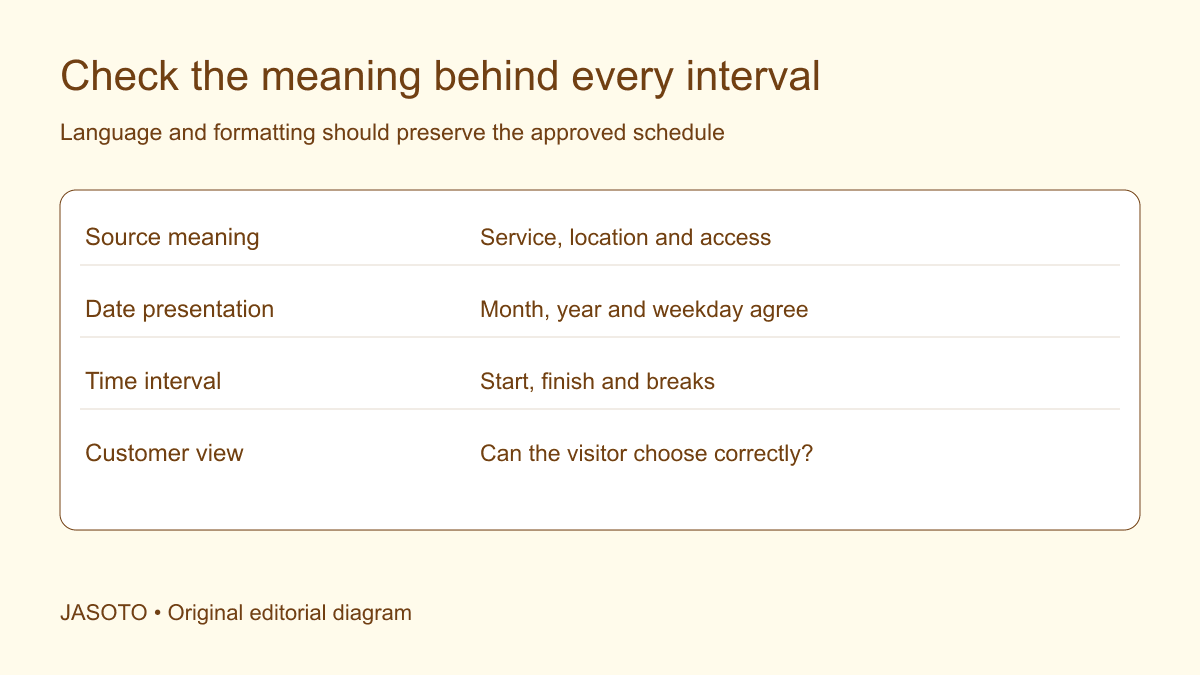
Original JASOTO editorial diagram. Its complete workflow is explained in the article; no actual customer outcome is depicted.
Check translated opening hours by comparing every language version with one approved schedule, then testing whether a reader can choose the correct date and local-time interval. Review service labels, breaks, temporary exceptions and reopening statements as well as the digits. A translation can reproduce the numbers perfectly while changing “phone support” into an apparent invitation to visit closed premises.
This guide uses a United States business serving international visitors and multilingual local customers. The examples are fictional. The proposed worksheet checks factual meaning and presentation; language choices need an appropriate reviewer, and any time conversion or platform behavior should be verified by the responsible owner rather than guessed from a familiar date convention.
The practical answer
- Verify the schedule's meaning before reviewing its language.
- Make dates and local-time context understandable to the intended audience.
- Check breaks, exceptions and periods crossing midnight explicitly.
- Test the final published version rather than only the translation file.
Establish one approved schedule to compare
Record the service, location, day or date, start, finish and access condition in a controlled source. Distinguish regular weekly hours from temporary exceptions. Confirm the information with the person responsible for the operation. If the source itself has a contradictory date or an unexplained overnight interval, settle that question before asking someone to translate it.
Give each row an identifier so the versions can be compared without relying on identical wording. A label such as H07 can identify a particular temporary closure even when its translated date appears elsewhere in the sentence. Record the source version and review date. This prevents a reviewer comparing a new translation with an older schedule that the business has already superseded.
Define what the hours describe
State whether the schedule concerns visits, telephone inquiries, deliveries, collections or appointments. Check that this distinction remains visible in each version. A short table heading may carry the only explanation, so include it in the translation and factual review. Do not assume a row of times is meaningful without the surrounding service and location label.
Discuss terms such as open, available, staffed and appointment-only with the language reviewer. They can imply different access conditions. Use the actual process as the reference. If customers need a confirmed booking, the translated text should not suggest walk-in access simply because a brief equivalent of “open” fits more neatly into the design.
Make the intended date unambiguous
Check numeric dates for plausible alternative readings. A customer bringing another date convention may interpret the same digits differently. [W3C's date-format guidance](https://www.w3.org/International/questions/qa-date-format.en) explains that presentation should consider linguistic context and offers ways to make the intended date clearer. Choose the appropriate approach for your audience and publication format rather than relying on browser settings alone.
Where suitable, use an explicitly localized month name and a full year for a dated notice that may be shared or retained. Check that the weekday agrees with the date. A correct-looking translation can preserve an error from the source, so the factual reviewer should verify the actual calendar relationship. Avoid publishing “next Monday” as the only date in material that can circulate after the week changes.
Keep language formatting separate from time conversion
Agree whether the schedule describes the premises' local time or another defined context. A translation normally needs to preserve that underlying meaning. Switching between a twelve-hour and twenty-four-hour presentation is different from converting a time zone. Record who authorizes either decision and how the final result will be checked.
If the audience may be remote, identify the relevant location or time context clearly. Do not add a time-zone abbreviation from memory to a long-running notice without review. The useful level of detail depends on the task. A local storefront schedule and a cross-border online session have different needs, so the worksheet should describe what customers are actually deciding.
Verify each opening interval and break
Compare start and finish values row by row, including any midday closure. Confirm that a dash means an opening interval rather than a range of possible appointment times. Check whether the design clearly distinguishes separate intervals on the same day. Two accurately translated times can still be misleading if a break disappears in layout.
Look for omitted labels or symbols. An asterisk may refer to an appointment condition, a seasonal note or an exception. Keep it attached to the correct row and ensure its explanation is translated. Do not shrink a material qualification into unreadable text to preserve the source layout. Adjust the design through the appropriate owner so the schedule remains usable.
Handle overnight periods explicitly
If a period crosses midnight, confirm which day it starts and which day the final time belongs to. Ask the operational owner how customers should interpret the interval. Do not assume that a translator or designer can resolve an ambiguous source such as “Friday 10–2” without knowing whether the business means afternoon or the next morning.
Write enough context to remove the ambiguity and test it with a realistic arrival question. If the business does not offer overnight service, do not add this complexity to the public schedule; simply check that the numbers cannot accidentally suggest it. The review should address actual possibilities in the business's information, rather than create a long technical explanation irrelevant to its customers.
Review temporary closures and reopening wording
Check whether the notice says closed on a particular day, closed through a date, or reopening at a stated time. These statements are not interchangeable. A translated phrase meaning “until” may leave a reader unsure whether the final day is included. Ask the language reviewer to express the actual boundary clearly using the approved source meaning.
Verify that the regular schedule and exception can be understood together. A closure notice should not appear to replace every week's hours indefinitely. Give the temporary version a removal or review owner. A correct translation becomes stale if the team forgets to restore the normal information after the exception ends, so maintenance belongs in the same plan as initial publication.
Check the final layout and channel fields
Inspect the published website, printed notice, profile fields and message templates where relevant. Some platforms localize parts of a schedule automatically while others display manually entered text. Have the responsible technical or channel owner verify the actual behavior. Do not infer the public result solely from the source spreadsheet or editing screen.
Check line breaks, font support and the association between headings and values. A translated month or service label may take more space and wrap into another row. A review of fluent prose in a document will not catch that layout error. Record the rendered version checked and distinguish submitted external edits from information already visible to customers.
Work through a fictional arrival question
Imagine a visitor asking whether they can collect an item on the final day of a temporary closure. The source notice says collections resume the following morning, while one translation uses a phrase that could imply access on the closure's last afternoon. The reviewer identifies the ambiguity and writes an explicit reopening date and time approved by the service owner.
The updated version is checked beside the ordinary weekly hours and in the appointment message. The visitor can now identify the relevant collection interval without assuming phone coverage means collection access. This fictional scenario shows why a practical task can reveal a semantic error that a digit check misses. It does not establish a preferred wording for every language.
Give reviewers a read-back task
Ask a suitable reader of each version to explain when they can visit, which service is available and what requires confirmation. Use a specific date, including an exception where one exists. Compare the answers against the approved source. Keep the task focused on meaning instead of asking only whether the translation sounds natural.
If a reviewer hesitates, identify whether the cause is language, layout or an unresolved operating rule. Explore language support for appropriate expertise and research business providers with the precise review need. Do not ask an unqualified colleague to approve a language they cannot read merely because they can verify the source numbers.
Record the meaning of abbreviations before reuse
Keep a short note of approved day labels, service abbreviations and symbols used in each version. A designer may later shorten a translated label to fit a new panel without realizing that the abbreviation is unfamiliar or ambiguous. The note gives them a checked starting point and a reviewer to contact when the layout changes.
Do the same for copied seasonal notices. Before reusing last year's artwork, compare its dates, weekdays, service conditions and version references with the current approved schedule. A familiar design can conceal stale facts. Treat reuse as a new factual check rather than assuming that previous language approval establishes the accuracy of a different year's opening arrangements.
Maintain the schedule as a linked set
Record each version, publication location, reviewer and owner. When a schedule changes, identify all affected language and channel versions before issuing the update. Consider multilingual support roles if maintaining those relationships requires dedicated capacity. Keep earlier versions and a rollback path for publishing errors.
Before visitors plan journeys, the current information should support a correct practical decision. Review questions about wrong-day arrivals and confusing exceptions using real evidence, noting the channel involved. The immediate result of the check is a schedule whose dates, intervals and access conditions preserve the same approved meaning across versions, with a clear process for keeping them aligned.
Put the guide into practice
- Approve one source schedule with service and location labels.
- Check every date, day and opening interval.
- Verify localized presentation without changing the underlying time.
- Review exceptions and reopening language.
- Test a visitor's practical arrival question in each version.
Frequently asked questions
Is a numeric date like 04/05 clear enough for international readers?
It can be interpreted differently depending on the reader's conventions and context. Choose a presentation that makes the intended date clear, such as an appropriately localized written month with a full year where needed. Check the final translation and layout rather than assuming a translator will infer the business's intended date.
Does translating the time mean converting the time zone?
These are separate decisions. A local opening schedule ordinarily describes the location's actual local time, while a remote event may need a different presentation. Tell the reviewer what the schedule represents and who approves any conversion. Do not let language formatting silently change the underlying opening period.
What if one language says ‘open’ while another says ‘by appointment’?
Resolve the operational meaning with the service owner and correct the versions together. Those phrases can create different expectations about access. Review the source labels as well as the translation, and test whether readers in each language understand when they may actually visit.
Explore JASOTO tools
Find language or website support for a defined schedule review.
Explore multilingual support roles →Assign ownership for schedule changes and translated versions.
Research visits →Confirm the relevant opening interval before planning a journey.
Explore language support →Consider appropriate review for translated customer information.
Continue with JASOTO
Compare your next step
Discover UK businesses, compare services and request written quotes before making a decision.