
Global Business · UK Guide 2026
Compare Translated Service Descriptions for Consistency
JASOTO · Updated 5 November 2026 · 1,593 words
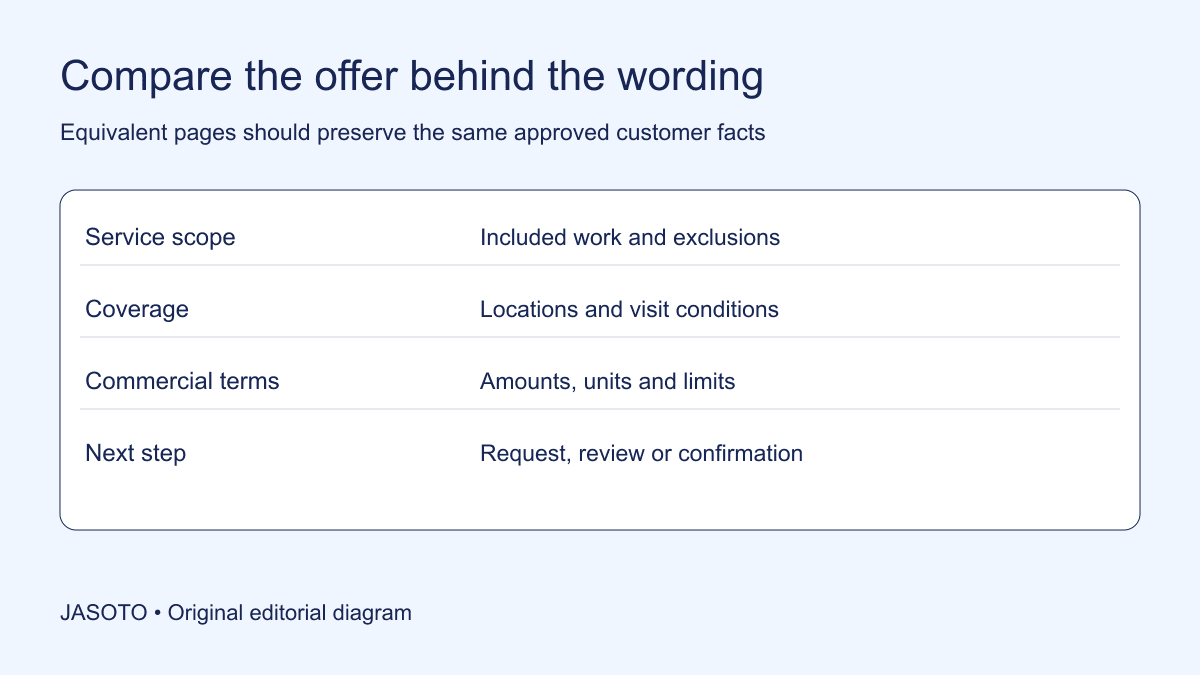
Original JASOTO editorial diagram. Its complete workflow is explained in the article; no actual customer outcome is depicted.
Compare translated service descriptions with a fact matrix that records the approved scope, coverage, commercial conditions and customer next step. Have suitable language reviewers verify how each version expresses those facts. Investigate discrepancies with the service owner before changing wording. Equivalent pages can read naturally in different ways while still giving customers the same accurate understanding of the offer.
Begin with the current approved versions and a defined service. This practical review for a UK business focuses on factual equivalence, with fictional examples. It works alongside linguistic editing and any specialist review the actual claims require. A reader recognizing the company name and several numbers cannot establish that every translated condition preserves the intended meaning.
The practical answer
- Compare approved meanings using stable facts and service identifiers.
- Check commercial and operational claims separately from fluency.
- Investigate differences before deciding whether they are intentional.
- Review the published journey and record each version's approval.
Identify which pages are meant to be equivalent
List the source and target pages, language varieties, intended audiences and version dates. Confirm whether they describe the same service arrangement. Some localized pages may intentionally have different availability or terms. Record those authorized differences explicitly. Otherwise a reviewer may either erase a legitimate distinction or overlook an accidental difference because they assume every market operates differently.
Assign each page set a service identifier and owner. Keep the approved source snapshot accessible during review. If the source changes, identify the affected facts and pause or amend the comparison accordingly. Comparing a new target page with an obsolete source creates apparently contradictory findings that cannot be resolved by proofreading more carefully.
Build the fact matrix from the actual offer
Extract the facts a customer uses to decide: what the service covers, exclusions, area, delivery method, availability process, price basis and next commitment. Give each fact a short identifier and source reference. A row might state that a visit requires separate confirmation, linking to the approved process. Keep the matrix concise enough that reviewers can use it consistently.
Do not turn every adjective into a separate test. Focus on statements whose meaning affects suitability, expectations or action. Mark unresolved business questions rather than choosing an answer for the sake of completing the worksheet. If the source says “complete support” without an agreed definition, the business owner must clarify the scope before translation review can establish equivalence.
Give reviewers context and a clear query route
Explain the intended customer task, service process and relevant terminology. Supply reference material that helps a reviewer distinguish a branded label from an ordinary description. Ask who will answer operational and commercial questions. A reviewer should be able to raise uncertainty without having to infer the business's policy from a disconnected paragraph.
[ITI's translation-buying guide](https://www.iti.org.uk/asset/6A607F17-ACF6-4B14-A5523B218420B860/) encourages considered preparation and communication with translation providers. Use the comparison brief to make the actual review need explicit. The fact matrix proposed here is an editorial control; its value comes from accurate source decisions and suitable reviewers, rather than from a claim that one worksheet certifies every translation.
Check service scope and exclusions together
Compare what is included with the limitations attached to it. A target version may retain the service name while losing the condition that defines who can use it. Ask the language reviewer to explain the meaning in context and identify any ambiguity. Keep conditions beside the relevant claim in the final page rather than treating them as optional background text.
Check combined phrases carefully. A sentence describing “supply and installation assessment” might become an apparent promise of supply and installation. The correct decision depends on the actual approved offer. Record the discrepancy in terms of the customer expectation it could create, then have the service owner and language reviewer agree the correction.
Verify area and delivery-method claims
Check locations, service-area boundaries and whether work is remote, onsite or at the business premises. A translated location name may be correct while the page implies broader coverage through another sentence. Compare the full proposition. If some areas need individual review, preserve that status rather than turning a request route into an assurance of attendance.
Inspect the linked directions and appointment information. Customers may research travel based on the service page's apparent promise. Verify that the target journey does not send them to a different location or an outdated English-only instruction with contradictory access information. A translation review should include the steps needed to act on the description, not just its opening paragraphs.
Check quantities, prices and conditions as relationships
Compare amount, currency, charging unit and scope together. A correct number attached to the wrong unit can materially change meaning. Identify whether the value is fixed, indicative or subject to assessment according to the approved source. Keep commercial decisions with the responsible owner and appropriate adviser rather than expecting the translator to choose a more attractive offer.
Review date, duration and quantity relationships. A translated label might change a review target into a delivery commitment or make a preferred date appear confirmed. Record what each version leads the customer to believe. Checking digits alone will miss these semantic differences, so combine controlled factual checks with suitable language review.
Follow the customer next step through the target version
Open the action, form, confirmation and relevant contact route. Determine whether the customer is requesting information, asking for a quote or securing a booking. The button and next message should preserve the same state as the service explanation. A careful paragraph can be undermined by a translated action label that promises immediate confirmation.
Check language continuity where practical. A target-language page may link to another language for necessary detail; if so, make the situation clear and consider appropriate support. Do not imply that full ongoing communication is available in a language merely because one landing page exists. The service process and staffing need to support whatever communication promise is published.
Classify discrepancies before editing
Use practical categories: source ambiguity, translation meaning, intentional localization, outdated version, layout association or linked-journey problem. Assign the issue to someone able to resolve it. A source ambiguity needs a business decision; a stale version needs coordinated updating; a language issue needs suitable linguistic review. Avoid sending every finding back as a vague request to “improve accuracy.”
Record the proposed correction, authority and affected versions. Keep an evidence reference and the final decision so later editors understand why wording differs. If the business authorizes a genuine localized variation, state its scope in the register. That prevents a future consistency pass from accidentally reverting an approved market-specific arrangement.
Work through a fictional appointment discrepancy
Imagine a service description saying customers may request a preferred assessment date. One target version uses wording readers understand as reserving that date. The fact matrix identifies the approved state as a request pending review. The language reviewer explains the implication, and the scheduling owner confirms the actual process.
The correction updates the target paragraph, action label and acknowledgement together. A new reviewer then answers what happens after submission using the final journey. This fictional example shows a factual consistency issue with operational consequences. It does not establish that the source wording is ideal for every service or that the correction has produced a measured increase in bookings.
Review the final layout and publication record
Inspect the rendered pages after approval. Check that conditions remain attached to the correct service, figures align with rows and headings preserve the intended structure. Text expansion can move a qualifier away from the statement it explains. Record the exact version reviewed and distinguish a translation delivered for review from a page actually published.
Ask the technical owner to verify language links and any automatically inserted data through the site's real process. An editor should not assume a correct document guarantees correct application behavior. Research translation providers with the actual scope of the final check when outside support is needed, including whether review covers the live layout or only the supplied text.
Check omissions as well as contradictions
Use the fact identifiers to confirm that each required meaning is present somewhere appropriate. A comparison focused only on conflicting sentences may miss a qualification omitted completely from one version. Record the location of the answer rather than assuming that similar page length means equivalent coverage. A longer introduction can easily conceal a missing operational condition.
Ask the language reviewer whether the meaning is explicit, reasonably clear from context or absent. Keep those judgments separate so the business can decide whether the customer needs a more direct statement. Where information is intentionally supplied elsewhere, test the link and explain the dependency. This also helps reviewers avoid unnecessary duplication: the task is to preserve the useful fact in the customer journey, not require the same paragraph in the same position on every page.
Maintain equivalence through later changes
Keep the page set, fact matrix, approvals and current owners linked. Use service identifiers to identify every language version affected by a new scope or process. Explore multilingual content roles if maintaining those relationships requires dedicated capacity. Preserve earlier wording and a rollback path for errors.
Review genuine customer questions and discrepancies as evidence for further improvement. Avoid claiming that equal word counts, matching layouts or one successful check prove permanent equivalence. The useful outcome is traceability: reviewers can identify the approved offer, understand intentional differences and verify that each current language version gives customers an accurate basis for their next decision.
Put the guide into practice
- Freeze the source and identify equivalent pages.
- Build a fact matrix from the approved offer.
- Assign linguistic and business reviewers.
- Resolve discrepancies with a documented decision.
- Check final links, forms and rendered pages.
Frequently asked questions
Do translations need identical sentence structures?
No. Natural wording and order may differ while preserving the same approved facts. Compare meaning, scope and customer action rather than counting matching sentences. If a page intentionally serves a different offer or market, document that distinction so the review does not mistake an authorized difference for an error.
Can a non-speaker check the translated page?
They can verify some controlled fields and layout relationships, but need suitable language support to assess meaning. A familiar number or service code does not prove its condition was translated correctly. Pair factual review with an appropriate linguistic review and keep the limits of each check clear.
Should a back translation settle every disagreement?
It can help investigate meaning when used appropriately, but it is another interpretation rather than an automatic proof of equivalence. Give the reviewer the actual task, source context and disputed claim. Resolve the underlying business meaning with its owner and use qualified language review for the final wording.
Explore JASOTO tools
Brief suitable reviewers with a clear factual comparison task.
Explore multilingual content roles →Define ownership for linked service-page versions.
Check service visits →Review location and appointment claims before customers plan journeys.
Explore language support →Consider qualified assistance for meaning and terminology review.
Continue with JASOTO
Compare your next step
Discover UK businesses, compare services and request written quotes before making a decision.