
Travel · UK Guide 2026
Organize Travel Receipts Without Losing Their Context
JASOTO · Updated November 5, 2026 · 1,657 words
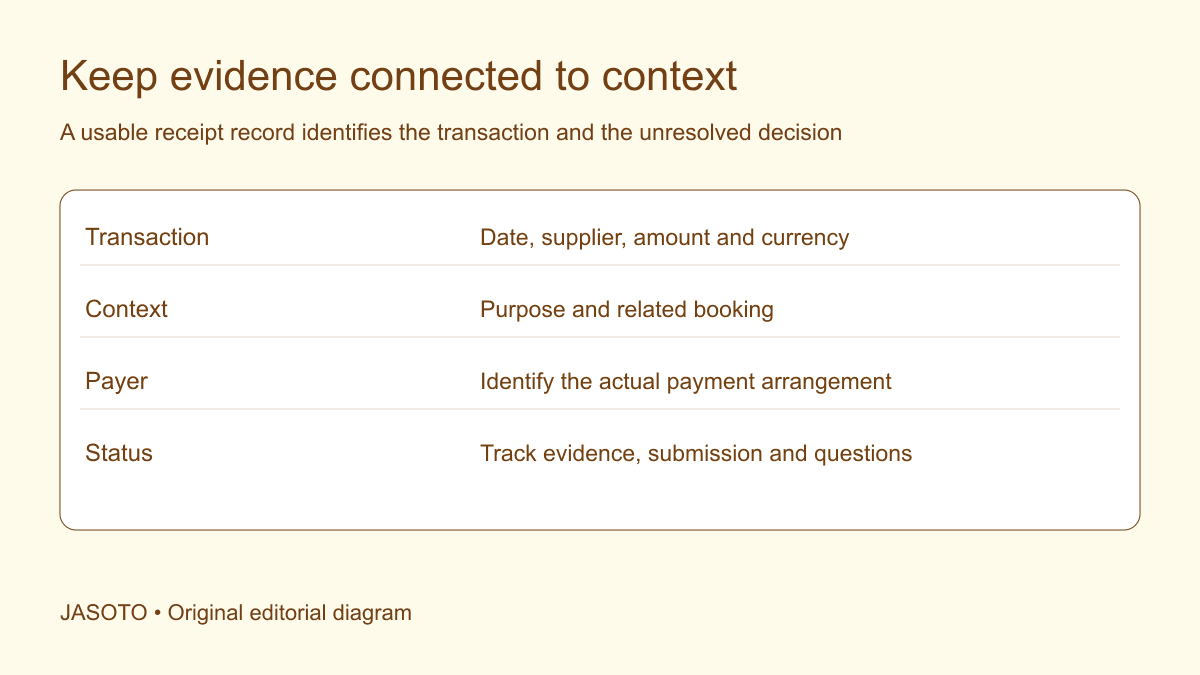
Original JASOTO editorial diagram. Its complete workflow is explained in the article; no actual customer outcome is depicted.
Organize trip receipts by connecting each document to the transaction, business purpose, payer and relevant booking while the context is still easy to remember. Keep missing documents and unresolved questions visible. A folder of images can preserve paper while losing the information needed to understand why the expense occurred or whether it has already been submitted.
This original guide is for US travelers recording business-trip documents. The IRS explains that suitable business records help track income and expenses and support reporting. Follow your organization's expense process and obtain appropriate tax or accounting advice for classification, deductibility and retention decisions. The method below organizes evidence and questions; it does not determine whether a particular cost is reimbursable or deductible.
The practical answer
- Connect each document to the actual transaction.
- Keep payment, approval and reimbursement distinct.
- Record factual context while it is clear.
- Route missing evidence and treatment questions.
Learn the submission process before departure
Ask which system, document type and information your organization expects. Confirm who reviews questions and how deadlines are communicated. A personal note tool can help collect context, but it should connect to the approved process rather than become a parallel record nobody else can use. Know what to do with paper and electronic documents before the trip produces a mixture of both.
Identify the difference between business approval, payment and reimbursement. Permission to book a journey does not establish that every later purchase is approved. A card charge establishes something different from a detailed receipt, and a submitted item is different from a paid reimbursement. Keep those states separate in your preparation. The traveler should be able to say what evidence exists and which decision is still needed without interpreting an ambiguous green status as completion of the entire expense process.
Create a short trip reference
Give the trip an internal name or approved reference that connects its documents. Use enough detail to distinguish it from another visit without placing unnecessary client information in every filename. Record the dates and main purpose through the organization's appropriate route. The reference should make later searching easier, especially when several people attend the same event or one traveler makes repeated visits to the same city.
Keep provider booking references separate where necessary. The internal trip label helps organize records, while each actual reservation retains its own identifier. Do not replace those provider codes with an invented single number that cannot be used to locate the booking. A traveler can maintain a simple index showing which record belongs to which leg. This preserves the link without circulating sensitive confirmation details to people who only need a summary of the trip's business purpose.
Capture the transaction while it is recognizable
At a suitable moment, record the date, supplier, amount, currency and what the item relates to. Include the purpose required by the actual expense process and the relevant appointment or journey reference where appropriate. Do not wait until several similar receipts are mixed together if a short contemporaneous note can resolve the ambiguity. Keep the note factual rather than guessing what the reviewer will want to hear.
For an invented work visit, two local transport purchases occur on the same day. One takes the traveler to a client appointment, while another relates to a different agreed activity. A brief context note lets the reviewer ask the right question later. The example does not determine how either item should be treated. It demonstrates why matching the document to the actual journey is more useful than renaming both images with the same vague label, such as “taxi receipt”.
Check readability before putting paper away
If the approved process allows an image, inspect it before leaving the collection task. Check that the relevant document edges, date, supplier and total are readable and that the image is associated with the correct entry. Avoid assuming the camera captured a usable record merely because a thumbnail appears in the folder. Follow the organization's instructions about originals and acceptable evidence.
Keep unrelated people, card details and private information out of the image where they are not needed. Do not alter a document in a way that changes the evidence. If a detail is unclear, preserve the uncertainty and ask for the appropriate correction or replacement through the provider's process. A neat image should not hide that the underlying document is incomplete or belongs to a different transaction. Readability and accurate association matter together.
Separate receipt, invoice and payment evidence
Label what each document actually is. A booking confirmation, itemized invoice, card notification and receipt can provide different information. Keep related documents connected without treating them as interchangeable. If the organization's process requires a particular record, find that record or flag the question. Avoid manufacturing a substitute document or editing a different file to make it look like the missing one.
Record the transaction once in the working list and attach or link the related evidence through the approved system. This reduces the chance that a confirmation and receipt become two apparently separate expenses. Use a visible duplicate check where helpful, comparing supplier, date, amount and booking context. Do not assume matching amounts always mean duplication; two legitimate purchases can cost the same. The context note helps a reviewer distinguish the records without relying on a guessed rule.
Record who paid and who will submit
Identify whether you used a personal payment method, a business account or another approved arrangement. Keep the details appropriate to the expense process, without storing full payment credentials in a general travel log. When several colleagues share a cost, agree who records the item and how the others reference it. A shared meal or transfer should not become several full-value submissions because each person saved a copy of the same receipt.
Do not decide the reimbursement treatment from memory if the arrangement is unclear. Ask the designated reviewer and preserve the actual payer fact. An item can be paid while its approval or allocation remains unresolved. Recording that state helps the organization make the right decision and prevents the traveler from silently forcing a cost into the wrong category to clear the task. Accuracy includes identifying what you know separately from what the process owner must determine.
Preserve currency and conversion context
Record the original currency and amount shown on the document. If your organization's process requires conversion information, follow that process and retain the appropriate supporting record. Do not replace the source amount with a guessed domestic figure or use an exchange rate from another day merely because it is easy to find. The reviewer needs a traceable basis for any calculation the process requires.
Keep additional charges or adjustments connected to the relevant transaction. A later card settlement or refund can differ from an initial notification, so label the status rather than rewriting the history invisibly. This guide does not prescribe a conversion or tax method. Its practical aim is that the person responsible can locate the original evidence, understand the transaction and ask a precise question without requiring the traveler to reconstruct the trip from memory weeks later.
Keep missing evidence in an open-items list
When a receipt is unavailable, note the transaction and the attempted next action. Ask the supplier through its normal route for the appropriate document if needed. Use your organization's process for missing evidence and do not invent a receipt, unsupported amount or business explanation. A visible unresolved entry is more reliable than deleting the item from the record because it does not fit the usual workflow.
Name the person who will resolve a classification or approval question. The traveler may be responsible for supplying facts, while a finance or business owner decides the treatment. Keep the request concise: transaction, existing evidence, missing detail and decision needed. A long forwarded email chain can contain useful material, but a short context note tells the reviewer where to start. This separates evidence collection from decisions outside the traveler's authority.
Reconcile at a useful daily checkpoint
Choose a brief review point when it is practical and appropriate to do so. Match new documents to the working list, flag missing items and check that electronic confirmations reached the right place. The purpose is to prevent the context from decaying, rather than spend every free minute administering receipts. A small consistent check can be more manageable than a large uncertain task after returning.
Use travel research to understand routes, while actual provider records support the purchases made. If you seek document or bookkeeping support through business providers, confirm scope and appropriate handling before sharing sensitive material. When expense coordination is a recurring responsibility, describe it accurately in relevant roles, including who collects facts and who approves treatment. Clear ownership helps the routine work without requiring every traveler to become the authority for tax or company policy.
Close the submission with a traceable status
After the trip, review the list against the approved submission process. Mark what was submitted, what remains open and what response is expected. Keep the relevant confirmation or reference so you can find the actual submission later. Do not assume an uploaded image establishes approval or payment. If an item is returned for clarification, link the response to the same transaction rather than creating an unexplained new entry.
Follow the organization's and applicable professional guidance for retention and disposal. Avoid choosing an arbitrary period from an unrelated template. If the system becomes cluttered, preserve the reliable transaction record and reconcile duplicates through the appropriate process. The rollback for a mistaken association is to restore the original evidence, correct the context visibly and ask the responsible owner about the treatment. Useful receipt organization leaves each document connected to a real transaction and a known status, making later review possible without inventing the missing story.
Put the guide into practice
- Confirm the approved expense process.
- Check image readability and association.
- Reconcile shared and duplicate records.
- Close with a traceable submission status.
Frequently asked questions
Is a photo of a receipt always sufficient?
Use the evidence format required by your organization and the relevant professional guidance. Check readability and retain originals where the process requires them. A photograph can preserve an image without establishing that the underlying document is complete or acceptable for every purpose.
Should I record the business purpose immediately?
Add the factual context at a suitable point while it is still clear, following the actual expense process. A short note linking the document to the appointment or journey can prevent confusion later. Do not invent an explanation when the treatment needs a decision from the responsible reviewer.
What if a colleague and I both saved the same receipt?
Agree who submits the transaction and how the others should reference it through the approved process. Keep the actual payer and shared context clear. A duplicate document should not automatically become another full-value expense entry.
Explore JASOTO tools
Discover providers and check support for your specific task.
Explore roles and responsibilities →Consider the practical responsibilities involved when recruiting or joining a team.
Plan work-related travel →Research a journey when joining, training or meeting colleagues in person.
Continue with JASOTO
Compare your next step
Discover UK businesses, compare services and request written quotes before making a decision.