
Business Growth · UK Guide 2026
Write an Out-of-Office Handover for a Two-Person Team
JASOTO · Updated November 5, 2026 · 1,619 words
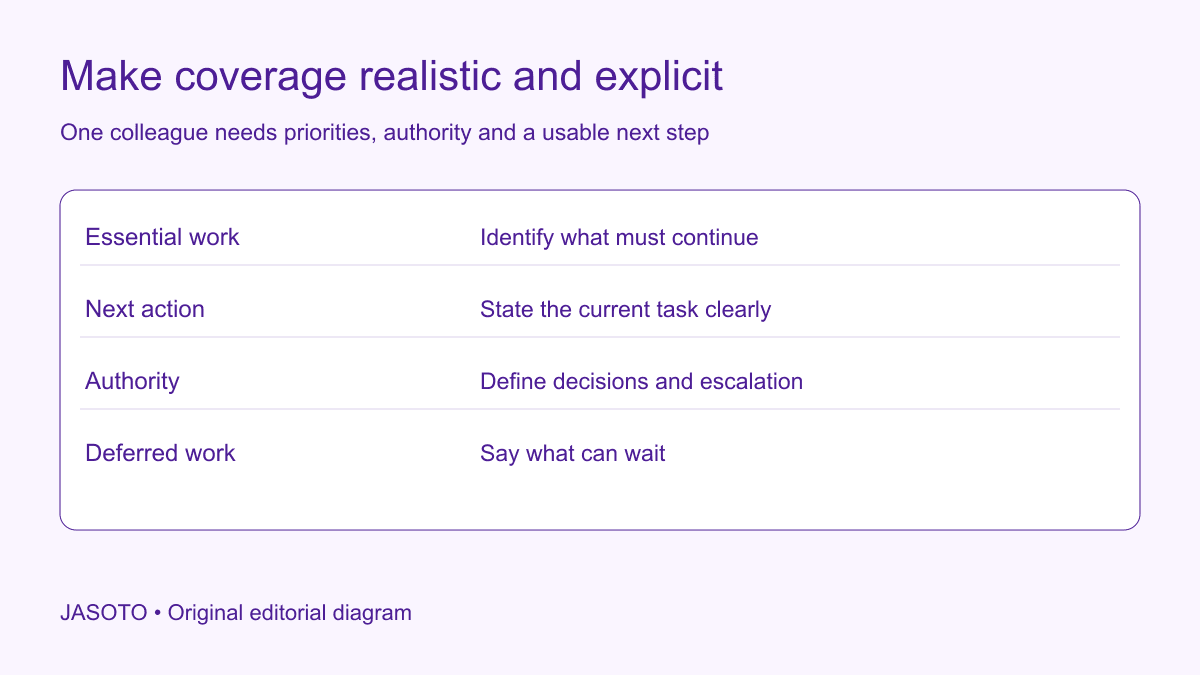
Original JASOTO editorial diagram. Its complete workflow is explained in the article; no actual customer outcome is depicted.
Write a two-person team's out-of-office handover by listing the work that must continue, the next action for each live item and the decisions the covering colleague may make. Agree what will wait and check the access needed before the absence begins. Customer messages should reflect the actual coverage available rather than implying the business still has two people's normal capacity.
This guide is an original administrative method for small businesses in the United States planning an ordinary absence. The example uses an invented design studio with live client enquiries and supplier appointments. It does not create continuous monitoring, emergency cover or authority the business has not arranged. Make every contact and availability statement accurate to the actual plan.
The practical answer
- Identify what must continue and what can wait.
- Give each live item a current status and next action.
- Confirm the covering colleague's authority and appropriate access.
- Make customer expectations match the actual coverage available.
Start with the calendar and real commitments
Review the absence period against customer deadlines, supplier appointments and recurring tasks. Identify what is genuinely time-sensitive and what can be completed beforehand or deferred appropriately. Do not copy the absent person's entire task list into the handover without considering priority. The covering colleague needs a plan they can use alongside their own responsibilities.
Keep confirmed commitments separate from hopes and provisional dates. A client asking for a quick reply is not the same as a delivery deadline already agreed. Record the relevant source and consequences where appropriate. This helps the team decide what needs attention without making the covering colleague discover the history through an urgent message after the absence has started.
Agree what will continue and what will wait
Discuss actual workload with the person providing cover. Identify essential work, work that can pause and work needing another arrangement. Use the business's appropriate process to revise commitments where necessary. Do not silently transfer an impossible set of tasks and describe the colleague's acknowledgment of the document as agreement that everything can be completed.
Make deferred work visible. A clear note that a non-urgent catalogue review resumes after the return is more useful than leaving it in the same list as a supplier confirmation due tomorrow. Explain relevant dependencies. If another person or provider must supply an answer, name who follows it up and what the cover can do while waiting.
Give each live item a concise current state
For each essential item, record the reference, current position, next action, relevant contact and useful date or trigger. Link the authoritative case record rather than retelling the full history. The next action should be concrete enough for the cover to perform appropriately. A note saying deal with client question leaves too much interpretation when the colleague lacks the original context.
Preserve uncertainty. If a supplier response remains unconfirmed, say so rather than entering the expected answer to make the handover look complete. Distinguish what the absent person knows from what they assume. A reliable handover can contain open questions; its value is showing who needs to resolve them and which commitments depend on the result.
Define authority before a decision becomes urgent
List the decisions the cover may make under the actual business arrangements. They may be able to acknowledge enquiries or confirm an existing appointment without approving a revised scope or price. Keep the relevant limits understandable and provide a route for questions. Do not assume a colleague's job title communicates every authority boundary to customers or suppliers.
Agree what happens when the required decision maker is unavailable. Some work may pause, another authorised person may be contacted or a pre-agreed option may apply. Use the actual contract and business processes where needed. A handover should not imply that urgency alone expands the covering colleague's authority or that silence from the absent person approves a change.
Arrange appropriate access and test it
Identify the systems and records the cover needs and use authorised delegation or administrative access. For example, [Microsoft's shared-mailbox guidance](https://learn.microsoft.com/en-us/microsoft-365/admin/email/about-shared-mailboxes?view=o365-worldwide) describes access through appropriate permissions in its own product context. Your business may use another service. Ask the responsible administrator to arrange a suitable method rather than sharing a personal password in the handover document.
Test the actual tasks, such as opening a relevant record or using the approved reply route. Access that appears available to the owner may not work for the cover. Check this before the absence while questions can still be resolved. Keep sensitive information controlled and avoid expanding access beyond the actual role simply because it is convenient to grant everything temporarily.
Make the customer contact message accurate
An out-of-office message should state the practical contact route and relevant expectations. Explain whether the mailbox is monitored, by whom in an appropriate form and for what purpose. Do not promise an immediate reply if the covering colleague cannot provide it. If only defined work is covered, make that clear through suitable customer wording rather than exposing internal workload details unnecessarily.
Use a concise original structure: I am unavailable until the stated return point. For the defined covered matter, contact the agreed business route with your order or project reference. Other enquiries will be reviewed under the actual response arrangement. Adapt every element to the real plan and appropriate communication requirements. A template should never invent monitoring hours or a backup person who has not agreed to the role.
Keep supplier and appointment contacts informed
Tell relevant providers who handles the existing booking during the absence and which reference to use. Confirm any change through the appropriate process. A supplier may otherwise continue calling the absent person because their number remains on the appointment. Keep the contact update separate from approval of extra work or a changed commercial scope.
Check the covering colleague's calendar before leaving them as the receiving contact. They may be away from the premises when a delivery or visit is expected. Agree an appropriate alternative rather than assuming one person can be at the desk, serve customers and attend another meeting simultaneously. The handover should expose those conflicts early enough for a real arrangement to be made.
Provide a usable exception route
Describe the ordinary exceptions the cover is likely to encounter and the next authorised step. Examples include a missing approval, changed appointment or unavailable source document. Keep the relevant urgent and emergency processes accurate and separate. Do not ask the colleague to treat every unexpected email as an emergency or to wait for a routine review when another proper process applies.
Use factual escalation notes. Identify the issue, current evidence, decision needed and effect of waiting. This helps the next responsible person act without an entire inbox forward. Avoid circulating unrelated customer information or sensitive records in a broad group message. The handover should help the cover know what to share appropriately and whom to contact.
Worked example: a two-person design studio
Imagine a studio where one colleague will be absent while an existing supplier visit and several client enquiries remain active. The team agrees that the cover will receive the supplier and acknowledge defined enquiries, while a non-urgent internal project waits. The handover links current client records, identifies the actual approval limits and confirms the appropriate shared communication access before departure.
The supplier receives the current business contact, and customer messages reflect the agreed coverage. This invented example claims no uninterrupted service or increased productivity. It shows how a small team can make an absence plan understandable without pretending that one colleague has unlimited time, every decision right or continuous availability.
Test the handover through one realistic case
Ask the covering colleague to explain the next action for a representative live item and an exception. Let them use the document and authorised records rather than relying on the absent person's verbal help. Check whether they can find the current state, contact and authority boundary. A problem may require a clearer note, corrected access or a changed commitment rather than another page of background.
Record the agreed changes and keep the current handover identifiable. Avoid several parallel copies with different dates or instructions. If a live item changes just before departure, update the authoritative record and notify the cover through the agreed route. A handover prepared early needs a final relevant check, because the business may have progressed since the first draft.
Plan the return and close temporary arrangements
Begin the return review with commitments made during cover. Check the current client or supplier record before sending a reply based on the pre-absence plan. This prevents the returning colleague from unintentionally contradicting a valid arrangement the cover made within their authority.
Give the cover a simple way to record actions, unresolved questions and changed commitments during the absence. On return, review that record before resuming customer conversations. Do not assume everything remained as described in the original handover. Preserve the actual history and identify who owns each remaining action so responsibility does not fall into a gap between the two colleagues.
Review temporary access and automatic messages through the appropriate administrative process. Confirm which arrangements should end and which should remain for ordinary work. Ask what the cover found unclear or unrealistic and improve the next handover based on those observations. Keep the earlier template so a confusing change can be reversed rather than becoming the permanent routine.
Use JASOTO businesses to discover defined temporary support and verify availability directly. If recurring cover gaps need staffing, explore administrative support roles within a realistic workload review. For necessary appointments elsewhere, research travel after checking the actual commitments. A useful absence handover gives one colleague a workable plan, clear authority and an honest account of what will wait.
Put the guide into practice
- Review commitments and deadlines during the absence.
- Agree priorities and decision limits with the covering colleague.
- Test authorised access and customer contact routes.
- Prepare the return handover and remove temporary arrangements appropriately.
Frequently asked questions
Should the covering colleague do all of the absent person's work?
Plan around actual capacity and priorities. Agree which tasks continue, which can wait and which need another arrangement. Do not imply normal full capacity if one person is covering two roles, and update relevant commitments through the appropriate process.
Should passwords be included in the handover?
Use the business's authorised access and delegation process. Do not place passwords in a general handover document or assume another person's private login is an appropriate substitute. Ask the responsible administrator to arrange and test suitable access before the absence.
What if an unexpected decision exceeds the cover's authority?
Define the escalation route and what can pause before the absence starts. Keep any emergency process separate and accurate. Do not make the colleague guess whether a customer's urgency grants permission to approve a change they are not authorised to make.
Explore JASOTO tools
Discuss defined cover tasks and actual availability with suitable providers.
Explore administrative support roles →Consider staffing where recurring cover gaps exceed the team's capacity.
Research a confirmed work journey →Plan necessary travel after checking the covering colleague's actual commitments.
Continue with JASOTO
Compare your next step
Discover UK businesses, compare services and request written quotes before making a decision.