
Websites & Visibility · UK Guide 2026
Compare Two Service-Page Drafts with Customer Tasks
JASOTO · Updated 5 November 2026 · 1,540 words
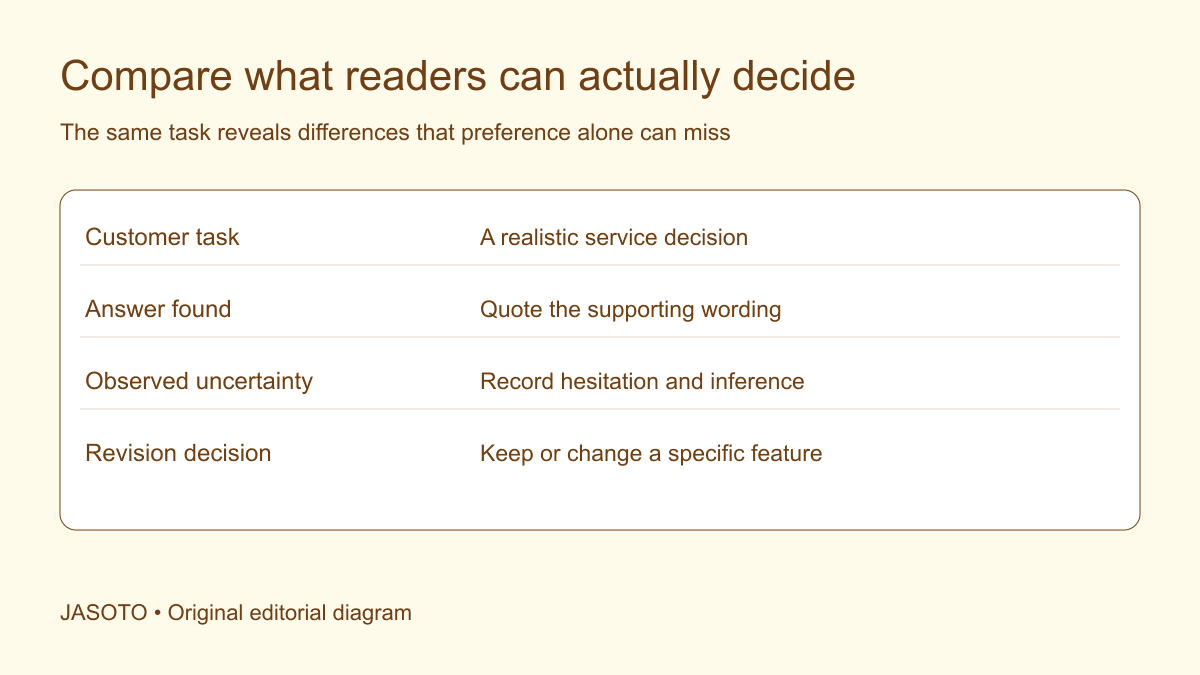
Original JASOTO editorial diagram. Its complete workflow is explained in the article; no actual customer outcome is depicted.
Compare two service-page drafts by giving suitable readers the same realistic tasks and recording what they understand, where they find the answer and what they would do next. Keep the service facts and relevant conditions comparable. Use neutral prompts and preserve exact draft versions. The useful result is evidence about particular customer decisions, rather than a vote for the page the team finds more attractive.
Start with the audience and task the page must support. The workflow below uses a fictional UK service business and a practical moderated review. It does not claim that a small content exercise predicts conversion or proves one version best for every visitor. Use appropriate research expertise when the decision requires a more rigorous design.
The practical answer
- Choose customer decisions before judging either draft.
- Keep approved service facts and test conditions comparable.
- Record what readers find, infer and do with neutral prompts.
- Use findings to revise specific problems without inventing a universal winner.
Define the decision before opening the drafts
Write what a reader should be able to determine: whether the service fits, what is included, where it is available or how to request the next step. Choose tasks from relevant evidence where possible. Avoid defining success only as clicking the main button, because a well-informed unsuitable customer may correctly decide not to inquire.
Record the audience and relevant circumstances without inventing an elaborate persona. A buyer arranging a routine appointment has different questions from an organization commissioning a continuing service. The comparison should focus on a plausible real task, with uncertainty about the audience stated rather than hidden behind a generic claim to represent everyone.
Preserve the drafts and approved facts
Give each version an identifier and retain the exact content and layout used in the exercise. Record meaningful differences and known placeholders. If an edit occurs during the review period, identify which participants saw which version. Otherwise findings can be assigned to wording they never encountered.
Confirm the underlying service facts with the owner. A draft that promises broader availability may appear easier to understand because it omits real conditions. That is not automatically the preferred version. Keep factual accuracy as a requirement and investigate differences in the offer before interpreting them as differences in writing quality.
Design tasks without revealing the answer
Describe a situation and ask the reader to decide what they would do. Avoid repeating the page's exact heading when the purpose is to test whether the information is findable. A task such as checking whether a particular request can be considered gives more useful evidence than telling the reader to open the section containing the desired answer.
Use consistent task meaning across drafts. Keep prompts neutral and avoid praising one version beforehand. [GOV.UK's usability-testing guidance](https://www.gov.uk/service-manual/user-research/using-moderated-usability-testing) describes observing people attempting specific tasks. Apply suitable research practice to the actual comparison and record its limitations, especially where participants or conditions are selected for a small internal review.
Plan who should take part
Use actual or likely readers through an appropriate recruitment and information-handling process. Staff can identify issues but may fill gaps with business knowledge. Record that limitation if they are the available reviewers. Ask participants to rely on the presented material and show where each answer comes from.
Consider relevant access and communication needs with suitable support. Do not assume one confident reader represents the whole audience. The review need not claim universal coverage to be useful, but its scope should be honest. Record which tasks and readers were included so the decision-maker can judge what the findings actually address.
Consider order and learning effects
Decide whether participants see one draft, both or a planned subset, using appropriate advice for the question. Reading the first version can teach the service facts and make the second seem easier. A side-by-side display can also encourage comparison of style rather than natural task use. Record the design and why it was chosen.
If both versions are shown, plan order and note what people may have learned. Do not present the resulting preference as an unbiased estimate of future behavior. The exercise can still reveal useful differences in clarity or findability when interpreted within its actual setup. Keep the observation separate from a stronger claim the design cannot support.
Keep the presentation conditions useful
Use a format close enough to the intended experience for the task, such as a realistic preview on the relevant device. Label non-working elements appropriately and avoid sending test submissions into live customer workflows without authorization. A plain document may suit a wording review while being insufficient to assess navigation or responsive layout.
Record important conditions, including assistance, screen size and whether the reader can follow links. Do not compare a polished working version with an incomplete text-only version and attribute every difference to prose. Where fidelity differs, state it and focus conclusions on the questions that remain meaningfully comparable.
Observe actions before explaining the page
Ask readers to describe what they are thinking where appropriate, then allow them to attempt the task. Record what they look for, where they hesitate and which wording supports their answer. Avoid rescuing them immediately with the intended interpretation. A moderator's helpful explanation can conceal the very gap the comparison should reveal.
If assistance is needed, record what was given and its effect. Keep successful unaided decisions separate from answers reached after prompting. The purpose is to learn about the material, not test the person's intelligence. Treat confusion as evidence to investigate and keep the conversation respectful.
Record answers and confidence separately
Use a worksheet with task, draft, observed answer, supporting reference, action and uncertainty. Distinguish what the reader said from the team's explanation of why. A confident wrong answer can be more consequential than a hesitant correct one, while a reader may appropriately recognize that individual review is needed.
Do not turn subjective confidence into proof of correctness. Check answers against the approved service process. If the actual correct answer is unresolved internally, pause that judgment and assign the business decision. The comparison should not reward whichever draft makes an unsettled offer sound most definite.
Include the next step in the task
Ask what happens after the reader contacts the business and what information they need to provide. Inspect relevant links, forms and confirmations in an appropriate environment. A page can answer scope clearly while its action label implies a booking the process does not provide. Record that journey issue with its owner.
For visit-related services, test whether the reader knows when a location or appointment is confirmed before planning travel. Keep actual coverage and arrival requirements accurate. Do not interpret a willingness to click as evidence that the person understands the commitment they are making or receiving.
Work through a fictional scope comparison
Imagine draft A lists a broad service name while draft B explains that a related specialist task requires separate assessment. Readers of A assume the specialist work is automatically included. Readers of B can identify the review step, though some struggle to find the contact route. The findings point to specific scope and navigation issues rather than one simple aesthetic preference.
The team retains B's accurate boundary and revises the route to request assessment. This fictional example illustrates a decision based on observed tasks. It supplies no conversion forecast or claim that one sentence universally improves sales. The next review checks the changed contact task using the final version.
Synthesize by task and consequence
Compare findings for each decision, noting repeated patterns, exceptions and sample limits. Prioritize inaccurate interpretations or blocked actions over cosmetic preferences unless design directly affects the task. A small exercise can reveal a definite contradiction while remaining insufficient to rank every feature statistically.
Keep participant observations traceable through appropriate controlled references. Avoid averaging unlike tasks into a single score without a defensible reason. The decision-maker should understand what each version helped or hindered and which uncertainty remains. That makes a focused revision possible without overstating the exercise's precision.
Build and verify the final revision
Choose changes grounded in the findings and preserve the approved offer. Record the owner, expected user benefit and version. Research website support using the actual task evidence if outside help is needed. Avoid expanding the work into an unrelated redesign simply because the review generated several opinions.
Retest consequential changed tasks and inspect the final journey. Do not assume combining preferred pieces from both drafts automatically produces a clear page. The new arrangement can create fresh relationships or contradictions. Verify enough to resolve the identified concern, then broaden checks only where new evidence or failures justify it.
Preserve the learning and later outcome limits
Keep the task plan, versions, findings and decision in a concise record. Consider content research roles if recurring work needs suitable capacity. Follow appropriate access and retention arrangements for participant material. Preserve earlier wording and a rollback path for misleading or broken changes.
After publication, review relevant customer questions and task outcomes with traffic and operational context visible. Keep that evidence separate from the moderated exercise. The practical result is a service page selected and revised through understandable customer-task evidence, with the limits of the comparison stated and a clear basis for future improvement.
Put the guide into practice
- Define the audience, tasks and approved service facts.
- Preserve exact draft versions and meaningful differences.
- Plan appropriate participants and presentation order.
- Separate observation from interpretation in the record.
- Choose revisions and verify the final journey.
Frequently asked questions
Is asking which draft looks better enough?
Preference can be useful context, but it does not establish that a reader understands scope or the next step. Give realistic tasks and ask for the answer and supporting text. Compare observed understanding, uncertainty and action alongside any visual feedback.
Should every participant read both drafts?
Choose a design suited to the question with appropriate research support. Seeing one version can teach someone information they then carry into the second. If both are shown, plan order and acknowledge that effect. Do not treat an informal side-by-side exercise as a controlled live conversion experiment.
What if each draft works better for a different task?
Record the specific strengths and problems, then decide what the final page needs to support. A combined revision may be more useful than naming one overall winner. Preserve approved facts and retest the changed journey where consequential uncertainty remains.
Explore JASOTO tools
Continue with JASOTO
Compare your next step
Discover UK businesses, compare services and request written quotes before making a decision.