
Business Growth · UK Guide 2026
Separate Urgent Requests From Routine Work
JASOTO · Updated 5 November 2026 · 1,615 words
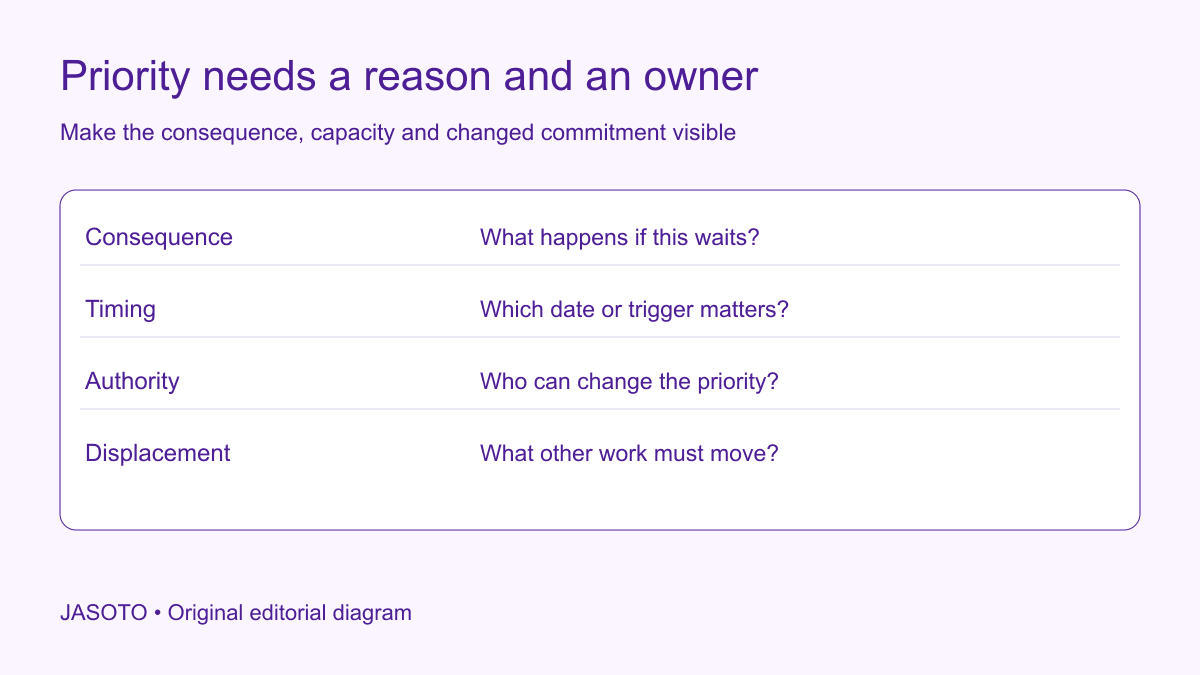
Original JASOTO editorial diagram. Its complete workflow is explained in the article; no actual customer outcome is depicted.
Separate urgent requests from routine work by asking what happens if the request waits, checking the actual timing and having the authorised person decide how it affects existing commitments. Keep the next action and owner visible. A customer or colleague using the word urgent is a prompt to clarify the need, not a complete scheduling decision or a reason to ignore every other task.
This guide is an original administrative method for small UK teams handling ordinary business requests. It does not provide medical, emergency or specialist safety triage. Use the appropriate established process for those situations. The example concerns an invented service agency balancing a time-sensitive customer correction with planned routine work, using actual authority and realistic capacity.
The practical answer
- Ask what happens if the request waits.
- Use agreed authority to change priorities and commitments.
- Keep urgent and emergency processes distinct and accurate.
- Review displaced routine work rather than letting it disappear.
Define the ordinary request route
State where routine requests should arrive and who reviews them. A shared inbox, form or suitable system can work if the team actually uses it and understands ownership. Avoid promising instant attention when the route is checked only at particular times. Give internal staff and customers accurate expectations through the business's appropriate communication process.
Keep alternate channels connected appropriately. A phone call may raise a request that later needs a record, while a message to an individual may be missed during absence. Identify how relevant work reaches the authoritative queue. Do not assume that every employee monitors every channel continuously or that forwarding a message establishes someone has accepted the action.
Ask about the consequence of waiting
Record what the requester needs to achieve and what is affected if the work happens later. A fixed customer event, blocked dependent task or correction to published information can have different consequences. Ask a focused question rather than demanding an elaborate justification for every small request. The useful information is the practical reason timing matters.
Keep consequences evidence-based. Do not invent financial loss or a safety claim to make an item rise in the queue. If the requester reports a potentially serious specialist issue, use the appropriate responsible process rather than having an administrator assess it alone. The ordinary priority record should identify the relevant route and known facts without pretending to provide expertise it does not have.
Separate a required date from a preference
Ask which date or trigger matters and whether it is confirmed. A person may prefer an answer today, while another has an actual commitment before tomorrow's agreed event. Both deserve a clear response, but they create different scheduling questions. Preserve the source and meaning of the timing rather than treating every requested date as a promise already accepted by the business.
Use unambiguous dates in the actual record and check time zones where relevant. Avoid vague labels such as as soon as possible when the team needs a concrete next review point. If the date is uncertain, show that and assign clarification. A precise-looking deadline entered without evidence is no more useful than an undefined urgent flag.
Define categories staff can apply
Choose a small number of categories suited to the actual work and explain the decision behind each. A category should help determine the next action, reviewer or schedule. Avoid elaborate scoring that staff cannot maintain during ordinary service. Equally, do not let every item become top priority simply because no one wants to make a trade-off.
Use representative examples from the business's real tasks, appropriately anonymised or fictional. Explain the boundaries and escalation route for uncertain cases. The categories should support consistent judgment while allowing appropriate review when conditions change. They should not become a rigid substitute for the authority and expertise needed to handle a consequential request.
Put priority authority in the right place
Identify who may change the order of work or revise a customer commitment. The person receiving a request may be able to gather facts without making that decision. Keep the role clear so staff do not promise a fast completion merely to be helpful. A new request may require the approver to consider other commitments, specialist availability or an actual change process.
Record the decision and any conditions. An acknowledgement from a manager does not necessarily authorise interrupting another task. If the decision is to investigate before scheduling, preserve that stage. The requester should receive a supported next step rather than a stronger delivery promise than the team has agreed or can realistically provide.
Check capacity and interruptions honestly
Ask what the team is already committed to and what work the urgent request would displace. [HSE's workload guidance](https://www.hse.gov.uk/humanfactors/topics/workload.htm) discusses clear roles and priorities within its human-factors context. The original operational method here uses a limited question: who can do this work, with the necessary competence and time, under the actual arrangements?
Do not assume an empty diary slot means available capacity. Staff may be completing work not shown as meetings, and switching tasks can require a practical handover. Ask the responsible people rather than planning from appearances. A short priority list should acknowledge real constraints and identify when another arrangement is needed, without claiming that better labels create additional working time.
Keep displaced work visible
If the authorised decision moves a routine task, record its new position and owner. Do not let it disappear from the tracker because the urgent work occupies attention. Review any affected customer or supplier commitment through the appropriate process. A priority change can be reasonable while still requiring a clear update to people relying on the original plan.
Distinguish internal rescheduling from a confirmed external change. Moving a calendar entry does not prove the customer agreed or the provider can attend later. Identify who communicates and obtains the relevant confirmation. Keep the original and current record traceable so a substitute colleague can understand why the sequence changed and what remains unresolved.
Give the requester a useful response
Explain the next step and actual commitment in plain language. A response can acknowledge the reported consequence, state that the appropriate person is reviewing it and give the agreed update point. Do not claim that work has started if the team is only assessing the request. Avoid vague reassurance that leaves the customer unable to plan.
Keep the tone respectful for routine work too. Explaining that a request has a normal review route should not imply that it is unimportant. State what happens next and how a material change in circumstances can be reported. The customer needs a dependable pathway, while the team needs enough relevant information to reassess a priority without restarting the whole conversation.
Keep urgent and emergency routes accurate
Make sure the ordinary business queue is not described as an emergency channel unless an actual appropriate service exists. Use the business's established safety, security or other specialist process for the relevant situation. This guide does not prescribe those processes. The administrative role is to know the correct route and avoid leaving a consequential issue in an unmonitored routine inbox.
Do not create fictional cover by naming a colleague who has not agreed to monitor it. State actual hours and responsibilities in the appropriate internal record. If the team cannot provide a requested service, use the suitable customer response and advice route rather than implying continuous availability. Accuracy about capability supports planning better than an unsupported promise of always being there.
Worked example: a time-sensitive service correction
Imagine an agency receiving a request to correct information before a customer's confirmed event, while another colleague asks for a routine internal document update. The intake owner records the actual consequence and timing, then asks the authorised manager to review capacity and commitments. The correction receives an agreed next action, and any displaced work remains visible with its appropriate follow-up.
The team does not label every request urgent or promise completion before checking the responsible person's availability. This invented example claims no productivity or stress outcome. It shows how a clear consequence, authority decision and displacement record can support a practical priority choice without treating the requester's label as the entire process.
Review recurring urgency as process evidence
Check routine work that was repeatedly displaced. A team can respond to immediate requests while accumulating a less visible backlog of promises. Review the actual owners and next dates rather than assuming those tasks are unimportant because they lack an urgent label. The appropriate manager can then make the trade-off explicit and communicate changes through the normal process, instead of leaving individual employees to carry contradictory expectations without a decision.
Look for repeated causes: late inputs, unclear approval, missing ownership or work regularly added beyond capacity. Keep cases comparable and avoid assigning a cause without evidence. A recurring urgent label may indicate a service-design or staffing issue rather than an individual failing to manage time. Ask the responsible team to review the actual pattern.
Make a focused improvement and preserve the previous process. A clearer input deadline or ownership field may help one identified gap, while another needs additional capacity. Do not claim a measured benefit without appropriate comparison. Keep the review useful to ordinary work, with a defined owner and a realistic point for checking whether the change helped.
Use JASOTO businesses to discover defined support services and verify actual availability directly. If recurring demand requires staffing, explore operations support roles within a realistic workload review. For a confirmed priority visit, research travel after the arrangements are agreed. A useful priority process makes the consequence and next decision clear while preserving an honest account of capacity and existing commitments.
Put the guide into practice
- Define the routine request route and review owner.
- Capture consequence, timing and relevant evidence.
- Agree priority changes with the authorised person.
- Update affected commitments and review recurring demand.
Frequently asked questions
Does a customer marking urgent set the priority?
Treat it as information to clarify through the business's process. Ask what timing and consequence the customer means, then use the appropriate authority to decide the response. Do not dismiss the request or assume the label alone overrides existing commitments.
Can a team use a simple priority list?
Yes, if the categories have understandable meanings and someone owns the decisions. Keep the actual next action, capacity and authority visible. A list with every item marked highest priority does not explain which work can proceed or what must change.
Should emergencies use the same queue?
Use the relevant established emergency or urgent safety process for those situations. An ordinary administrative request queue should not be presented as an emergency service or as continuously monitored unless the business actually provides that arrangement.
Explore JASOTO tools
Discuss actual response tasks and availability with suitable providers.
Explore operations support roles →Consider staffing where recurring demand exceeds the team's realistic capacity.
Research a confirmed priority visit →Plan travel after the appointment and service arrangements are agreed.
Continue with JASOTO
Compare your next step
Discover UK businesses, compare services and request written quotes before making a decision.