
Global Business · United States Business Guide 2026
US Small Makers: Test Packaging Before Promising Delivery
JASOTO · Updated October 29, 2026 · 3,013 words
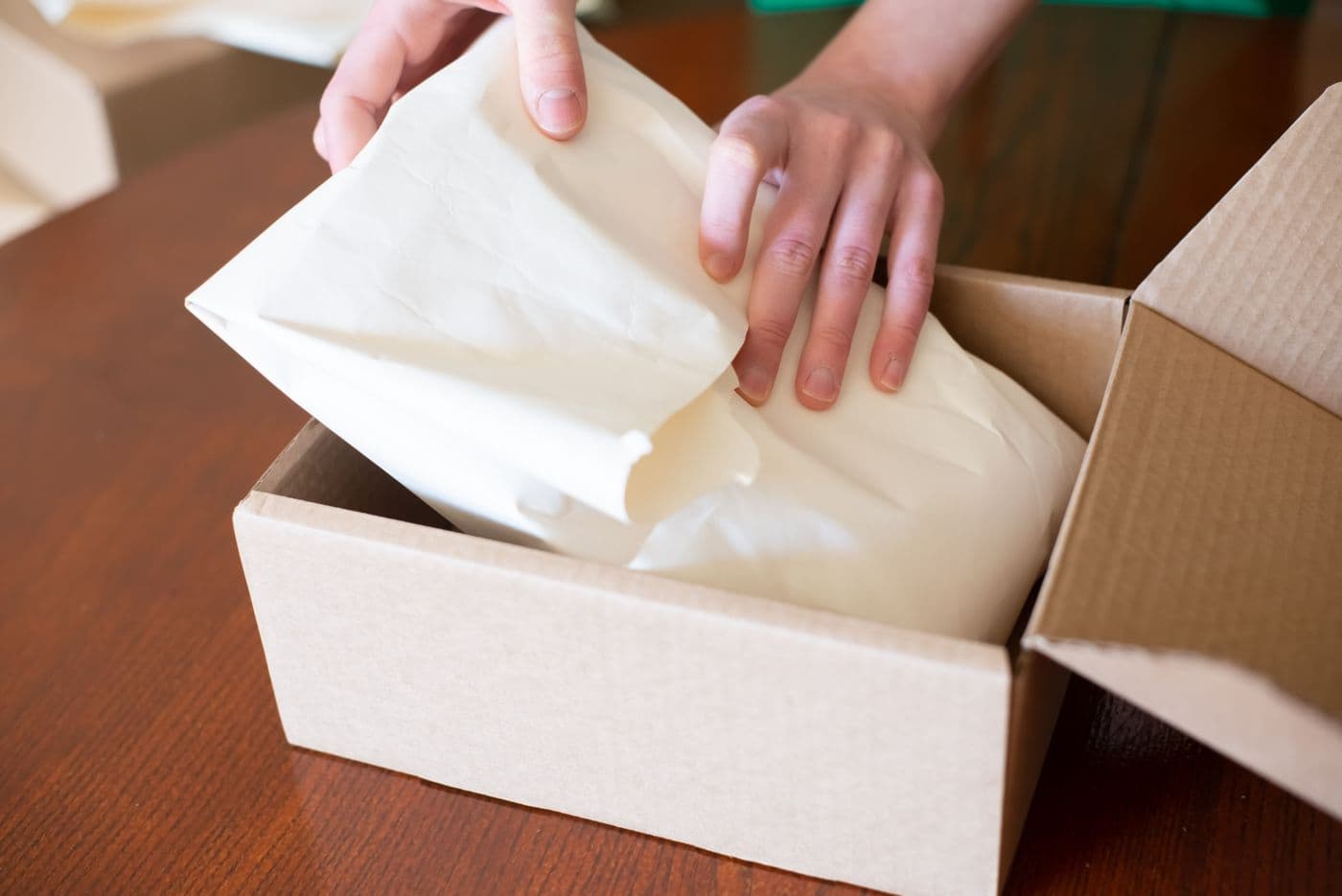
Illustrative stock photograph: person packing an order into a cardboard box. It does not document the hypothetical business examples or establish that the image was taken in the United States.
A product can look ready to sell while its parcel is still an unresolved prototype. The maker knows how to lift it, which edges are delicate and how the parts fit together; a parcel network and a customer opening the box do not share that knowledge. For a small US producer, a packaging trial makes those assumptions visible before a wider shipping offer depends on them. The objective is to establish a repeatable packing method and useful evidence about its limits, then connect that method to accurate dispatch and delivery information.
This guide outlines an operational trial for ordinary nonhazardous maker products, such as ceramics, paper goods and decorative objects. It does not replace category-specific carrier requirements, formal package testing or specialist advice where those are needed. All business examples are hypothetical. The process begins with one defined product and ordering configuration, follows it through packing and a permitted test shipment, and finishes with a documented decision about what can be offered. A successful single parcel is a useful observation, not proof that every destination, order size and season will produce the same result.
What the trial should establish
- Which product and order configuration the packing method supports.
- A repeatable parcel specification with measured dimensions and weight.
- Whether the receiver can unpack, identify and inspect the contents.
- What the business can accurately say about dispatch and delivery.
1. Define the parcel you are actually testing
Begin with a specific product configuration rather than a general category. A single mug, a pair of mugs and a mug packed beside a heavy accessory may need different protection. Record the exact contents, finish, dimensions and included components. Identify whether the product is a production item or a prototype, because a change in material or shape can affect the packing result. A maker testing one arrangement should not later describe the evidence as a test of every product in the range. Make the trial record precise enough that another staff member could assemble the same contents.
Choose a configuration that represents a meaningful first shipping offer. The most attractive display combination may be harder to pack consistently than a simpler order. If the business is new to shipping, it can start with a narrower supported selection and add configurations after review. A hypothetical North Carolina ceramics maker might test a single bowl before offering a mixed dinnerware box. That sequencing is a business choice, not a guarantee of safety. Record excluded combinations so staff and website copy do not quietly expand the offer beyond what the trial examined.
2. Identify the ways the product could be damaged
Inspect the product and list the damage modes relevant to its shape and materials. Think about contact between components, movement inside the box, abrasion, crushing, moisture exposure and the pressure created by the packing itself. A projecting handle needs a different review from a flat paper print. Do not assume that an extra layer of soft material solves every problem; some arrangements can transmit force, rub a finish or allow a heavy object to shift. The risk list helps the maker choose what to observe and explain to a packaging supplier.
Include damage that does not make the product visibly broken. A scuffed presentation box, bent instruction card or detached component may still prevent the customer using or gifting the item as intended. Decide what acceptable condition means for this specific offer and document it before the trial. Otherwise the team may redefine success after seeing the result. For specialist or regulated categories, establish the applicable requirements with authoritative sources and appropriate expertise. This ordinary-product workflow should not be extended by analogy to batteries, liquids, perishables or other categories whose transport conditions need separate assessment.
3. Read the actual carrier's preparation requirements
Choose the service being considered and review its current requirements for the contents, container, labeling and preparation. USPS's domestic package guide describes selecting strong packaging, allowing protection around contents, preventing movement and measuring the prepared package. Its packaging pointers distinguish approaches for different types of contents. These sources support the initial review, but the maker must check the requirements that apply to the actual product and chosen service. A video or blog about another business's shipment is not a substitute for the carrier's instructions.
Save the source link and review date in the trial record, then record any question that needs confirmation before sending. Separate an operational preference from a carrier rule. For example, the maker may prefer a particular unboxing appearance, but that preference does not establish whether the container is acceptable for the selected service. If using more than one carrier, maintain a separate service check rather than assuming the same preparation is accepted everywhere. Avoid copying old numerical limits into evergreen marketing text unless there is a clear process to keep them current. Link customers to the information relevant to their actual order instead.
Source: USPS: preparing and sending domestic packages. Check the source for current guidance and terms.
4. Compare packaging candidates on practical criteria
Select a small number of packaging candidates that address the damage modes identified. Record the outer container, inserts, cushioning and closure materials in each version. Give versions simple names that will survive a busy packing day, such as trial A and trial B with dated specifications. Compare more than the purchase cost of the box. Consider assembly time, storage space, repeatable positioning, available supply and the ease with which another person can follow the method. A clever arrangement built by its designer once may be unsuitable if everyday packing requires guesswork.
Ask suppliers questions using the actual product configuration and proposed service. Provide accurate dimensions and relevant photographs without assuming the supplier has assessed every risk from a brief email. Record the basis of any recommendation and clarify whether formal testing is included or would require a separate service. Keep sample packaging distinct from approved production supplies until the review is complete. If a component is difficult to source consistently, identify an alternative and plan whether that substitution needs another trial. The packaging method should be a defined combination of materials, not an instruction to use whatever protective fill happens to be available.
5. Make the packing instructions reproducible
Write the packing sequence as another person performs it. Explain the orientation of the product, separation of components, placement of inserts and closure steps. Use photographs where they remove ambiguity, but keep essential instructions readable as text. Avoid vague directions such as add plenty of cushioning; describe the specific method chosen for the configuration. USPS's packaging pointers emphasize preventing movement and separating fragile items from container surfaces. Translate that general principle into the actual materials and layout the business will use, and review the result rather than treating a written instruction as evidence that the package performs adequately.
Run a second packing attempt with a staff member or suitable helper who did not design the arrangement. Ask them to follow the draft without coaching and observe where the sequence is unclear. Check whether they can tell that the contents are positioned correctly before closing the box. A hypothetical Arizona print maker may find that a protective board can be inserted in two orientations, one leaving a corner exposed. Revising the insert or instruction can be more useful than repeatedly reminding the packer to be careful. The trial should improve the method as well as the document.
Source: USPS: packaging pointers by contents. Check the source for current guidance and terms.
6. Measure the finished parcel and record time
Measure and weigh the parcel after it is packed and closed in the intended form. Product dimensions and an empty box specification are not the same as the finished parcel's dimensions and weight. Use appropriate equipment and a consistent recording method. Check the carrier's current approach to measurements and charges for the service under consideration. The purpose is to establish reliable inputs for an actual quote or label purchase, rather than publish a generic shipping cost that may not fit the customer's configuration and destination.
Time the ordinary packing work separately from design and troubleshooting. Include gathering materials, inspection, assembly, paperwork and moving the parcel to the dispatch area. A business can then assess how shipping fits into the production day. If the maker sells at weekend markets, dispatch capacity on the following Monday may differ from a quiet studio day. Record that operational pattern before promising a routine dispatch interval. Keep trial cost observations internal until the business has reviewed the full arrangement. A low box price alone does not show that the shipping offer is economical or manageable.
7. Choose trial destinations that answer a question
A test destination should be selected for a stated reason. Sending a parcel to a nearby colleague may help assess packing and unpacking, while a farther destination may reveal other handling and receiving conditions. Neither represents the entire US network. Record the origin, destination type, selected service and why the route is being tried. Use a receiver who has agreed to participate and can provide meaningful feedback. Do not ship an unannounced trial to a prospect or use a real customer's purchase as an experiment without the appropriate arrangement.
Consider the geography of the proposed offer. A maker planning regional shipments has a different evidence need from one intending to offer every US destination. Delivery to a staffed store, an apartment building or a home with limited receiving access can also raise different questions. The trial need not cover every situation at once, but the supported offer should remain bounded by what the business has assessed. For destinations outside ordinary arrangements, state that the request needs review. Avoid extending a mainland trial into an unsupported promise about Alaska, Hawaii, territories or international shipping.
Schedule the trial so someone is available to record dispatch and the receiver is available to inspect it promptly. A parcel left unopened for several days may still offer useful observations, but it answers a different question from immediate receiving inspection. Note any unusual conditions without turning them into a claim about the entire route. If a holiday period or seasonal temperature pattern is relevant to the proposed offer, decide whether further review is needed. Keep those decisions proportional to the actual product and service rather than adding tests simply because another maker uses them.
8. Agree a receiving and inspection process
Before dispatch, give the participating receiver a short inspection brief. Ask them to photograph the unopened outer parcel, describe visible damage, record how the contents were positioned and inspect the product after unpacking. Keep the questions neutral so the receiver does not feel expected to report success. Ask whether the opening sequence was understandable and whether any component was easy to overlook. A product can survive transport yet still create a poor handover if the receiver discards an accessory hidden in protective material or cannot identify the intended assembly order.
Have the receiver separate observations from interpretations. A crushed corner is an observation; the claim that the carrier dropped the package is an inference unless there is evidence. Use the same discipline when reviewing the product. Record what changed, where the packaging contacted the object and whether the damage matches a risk identified before sending. The feedback should be attached to the exact packing version. If the receiver repacks and returns the item, treat that as a different journey with its own arrangement, because their materials and sequence may differ from the maker's original method.
9. Decide what the result proves and what it does not
Review the trial against the acceptance criteria set earlier. Did the product arrive in the intended condition, were all components present, and could the receiver unpack it without avoidable confusion? Identify failures and near misses separately. A shifted item that arrived undamaged may still show that the method needs attention. Compare versions using the same configuration where practical, and avoid declaring one superior based on unrelated routes or different contents. If the product is fragile or the commercial exposure is significant, decide whether specialist testing is needed before a wider offer.
Document the next decision explicitly: accept the version for the defined configuration, revise and retest, or pause the shipping offer. Record the limits of that decision. One successful test does not establish a statistically reliable damage rate, and it does not support a claim of guaranteed safe delivery. A maker can still use the evidence to make a more informed operational choice. The value lies in replacing undocumented assumptions with a record that can be reviewed when materials, product dimensions, order quantities or the selected service change.
When a trial fails, change one meaningful aspect at a time where practical. Replacing the box, insert, wrapping and product configuration together may produce a better parcel, but it makes the reason harder to identify. Photograph the revised arrangement and explain which observed problem it is intended to address. If the failure indicates that the current product cannot be shipped through the proposed method reliably enough for the business, pause that offer and investigate alternatives. The trial is useful when it prevents an unsupported promise as well as when it supports a workable method.
10. Translate the packing decision into customer information
Update the public product and shipping information only after the internal offer is clear. Explain the supported delivery area, the order review process and how dispatch timing is established. Distinguish the time required to make the product from the time after it is handed to the carrier. If a delivery estimate comes from a particular service, keep its nature clear and check the current source. Do not turn an estimate into a guarantee through more enthusiastic marketing language. A customer should be able to identify what the maker controls and which details are confirmed for the order.
Connect this information to the actual contact and order journey. A public business profile should describe the maker's operation consistently with the website. A site brief for JASOTO website services can include the supported configurations, readable shipping information and a route for unusual destination questions, subject to confirming the service available to the business. Avoid presenting a generic website feature as a parcel management system. Staff still need to assess the order, select the correct packing specification and confirm the delivery arrangement.
11. Build a dispatch record that supports follow-up
For each shipment, connect the order, product configuration, packing version and dispatch details. This makes a later question easier to investigate without guessing which materials were used. Record the handover to the carrier separately from preparation of a label. If a parcel remains in the studio after a label is created, customer communication should reflect the actual stage. Keep the receiving address and contact information in the appropriate protected system, and limit access to what each role needs. A packing bench should not become a public display of customer details.
Prepare a response process for a damaged, delayed or incomplete delivery. Ask for the information needed to understand the issue and explain the next action the business can take. Review the applicable carrier process and the business's actual obligations for the transaction rather than inventing a universal remedy from this guide. If AI assistance is used to improve a response template, work with a fictional case and verify the wording. Generated sympathy cannot establish what happened to a parcel or decide the appropriate resolution. A person should review the evidence and communicate the actual decision.
12. Maintain the method as the range changes
Packaging is part of the product operation, so give its specification an owner. Review it when the product changes shape, the maker introduces a new bundle, supplies are substituted or the shipping service changes. Store one approved instruction where packers can find it, and archive previous versions. Mark a temporary substitution clearly so it does not become an undocumented standard. A small workshop may need only a well-managed folder and a simple packing record, but it still benefits from knowing which method is approved for which configuration.
Use actual delivery feedback to improve the method over time. Group problems by product, configuration, packing version and observed damage rather than treating every incident as identical. A rising number of complaints might reflect higher order volume, a changed insert or a new destination mix; look at the underlying records before drawing a conclusion. Share useful findings with production and customer service so they can update their own checks. The result should be a repeatable, reviewable shipping offer whose public promises match the operation. That gives a small maker a firmer basis for expanding than a successful parcel photograph alone.
Train the person who handles customer questions to recognize the same configuration names used at the packing bench. If a customer asks to combine products, staff should be able to identify whether that combination is supported or needs assessment. This keeps a helpful sales conversation from creating a new parcel design without review.
Packaging trial checklist
- Define the exact product and order configuration.
- Review current requirements for the actual contents and carrier service.
- Document materials, sequence, finished measurements and packing time.
- Agree receiver observations and attach them to the packing version.
- Limit the approved offer and retest when relevant conditions change.
Frequently asked questions
Does one successful shipment prove the packaging works everywhere?
No. It is one observation for a defined configuration and route. Record the limits, review feedback and use specialist testing when appropriate.
Should we measure the empty box or the finished parcel?
Record the finished packed and closed parcel using the selected service's current measurement requirements.
Can every product use the same box and instructions?
Only if the method has been assessed for those configurations. Different shapes, weights and mixed orders may create different risks.
What should the receiver record?
Outer condition, contents position, component completeness, product condition and any unpacking confusion, with observations linked to the packing version.
Explore JASOTO tools
Match shipping information to a tested operation
Review the product configuration, packing method and customer journey before expanding the public delivery offer.
Browse business profiles