
Customer Communication · UK Guide 2026
Measure Response Time Without Rewarding Empty Replies
JASOTO · Updated 5 November 2026 · 1,558 words
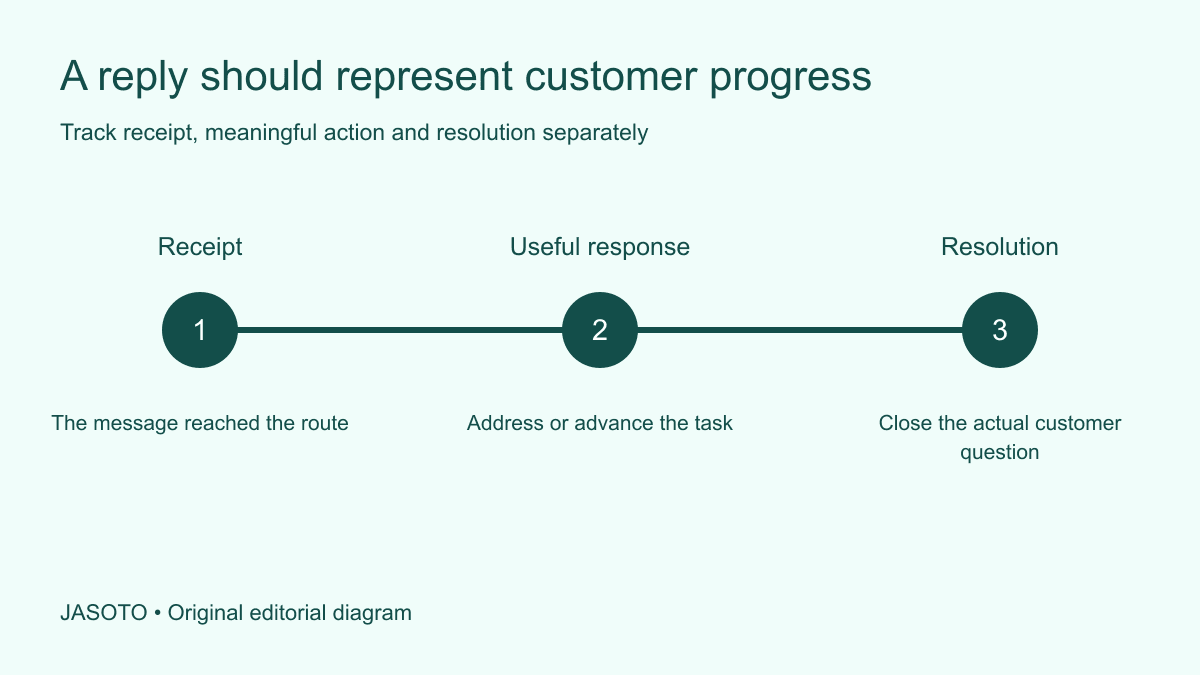
Original JASOTO editorial diagram. Its complete workflow is explained in the article; no actual customer outcome is depicted.
Measure response time by defining when a genuine inquiry starts and what counts as a reply that addresses or advances the customer's task. Record acknowledgments and final resolution separately. Apply consistent rules for working periods, waiting states and unresolved cases. A quick message saying “we are looking into it” should not automatically conceal several days with no useful answer or accountable next action.
Start with the service purpose and actual customer commitment. This guide uses fictional UK support cases and proposes a local measurement method. It gives no universal response benchmark. The appropriate timing depends on the business, request and relevant obligations, while the evidence should accurately represent what customers experienced and what staff could influence.
The practical answer
- Define the customer progress the measure should represent.
- Keep receipt, useful response and resolution as separate events.
- Apply time and waiting-state rules consistently.
- Review overdue and unresolved cases alongside completed ones.
Decide what the measure should help improve
Ask whether the business needs to understand receipt, useful progress, resolution or several related stages. A single response-time label can conceal different goals. A scheduling question may need confirmation, while a technical case may need a clearly owned investigation. Define the customer task before selecting a convenient timestamp from the mailbox.
Record the intended benefit and decision. [GOV.UK's performance-metric guidance](https://www.gov.uk/service-manual/measuring-success/how-to-set-performance-metrics-for-your-service) emphasizes measures with clear meaning linked to service purpose. Use that principle in the local workflow without importing government reporting rules as a universal business requirement. The definition should help the team find a real delay rather than reward a fast but empty event.
Define the genuine starting event
Choose when the relevant customer request is considered received through the supported route. Distinguish an initial inquiry from a reply on an existing case or a duplicate message. Record the evidence source and any known delivery uncertainty. A form submission, mailbox arrival and case creation can occur at different points.
Check what the system actually records through appropriate technical review. Do not assume the displayed time represents the customer's first attempt or the moment staff could access the message. If visibility is limited, state that in the measure. Consistency and honest boundaries matter more than an appearance of perfect precision.
Describe a useful response with examples
Define what addresses the question or enables a necessary next step. It might answer an availability query, request a genuinely missing detail or explain an owned investigation with a relevant update point. Use the actual process and customer need. Avoid counting every human message automatically while excluding a useful automated action without considering its role.
Add boundary examples. Repeating information already supplied, forwarding without ownership or sending a generic holding sentence may not meet the intended definition. Keep the rule practical enough for reviewers to apply. The objective is not to penalize courteous acknowledgments, but to prevent them standing in for evidence of progress they do not provide.
Keep acknowledgement and resolution distinct
Record receipt confirmation where it is useful and accurate. It can reassure customers about the route and explain what happens next. Label it as that event. Do not rename it substantive response simply because it is the fastest timestamp or because the tool's default dashboard uses that term.
Track final resolution separately when the service needs that view. A case can receive useful early progress while taking longer to settle for legitimate reasons. Conversely, an immediate acknowledgement can coexist with no meaningful action. Keeping the stages distinct gives managers a clearer picture and reduces pressure to close or reply prematurely just to improve one number.
Define time rules before inspecting results
Choose whether the report uses elapsed calendar time, supported working time or both. Record closures, coverage periods and relevant time context. A customer experiences the total wait, while staffing analysis may need the periods when the team operates. Neither view should be silently presented as the other.
Apply rules consistently across cases and comparison periods. Do not change the clock definition after seeing an unfavorable result. If the business changes coverage, note the effective point and interpret the evidence accordingly. A measure using working periods can be useful when its limits are clear and it does not erase the customer's actual elapsed experience.
Make waiting states transparent
Identify waiting for customer, supplier, specialist or internal approval through the actual workflow. Record who owns the next action and when the case is reviewed. A waiting label should explain a dependency, not become a way to remove an inconvenient case from the report indefinitely.
Decide which intervals each measure includes and why. The customer's total time and the team's active processing time can answer different questions. Keep dependencies visible in both the record and interpretation. If supplier delay dominates, a faster acknowledgement may do little to improve the real outcome; the business needs evidence about the bottleneck itself.
Preserve unresolved and overdue cases
Report open cases appropriately rather than calculating only from those already completed. Excluding the longest unresolved waits can make the service appear faster than customers experience. Record the observation cutoff and current state. Use a suitable analysis method or expertise when censored and incomplete timing data affects the decision.
Do not force an unknown outcome into a completed category. Assign review to material gaps and distinguish missing evidence from confirmed inaction. A dashboard should help staff find work needing attention, not merely summarize the easiest cases to measure. The unresolved view is often where operational improvement begins.
Audit replies against the definition
Have appropriate reviewers inspect selected responses through controlled access. Ask whether the message addressed or advanced the task and what evidence supports the decision. Compare interpretations and refine the definition where needed. A timestamp alone cannot establish usefulness, and a checklist should not reward formulaic wording that adds no actual next step.
Keep customer details in their appropriate system and use controlled references in the review. Record disagreements without pressuring staff to classify more replies as useful. Calibration should improve consistency and reveal process gaps. It should not become a mechanism for making the reported performance meet a desired target.
Distinguish necessary questions from repeated friction
A request for information can be useful when the business genuinely needs it to proceed. Check whether the detail was already supplied, whether the question is understandable and whether the customer can reasonably answer it. Repeated unnecessary questions can create fast replies while prolonging the overall case.
Use findings to improve forms, templates or staff access to case information. Do not discourage legitimate clarification to reduce message counts. The relevant question is whether the exchange moves the task forward accurately. Keep specialist judgments with the responsible people, especially where a premature answer could mislead a customer about a consequential matter.
Work through a fictional supplier-dependent case
Imagine a customer asks whether a replacement item can arrive before an office move. The business sends an immediate receipt message, assigns the case and seeks supplier confirmation. A useful update explains the unconfirmed status and agreed next review without promising an unsupported date. Resolution occurs only when the customer's actual question is settled through the process.
The log records these stages separately and shows the supplier dependency. This fictional example provides no ideal response time or claimed improvement. It illustrates why receipt, meaningful progress and resolution should not be compressed into the same event simply because the mailbox can measure one of them easily.
Connect timing to ownership and coverage
Check whether a named role owns each open next action and whether backup coverage works during absence or business travel. A slow case may reveal unclear handover rather than an individual writing slowly. Inspect the route and commitments before assigning blame. Make the operational action as specific as the evidence allows.
Research support-process providers with the actual bottleneck and measurement definitions when external help is useful. If workload needs capacity, define the responsibilities before exploring support roles. A staffing or software decision should address the observed dependency, not simply add another automated reply that improves the first timestamp.
Compare distributions and case context carefully
Avoid reducing every case to one attractive average. Examine relevant variation, unresolved work and case types with appropriate analytical support. A changing mix of complex requests can affect the summary. Keep the period, definitions and exclusions visible so another reviewer can understand the result.
Do not present small uncontrolled differences as proof of a general improvement. Describe verified operational fixes separately from broader performance conclusions. The business can establish that ownership was clarified or a broken route corrected while acknowledging that later timing outcomes remain uncertain or affected by other changes.
Use the findings without creating a new gaming incentive
Review whether the measure encourages useful behavior. Watch for empty updates, premature closure or unnecessary requests that satisfy the metric while frustrating customers. Discuss those patterns with the team and revise the definition or process through the responsible owner. A measurement system should support judgment rather than replace it with a superficial target.
Keep the rules, evidence and revisions in a concise record with appropriate access and retention. Preserve earlier definitions so comparisons remain interpretable. The practical result is a response-time view that represents customer progress honestly and directs attention to unresolved questions, meaningful next actions and the dependencies the business can improve.
Put the guide into practice
- Approve start and meaningful-response definitions.
- Record calendar and working-time rules.
- Keep acknowledgement and resolution states distinct.
- Audit samples of replies against the definition.
- Use findings to fix dependencies and ownership.
Frequently asked questions
Should automated acknowledgments be excluded completely?
Record them for what they actually show, such as receipt and accurate next-step information. Keep that event separate from a useful response that addresses the customer's task. An acknowledgement can help without being sufficient evidence that substantive progress occurred.
Does asking the customer a question count as a useful response?
It can when the information is genuinely needed and the request clearly advances the case. Repeatedly asking for details already supplied may not qualify under a sensible definition. Review examples and context rather than applying a rule that rewards any question mark or any human-written message.
Should the clock stop while we wait for a supplier?
Define the measure's purpose and record waiting states transparently. Internal processing time and the customer's total elapsed wait answer different questions. Keep both interpretable where useful, and do not erase an unresolved customer experience merely because the next action depends on another party.
Explore JASOTO tools
Continue with JASOTO
Compare your next step
Discover UK businesses, compare services and request written quotes before making a decision.