
Business Growth · UK Guide 2026
Brief a Venue for a Small Product Demonstration
JASOTO · Updated 5 November 2026 · 1,617 words
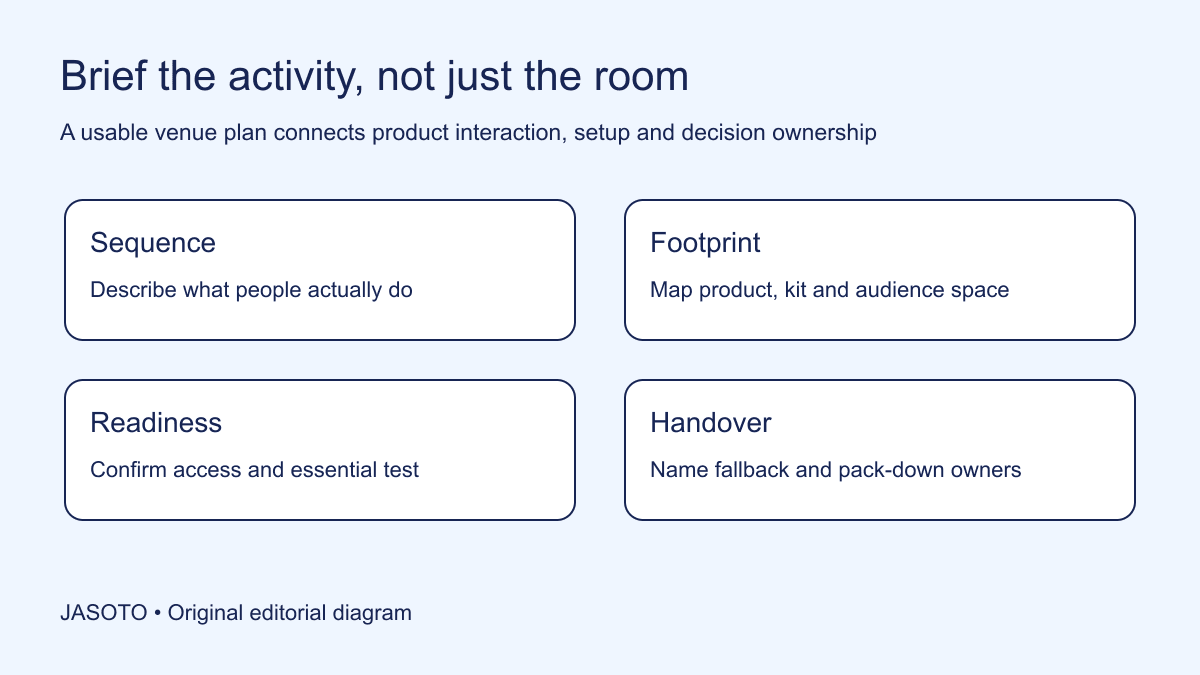
Original JASOTO editorial diagram. Its complete workflow is explained in the article; no actual customer outcome is depicted.
Brief a demonstration venue by explaining what the product will actually do, what the audience will do and which equipment, space and support the activity needs. Confirm setup access, testing, the live sequence and pack-down before treating a room booking as readiness. A venue can have enough seats while lacking the appropriate arrangement for the demonstration you intend to give.
This original guide is for UK small businesses preparing a modest product event. HSE's event-planning guidance says planning detail should reflect the event's scale and risk. Use competent advice and the venue's actual arrangements for technical or safety decisions. The brief below helps the organizer and venue identify practical requirements and owners; it is not a technical approval or a substitute for the appropriate assessment of the activity.
The practical answer
- Describe the actual demonstration sequence.
- Separate audience estimate from approved layout.
- Confirm supplied equipment and setup access.
- Assign technical, commercial and venue decisions.
Describe the demonstration as a sequence
Write what happens from the first audience introduction to the end of the product interaction. Include whether people only watch, approach a table, handle an item or take part in an approved activity. A label such as “small launch” does not tell the venue how space will be used. The sequence gives its staff a practical basis for asking the right questions.
Keep claims about the product separate from the activity plan. The venue needs to know what will happen physically and operationally, not just the marketing message. For an invented stationery organizer demonstration, the presenter shows the product on a table and invites a few participants to examine permitted samples afterwards. That creates different layout and movement needs from an audience remaining seated throughout. Use the actual product and interaction, with specialist requirements assessed by the appropriate responsible people.
State the audience and attendance assumptions
Record the expected number, how people are invited or registered and whether attendance is confirmed or still estimated. Ask the venue to confirm the suitable room arrangement through its approved process. Do not infer a safe capacity from the number of chairs visible in a photograph or from a different event held there. The actual activity, equipment and movement need to be considered.
Identify who might arrive late, whether guests need a welcome desk and how questions will be handled. Keep individual access requirements through an appropriate private route, sharing only the practical information needed to arrange the event. The brief should distinguish the audience estimate from the approved layout and the current registration count. Those facts are related but not interchangeable, and a higher response than expected may require a decision before more invitations are issued.
Map the product and equipment footprint
List the actual tables, displays, devices, cases and supporting items that occupy space. Include packaging or spare material that needs storage during the demonstration. A product fitting on a small table does not establish that the presenter, audience, cables and sample handoff also fit around it. Give the venue enough information to review the practical arrangement.
Use reliable dimensions or a clear approved plan where relevant. Do not guess specifications to complete the brief. Mark missing information and name who will supply it. If a proposed layout changes, ask the appropriate venue and technical contacts to review the effect. The organizer should not move an obstruction into a walkway or alter a venue control simply to make the display look better. The brief's purpose is to expose the requirement while there is time to arrange it properly.
Confirm what the venue supplies
Separate confirmed venue items from equipment the organizer brings. Identify the relevant connection or capability for each dependency, such as a display, sound system or approved network service. A room advertised with presentation equipment may still require checking the actual device and file route. Ask the venue's responsible contact instead of assuming every screen has the same input or that staff will configure unfamiliar equipment at the last moment.
Record each response as confirmed, requested or unresolved. If an external provider supplies part of the setup, connect it to the same brief and identify the handoff. The venue should know who brings the item, who sets it up and who can authorize a change. This prevents a simple room booking from becoming several disconnected arrangements where everyone expects another person to provide the cable, table or technical support essential to the demonstration.
Review technical and safety questions with the right owners
Describe features that affect how the demonstration should be assessed, using the manufacturer's and responsible specialist's information where appropriate. Ask the venue what it requires to review the activity and who handles the relevant decision. Do not assume small audience size removes technical or safety questions. Planning should remain proportionate to the actual activity and its risks.
Keep operational coordination distinct from competent approval. The organizer can collect information and arrange a review without deciding specialist matters beyond their role. If the venue cannot accept an activity as proposed, discuss an appropriate change through the responsible people. Avoid bypassing a restriction or presenting the product under a vague description that omits the feature causing the question. A factual brief supports a useful decision and protects the event from depending on an assumption nobody has explicitly accepted.
Reserve setup access and a representative test
Confirm when the room is available, who opens it and which staff can help. Include the actual setup process in the event schedule. A building being open does not establish that the booked room is free, and an equipment delivery time does not establish that the presenter can begin preparing. Connect the access window to the practical tasks that must happen before guests arrive.
Define a representative test in advance. Check what the audience will see or hear and the approved product interaction that must work. Use suitable sample material and the relevant technical instructions. Record a failure precisely and route it to the responsible support contact. The test should establish the essential event task, rather than only that a laptop powers on. If the intended demonstration cannot be performed appropriately, use the agreed decision route before the audience is waiting.
Plan the audience movement and sample handoff
Describe where guests enter, wait, sit and approach the display where that is part of the event. Ask the venue to review the arrangement through its appropriate process. Keep entrances, exits and other required routes under the venue's actual rules. The organizer should not improvise barriers or signs in places that interfere with those arrangements.
For the stationery example, the presenter first demonstrates from the front table, then opens a separate permitted sample area after the talk. The host explains when people can approach and who answers questions. This makes the activity understandable and avoids an unplanned crowd around the presenter during the main explanation. The example is an editorial sequence, not a claim that a particular layout is suitable for every room or product. Confirm the actual space and interaction with the people responsible for the venue.
Give questions and follow-up an owner
Decide who answers product questions, who handles registration or practical issues and who can make a commercial commitment. A venue staff member should not be expected to explain a product merely because they are nearest the guest. Likewise, a demonstrator may be able to explain operation without authority to promise a delivery date or special term. Make the boundary visible to the team.
Prepare a route for questions that cannot be answered on the day. Record the question and appropriate contact details only through the approved process, with a clear explanation of what follow-up is being offered. Avoid presenting every interested visitor as a qualified lead or claiming the demonstration produced sales before there is evidence. A useful event can create a specific follow-up action without converting attendance or a friendly conversation into a manufactured business outcome.
Agree the fallback and change decision
Identify which part of the demonstration is essential and which can change if equipment or access fails. A permitted static explanation may support some products while being inadequate for an interactive assessment. The business owner should understand that distinction before the event. Confirm who decides whether to simplify, postpone or stop an activity, with venue and technical responsibilities preserved.
Use business listings to discover potential venue or support providers, then verify suitability for the actual demonstration. Confirm delivery and staff journeys before researching travel, including the equipment and setup window. If demonstration coordination is a recurring responsibility, describe it accurately in relevant jobs. The brief should connect suppliers and staff to one maintained plan, rather than assume a single organizer controls every technical, venue and commercial decision.
Close with pack-down and a checked handback
Agree the finish, audience departure, equipment removal and venue handback. Identify who checks borrowed items and what must remain in place for the venue's next use. Pack-down belongs in the schedule before the doors open, especially when another booking follows. Do not assume staff can stay indefinitely or that material may be stored overnight without confirmation.
Afterwards, review the actual practical issues and assign useful improvements. Keep claims about attendance, enquiries or sales tied to real records and their limits. If the brief becomes overloaded, restore the core sequence, footprint, supplied items, test and decision owners, then attach specialist detail through the appropriate route. A useful venue brief makes the intended activity concrete enough for the right people to confirm it, with a clear way to revise the plan before a small event becomes dependent on several unowned assumptions.
Put the guide into practice
- Write the product and audience activity brief.
- List confirmed and unresolved dependencies.
- Reserve a representative setup test.
- Agree fallback, pack-down and handback.
Frequently asked questions
Does a room with enough seats automatically suit a demonstration?
No. Confirm the activity, equipment footprint, audience movement and relevant venue requirements through the appropriate process. A seating count or photograph does not establish that the specific product interaction and supporting arrangement are suitable.
What should the setup test check?
Test the essential audience-facing task using appropriate equipment and sample material. Confirm what people can see, hear or use, and route any failure to the responsible contact. Powering on one device does not verify the whole demonstration.
Who should approve a fallback format?
Identify the business owner who can decide whether the alternative serves the event purpose, alongside the venue and relevant technical owners for their responsibilities. A simpler explanation may be appropriate for some products, but it should not silently replace an essential interaction without agreement.
Explore JASOTO tools
Discover providers and check support for your specific task.
Explore roles and responsibilities →Consider the practical responsibilities involved when recruiting or joining a team.
Plan work-related travel →Research a journey when joining, training or meeting colleagues in person.
Continue with JASOTO
Compare your next step
Discover UK businesses, compare services and request written quotes before making a decision.