





















Business Growth · UK Guide 2026
Compare Venues Using the Same Working-Day Scenario
JASOTO · Updated 5 November 2026 · 1,606 words
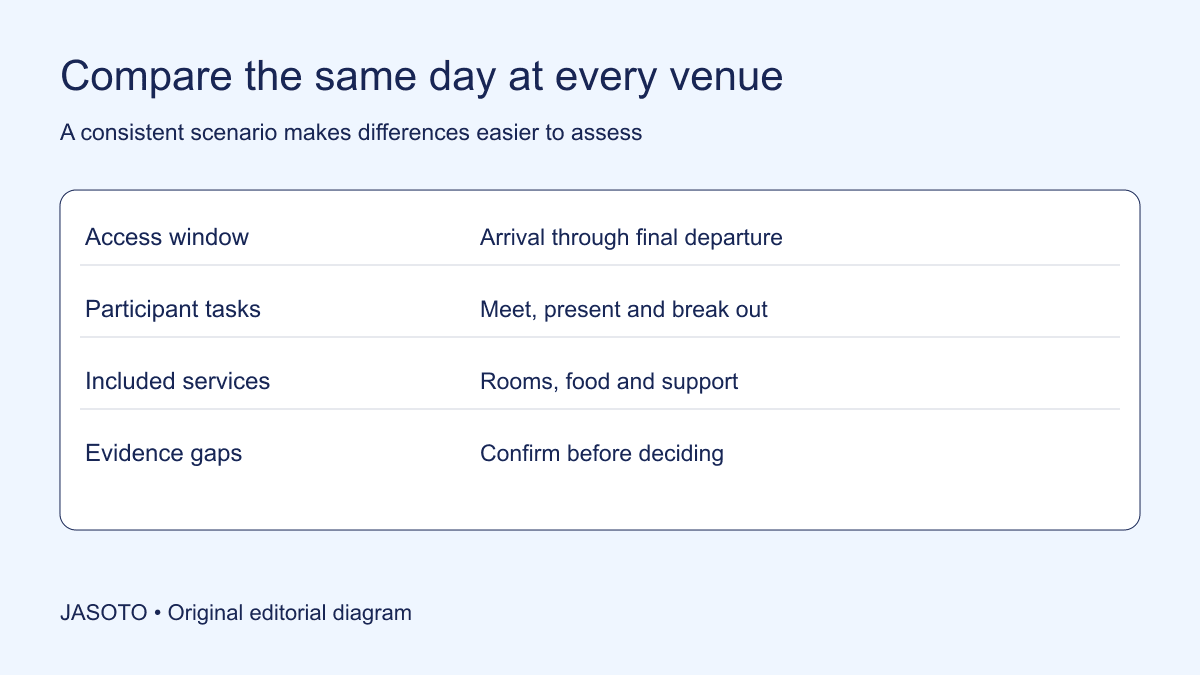
Original JASOTO editorial diagram. Its complete workflow is explained in the article; no actual customer outcome is depicted.
Compare venues by sending each one the same realistic working-day scenario and asking it to explain how the day would operate. Include setup, participant arrival, room layouts, breaks, technical support and departure. Then compare the complete offers against essential requirements and documented evidence. A room rate or a photograph alone cannot show whether the venue supports the activity you are planning.
This guide is for a small UK business choosing a venue for a meeting, workshop or similar working day. It provides an editorial comparison method, not venue recommendations or a price survey. The examples are fictional. Any safety, capacity or technical assessment should use the responsible venue and competent advice appropriate to the actual event.
The practical answer
- Give every venue the same attendance, schedule and room-use assumptions.
- Separate essential requirements from preferences before reviewing offers.
- Compare complete scenarios rather than headline room rates.
- Keep unconfirmed details visible and test important assumptions during a visit.
Write the day as a sequence of activities
Begin with what participants and organisers need to do. For example, a fictional team day may involve early equipment setup, an arrival period, a whole-group briefing, two discussion groups, lunch and a final shared session. Give each activity an approximate time, location need and dependency. Include the period after participants leave, when equipment is collected and the room returned.
Avoid starting with a preferred room photograph and forcing the day to fit it. A setting that suits a presentation may be awkward for simultaneous conversations or confidential discussions. The sequence makes those requirements visible. It also gives the venue an opportunity to identify a practical issue, such as a room change during lunch or a setup window that overlaps with another booking.
Fix the assumptions every venue receives
State expected attendance, organiser numbers, session pattern, layout and the equipment you intend to use. Identify uncertainty explicitly. If attendance may change, request a clear explanation of the alternatives and how the offer would be revised. Do not send one venue a firm count and another a wide range, then treat their answers as directly comparable.
Record a brief version and issue date. When an assumption changes, update all shortlisted venues that remain under consideration. Otherwise a venue may appear expensive because it priced a newer requirement that the others never received. Keep an amendment log with the question, answer and affected requirement. A comparison can only be fair if the options are responding to substantially the same task.
Separate essential conditions from preferences
Identify what must be true for the day to work. That may include the required room arrangement, a confirmed access route, a confidential space or support for a specific participation requirement. Preferences might include decor, a view or an optional networking area. Discuss this distinction with the decision-makers before attractive offers begin influencing the criteria.
Keep essential conditions visible outside any weighted score. A high total should not compensate for a failed requirement that makes the event unworkable. If the team decides to alter an essential condition, record the change and reassess all options consistently. This prevents the comparison from quietly changing its rules to favour whichever venue one colleague already prefers.
Compare arrival and departure as part of the offer
Map realistic journeys for the people attending, using the information actually available. Consider arrival time, the distance between the arrival point and meeting room, and the final session's relationship to return journeys. Research travel on JASOTO as part of this work, then confirm current arrangements through the relevant provider. A central address does not explain the complete journey.
Ask the venue about the planned entrance, check-in and wayfinding. If participants arrive while the organiser is setting up, who welcomes them? If equipment comes through another entrance, how is that coordinated? Keep journey research distinct from verified venue access. A route that looks straightforward on a map can still depend on an opening time or entrance arrangement that has not been confirmed.
Translate room capacity into your planned use
Ask each venue to respond to the actual layout and activity rather than a generic maximum attendance figure. A meeting with tables, screens, discussion areas and staff may need a different arrangement from a seated presentation. Request a plan or written explanation showing the proposed use, and identify any changeover required during the day.
[HSE's venue and site guidance](https://www.hse.gov.uk/event-safety/venue-site-design.htm) treats suitability as dependent on the event and audience, with relevant site information informing the assessment. Use the responsible venue's advice and appropriate specialist assessment for the real arrangement. The comparison sheet should record the confirmed proposal and its evidence; it should not calculate a safe capacity from room dimensions using an improvised rule.
Ask technical questions in terms of tasks
Describe what the presenter and participants will actually do: show slides, play an approved video, join a remote contributor or work in separate groups. Ask the venue what equipment and support it proposes for those tasks. Distinguish an installed screen from a complete tested connection and a person available to resolve difficulties. Record the setup and testing opportunity included in the offer.
Where your team brings equipment, state the relevant details and ask who checks compatibility. Do not assume the venue's equipment list guarantees that your presentation will work. If a task is important, arrange an appropriate test before commitment where practical, or document the unresolved dependency and fallback. The comparison should make technical confidence traceable to a check rather than a reassuring but vague phrase such as “fully equipped.”
Compare catering on the same schedule and quantities
Give venues the same meal and refreshment schedule, expected quantities and known requirements that you are authorised to share. Ask how service works around the session plan and where it takes place. A catering option may require participants to leave the working room, which affects the usable break and any room reset. Treat those operational details as part of the comparison.
Clarify the basis of the offer and the process for finalising numbers or requirements. Avoid assuming that a package includes every refreshment mentioned in a brochure. Record exclusions and options beside the relevant line. If the day includes simultaneous groups, ask whether both can access the planned service without disrupting the programme. The same menu description can conceal materially different delivery arrangements.
Build the complete scenario cost
List room use, access periods, catering, equipment, technical support and any other requested provision. Mark included services, separately priced requirements and unknowns. Use the venue's confirmed quotation and relevant terms. Keep optional upgrades separate so an attractive enhancement does not obscure whether the essential day has been fully priced. No invented average venue rate is needed to perform this comparison.
Ask about conditions that could change the total, such as a revised attendance or access period, without assuming a particular charging rule applies. Record what remains provisional and who will confirm it. A comparison with blank costs should show the gap plainly. Do not replace an unknown with zero merely to produce a complete-looking table or a ranking that the evidence does not support.
Use the visit to test important assumptions
Take the scenario and comparison questions to the visit. Walk from the agreed entrance to the rooms, identify the proposed setup and ask where participants go between sessions. Check the points that could change the decision, rather than spending the entire visit discussing decorative options. Where specialist assessment is needed, involve the appropriate person instead of treating an organiser's impression as technical confirmation.
Afterwards, write a short evidence note for each option: what was observed, what the venue confirmed, what was proposed but untested and what remains unresolved. Photographs can support the record where permitted, but should be dated and described accurately. They cannot prove every future operational arrangement. Send any material follow-up question in writing so the final comparison does not depend on differently remembered conversations.
Test a change before accepting a flexible promise
Ask each shortlisted venue how it would respond to one plausible adjustment in your scenario, such as adding a discussion group or moving a presentation later. Request the practical consequences and any revised offer, rather than relying on “we are flexible.” The answer may reveal a dependency on another room, a staffing period or a supplier booking that was invisible in the original proposal.
Use the same adjustment for every venue so this remains a comparison. Do not assume the exercise creates a reserved option or an agreed future change; confirm the booking implications separately. Record which parts of the response are documented and which remain provisional. This helps decision-makers understand flexibility as a specific arrangement with limits, rather than a reassuring adjective that could mean something different to each person involved.
Choose with a visible reason and review point
Summarise why the preferred venue fits the agreed day, which trade-offs the team accepts and what must be confirmed before booking. Include the decision owner and the current offer references. Research venues and event providers against this brief if more options are needed. For a larger programme, explore coordination roles when the work requires dedicated responsibility rather than informal cover.
Retain the scenario and comparison for the post-event review. Note where the actual day differed and whether the assumptions were useful. That record can improve the next brief without pretending one successful meeting proves a venue will suit every event. The practical benefit is a decision that another colleague can understand: the selected venue supports a defined working day, and the remaining uncertainties have named owners.
Put the guide into practice
- Write the working day from supplier arrival to departure.
- Confirm attendance, layout and participation requirements.
- Request the same inclusions and options from each venue.
- Identify evidence and open questions for each offer.
- Record why the selected venue fits the agreed scenario.
Frequently asked questions
Should the cheapest room always win?
The relevant comparison is the complete agreed scenario, including the services and access the day needs. A lower room charge may still be the best choice, but only after you understand inclusions, additional requirements and unresolved questions. Do not assume that either a low price or a premium setting proves suitability.
Can we score venues before visiting them?
Yes, as a provisional screening exercise based on documented information. Mark what is confirmed and what still needs verification. A score should not hide a missing essential requirement. Use a visit or a targeted discussion to test the assumptions that could change the decision.
How do we compare two different package styles?
Translate both into the same scenario. List the requested rooms, hours, catering quantities, equipment and support, then identify what each package includes or requires separately. Ask the venue to confirm ambiguities. Keep optional enhancements outside the essential comparison so they do not distort the basic choice.
Explore JASOTO tools
Continue with JASOTO
Compare your next step
Discover UK businesses, compare services and request written quotes before making a decision.