
Business Growth · UK Guide 2026
Check a Venue Invoice Against the Agreed Booking
JASOTO · Updated 5 November 2026 · 1,597 words
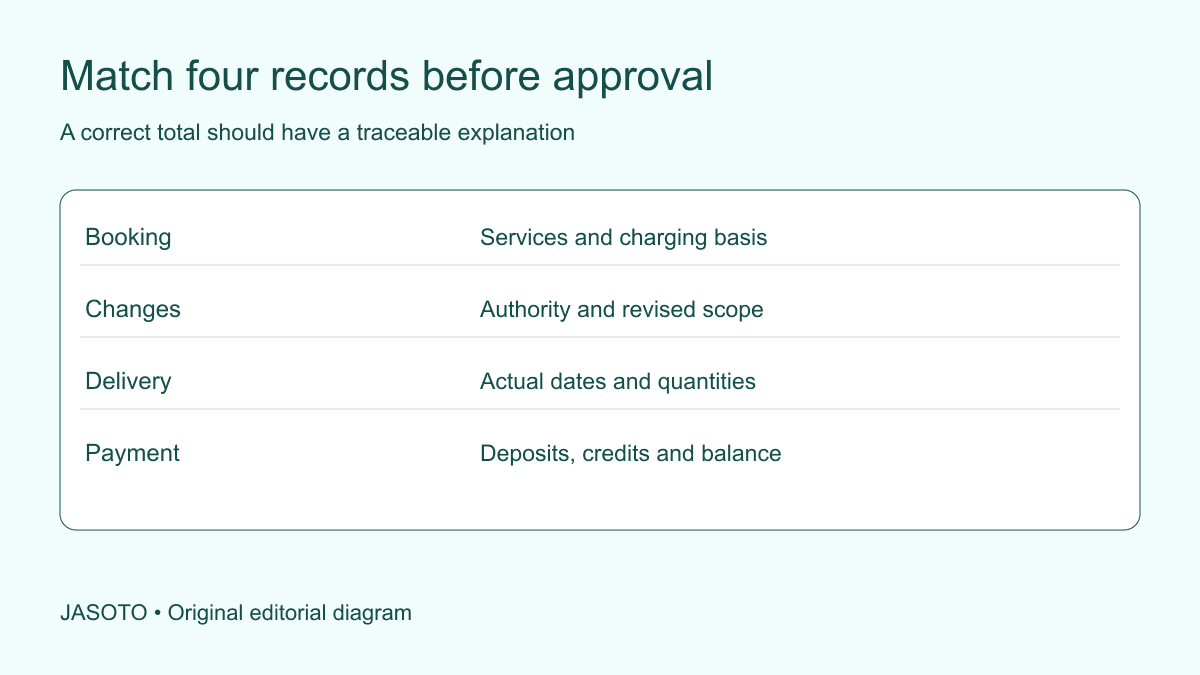
Original JASOTO editorial diagram. Its complete workflow is explained in the article; no actual customer outcome is depicted.
Check a venue invoice by matching each charge to the agreed booking, any authorised changes and the record of what was delivered. Then reconcile deposits, credits and the remaining balance. Start with the documents rather than the final total: a total can look plausible while containing the wrong room period, a duplicated equipment charge or a deposit that has not been accounted for.
For a small UK business, the most useful output is a clear approval record or a short, itemised query that the venue can answer. This guide offers a practical checking process. It does not decide legal liability, tax treatment or payment remedies. The worked examples are invented and do not represent prevailing venue prices or standard contract terms.
The practical answer
- Collect the booking confirmation, changes and delivery notes before checking totals.
- Match each invoice line to an agreed service and charging basis.
- Separate missing evidence from an identified discrepancy.
- Record queries, corrections and payment decisions with named owners.
Build one evidence pack for the event
Collect the accepted quote, booking confirmation, terms, final function sheet and recorded changes. Add delivery notes, attendance information where relevant, and any invoices or receipts for deposits. Identify which document is the latest agreed version. An early quote found in an email search may describe a different room layout or a provisional catering number that was later changed.
Give the event a clear reference and use it throughout the checking record. Keep documents accessible to the person approving payment without copying unnecessary attendee details into the finance folder. A simple evidence index can list document name, date, purpose and location. This lets a colleague review your reasoning without retracing an entire mailbox conversation or relying on your memory of a telephone call.
Confirm the invoice identity before the detail
Check that the venue, customer, event reference and service dates match the booking. Confirm the invoice number and date, and distinguish a quotation, a request for a deposit and a final invoice. Several documents can mention the same event while serving different purposes. Marking each as payable without understanding that relationship creates a risk of duplicate processing.
[GOV.UK's invoice guidance](https://www.gov.uk/invoicing-and-taking-payment-from-customers/invoices-what-they-must-include) lists core information including an invoice identifier, descriptions, dates, amounts and applicable VAT information. Use the relevant official guidance for formal invoice requirements. The reconciliation below asks an additional operational question: does the amount relate to the event and services your business agreed to buy? Having the expected fields alone does not answer it.
Translate the package into comparable lines
Read the package description before comparing individual prices. A room package might include equipment or refreshments that another booking treats separately. Note the inclusions and charging basis alongside each invoice line. Do not assume that an attractive package name tells you what was included. Refer to the actual confirmation, including any exclusions or conditions attached to the package.
Create columns for invoice description, quantity, period, agreement reference, expected basis, invoiced basis and status. Use plain statuses such as matched, clarification needed, discrepancy identified and resolved. Keep a space for the explanation. “Checked” is too weak if the next reviewer cannot tell whether you compared the quantity, the rate, the service date or only the arithmetic.
Compare room access with booked activity
Distinguish guest attendance time from the period of access purchased. Setup, supplier arrival, rehearsal and pack-down may matter to the agreement. If the invoice shows additional room time, compare it with the agreed access window and the event record. An extra hour on the invoice is not self-explanatory; ask which period it covers and what authorisation or term supports it.
Imagine a fictional briefing booked for the morning with early setup agreed separately. The invoice contains a line labelled “extended access.” Rather than crossing it out or accepting it automatically, note the booked windows and ask whether the line relates to early setup or a later departure. That focused question gives the venue a practical route to identify a duplicated charge, explain an authorised extension or supply missing evidence.
Check catering quantities and amendments
Identify whether the agreement charged for a confirmed minimum, an agreed final number, actual consumption or another basis. Match the invoice to that basis rather than simply comparing the bill with a head count. If fewer people attended than were booked, the financial effect depends on what was agreed. Do not present attendance alone as proof of the correct catering charge.
Trace quantity changes to dated instructions. Record who sent the amendment, which service it affected and whether the venue confirmed it. Different counts may apply to lunch, refreshments and an evening reception. A single “attendees” number can conceal those distinctions. If the venue's final function sheet differs from your last approved update, put both references in the query and ask which instruction was used.
Review equipment and labour against delivery
List equipment supplied by the venue separately from items brought by your business or an external provider. Check whether the venue invoice describes hire, operation, installation or support. These are different services. A screen being included in the room does not necessarily explain a separate technician line; the booking and change record should show what support was agreed.
Ask the event lead to confirm any operational variation. Perhaps a second microphone was requested during rehearsal or a technician stayed for a revised presentation. Record the evidence without reconstructing a convenient story after the event. If the business cannot find an authorisation, state that clearly and request the venue's record. Missing documentation and a proven incorrect charge are different findings and should remain distinguishable.
Reconcile deposits without losing the trail
Find each deposit invoice, payment reference and credit or allocation shown on the final account. Check how the venue presents the balance. Some records show the full event value and payments separately; others may show only an amount remaining. Read the documents together before deciding whether the deposit has disappeared or the full charge has been invoiced twice.
Give finance a compact reconciliation: event total as documented, adjustments, recorded payments, credits and the amount requiring approval. If a figure does not reconcile, retain the unresolved difference and ask for a statement or explanation. Do not force the spreadsheet to balance by adding a vague “miscellaneous adjustment.” A neat total obtained through an unexplained plug hides precisely the issue the review should uncover.
Keep venue charges separate from the wider trip
An event budget may combine the venue, transport, accommodation, printing and staff expenses. The venue invoice should be checked against its own agreement, then linked to the wider budget. Otherwise a travel saving can conceal a venue overspend, or a hotel payment made through a separate channel may be mistaken for a missing venue charge.
Use JASOTO travel when researching journeys and accommodation, and keep each booking reference distinct in the event record. If a supplier provides several services under one contract, document that relationship explicitly. The purpose is to explain the scope of each bill. It is not necessary to make every cost fit a single supplier category merely to simplify a budget summary.
Send a query that can be answered line by line
A useful message names the invoice and event, identifies the exact line, states the relevant agreement reference and asks a specific question. For example: “The invoice lists two display units. Confirmation version three includes one, and our event record shows one delivered. Please confirm the basis for the second unit or issue the appropriate correction.” This is more actionable than “The bill seems too high.”
Group related questions while keeping them separately numbered. Attach or link the relevant extracts using your normal information-sharing process. Record the query date, venue contact, internal owner and next review point. Keep tone factual. An efficient query gives the recipient enough evidence to investigate without making unsupported allegations, conceding an unresolved issue or introducing unrelated complaints about the event.
Test whether another colleague can follow the check
Before sending the invoice for approval, ask a colleague to choose one matched line and trace it back to its supporting document. They should be able to find the agreement, understand the charging basis and see how any amendment affected the amount. If they need you to explain an undocumented assumption, improve the note while the details are still available.
Use the same test on one queried line. The reviewer should understand precisely what remains unknown and who is obtaining the answer. This small review is especially useful when the event organiser and payment approver are different people. It turns a private investigation into a reusable business record and makes absence cover possible without requiring a second person to repeat all of the original checking.
Close the record with an accountable decision
When the venue replies, update each line with the explanation, correction or remaining question. Retain the superseded invoice with its status clear, and identify the document that finance should process. Record who approved the final treatment. If a credit is expected later, keep that action open rather than treating a promise of correction as a completed reconciliation.
For recurring events, review why queries arose. An unclear final catering deadline may require a better booking checklist; repeated missing authorisations may require a named change owner. Find bookkeeping or administrative support if evidence gathering needs specialist help, or explore finance administration roles when the volume warrants dedicated capacity. The useful improvement is a clearer purchase and approval trail that the next reviewer can follow.
Put the guide into practice
- Confirm the invoice belongs to the right event and customer.
- Match quantities, periods and inclusions to the agreement.
- Account for deposits and authorised additions.
- Send itemised questions with document references.
- Retain the corrected invoice and approval trail.
Frequently asked questions
Does a higher final total automatically mean the venue made an error?
No. The booking may have changed, a provisional quantity may have been finalised, or an agreed charge may fall outside the original package. Ask what supports the difference. Treat an unexplained total as a question to investigate rather than evidence of wrongdoing or automatic approval.
What if the colleague who authorised an extra has left?
Look for the written change, event record and applicable internal approval process. Ask the venue for its supporting record and give the query to the person responsible for resolving authority questions. Do not invent retrospective approval or assume that the absence of one colleague settles the contractual position.
Should we pay the original invoice while awaiting a correction?
That depends on the agreement, the nature of the query and your organisation's payment process. Give the responsible finance person the evidence and relevant due dates promptly. This operational checklist does not decide payment rights or dispute remedies; seek qualified advice where those questions are material.
Explore JASOTO tools
Research suitable support for event records and invoice reconciliation.
Explore finance administration roles →Define responsibility when recurring invoice work needs dedicated capacity.
Research business travel →Keep separately booked travel costs distinct from venue charges.
Continue with JASOTO
Compare your next step
Discover UK businesses, compare services and request written quotes before making a decision.