
Websites & Ecommerce · UK Guide 2026
Website Content Changes: How to Set Useful Rollback Triggers
JASOTO · Updated November 5, 2026 · 1,587 words
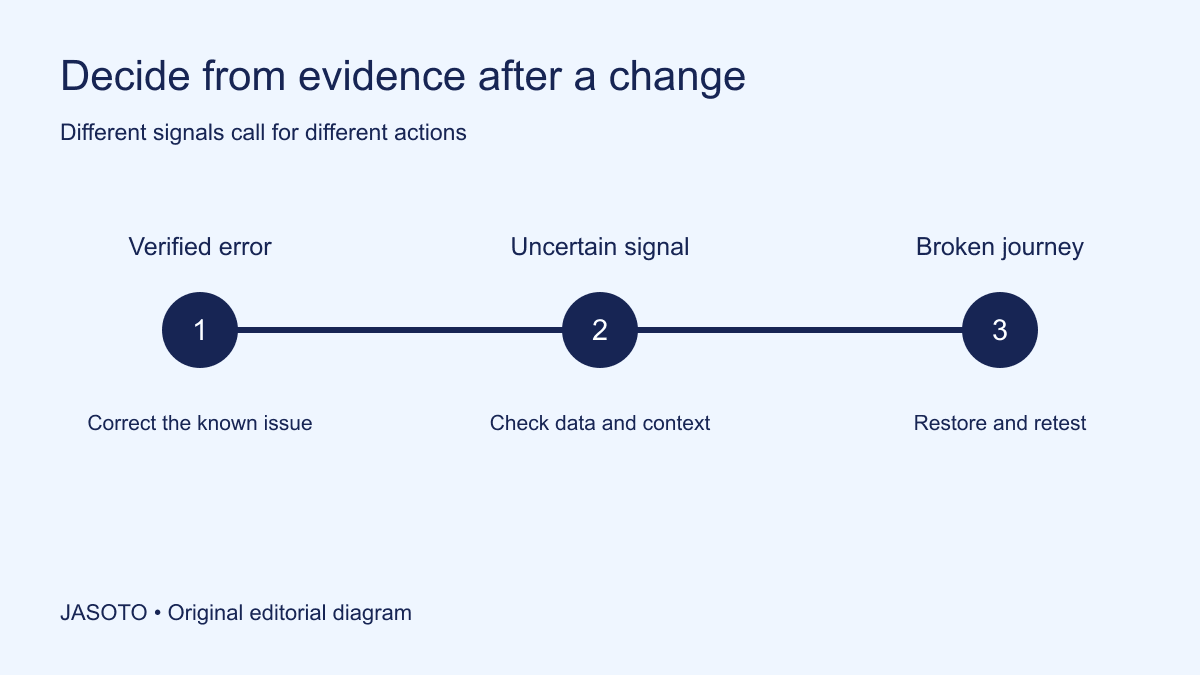
Original JASOTO editorial diagram. Its complete workflow is explained in the article; no actual customer outcome is depicted.
Before changing website content, record the problem, expected customer benefit and conditions that would make you correct or reverse the edit. Save the previous version and identify who can restore it. Treat a broken link or false service statement differently from a short-term traffic fluctuation: the former can be verified directly, while the latter usually needs investigation before it can be attributed to the change.
This guide offers an editorial review method for a small business website. It uses US English and an invented service-page example. It is not a ranking forecast or a universal experiment design. Google provides primary guidance on helpful content and Search Console; the practical decision log and rollback workflow below are original recommendations for making changes reviewable.
The practical answer
- Record the problem and expected benefit before editing.
- Keep a recoverable previous version and a named decision owner.
- Correct broken facts or journeys promptly.
- Investigate uncertain traffic changes before claiming a cause.
Define the problem in customer terms
State what a reader cannot currently do or understand. “Customers cannot tell whether we visit their location” is a useful problem. “The page needs more keywords” describes a proposed tactic without explaining the reader's need. Link the proposed change to the actual task, such as deciding whether to enquire, finding a meeting location or comparing two services. This gives the review a concrete point of reference.
Keep evidence with the problem statement. That might be repeated questions, an inaccurate service area or a contact route that fails when tested. Do not invent a baseline to make the project look scientific. If evidence is limited to a few conversations, describe that limitation. Google Search Central's people-first guidance is relevant to the general purpose of useful content, but it does not establish that any specific edit on your site will produce a particular search outcome.
Write a hypothesis that can be reviewed
Describe the expected behavior in plain language: clearer coverage information should help suitable customers decide whether to contact the business. Identify what you would observe if that seems to happen, such as fewer enquiries from outside the actual service area. Keep the prediction modest and distinguish it from a promise. A hypothesis helps focus learning; it does not turn an editorial judgment into proven causation.
List likely complications before release. Demand may change, a promotion may begin or the business may have less availability. Several edits made at once can also make interpretation difficult. You do not need a perfect experiment to make a useful improvement, but you should know what your evidence can support. If a necessary correction is being made to a false claim, the reason to correct it is accuracy, regardless of whether a later traffic comparison looks positive.
Save a version that can actually be restored
Keep the previous text, relevant images, metadata and destinations through the site's approved versioning process. Name the change and identify its scope. A copied paragraph in a private document may be insufficient if the update also changes forms or navigation. Ask the person implementing the edit how the prior version can be restored and what else would be affected by that action.
Test the restoration route where appropriate before a consequential release. A nominal backup is less useful if nobody has access or knows which version it contains. Separate content restoration from deleting collected data or changing other systems. A rollback should have a defined boundary, preserving unrelated work. If a service provider manages the site, agree who can act and how to contact them rather than waiting until a live problem reveals an unclear support arrangement.
Distinguish immediate errors from uncertain signals
Make a list of direct checks that can fail: an incorrect price statement, an unavailable contact destination, an image that misrepresents work or a form that no longer submits. Those issues do not need a lengthy traffic analysis before action. Correct them promptly through the appropriate process and confirm the affected task works. Decide whether a targeted correction is sufficient or restoration is safer.
Use a different category for ambiguous signals such as lower impressions, fewer enquiries or a changed search position. First check that the measurement is available and comparable. A lack of data can mean tracking failed rather than customers disappeared. One search result observed on one device is not a complete ranking measure. Keep the uncertainty visible instead of converting the first unexpected number into proof that the edit failed.
Choose measures that match the page's purpose
For a service page, useful observations may include relevant enquiries and whether customers understand the service limits. For a travel page, a reviewer might follow a booking-research journey through JASOTO travel and check that the descriptions match the destinations. The measure should reflect the real next step, rather than adding a metric solely because a dashboard makes it easy to count.
Google's Search Console documentation is a reference for search-related reporting. Use the available reports within their actual limits and keep the time window clear. Do not call a raw click increase a rise in qualified business enquiries unless you have evidence connecting them. Likewise, fewer enquiries can be beneficial if an edit reduces unsuitable contacts while useful ones remain. Record the business question before selecting a convenient chart to answer it.
Set review points without inventing universal deadlines
Choose an initial functional review after implementation and a later outcome review suited to the traffic and business cycle. State who reviews, what evidence they will use and what could trigger earlier action. A small low-traffic page may need more observation than a busy transactional page, but there is no magic number of days that makes every comparison reliable.
Record the periods being compared, known closures, campaigns and tracking changes. If the baseline is unstable, acknowledge it. Avoid extending observation indefinitely just because a preferred result has not appeared. Equally, do not choose a shorter window after seeing a favorable spike. The plan should support a reasonable decision, including a decision that the evidence is inconclusive and a narrower follow-up is needed. An honest inconclusive result is more useful than a precise but unsupported success claim.
Worked example: clarifying a genuine service area
Imagine a mobile service business whose page leaves readers unsure which locations it covers. The business adds a clear description of its actual area and an explanation of how to ask about borderline locations. This is an invented scenario, not a customer result. The change record preserves the previous content, identifies the owner and states the expected benefit: fewer avoidable conversations about work the business cannot undertake.
During checking, a reviewer discovers that the new enquiry button points to an old form. That is a verified problem, so the team fixes or restores the route immediately. Later, a quieter week produces fewer clicks, but the team does not automatically blame the coverage text. It checks tracking and comparable periods and reviews enquiry relevance. The same change can contain a clear functional defect and an uncertain outcome signal; those need separate responses.
Record a decision that another colleague can understand
At each review, write the observation, source, interpretation and action. Keep them distinct. “Three people asked whether we cover the airport area” is an observation if it was actually recorded. “The page is confusing” is an interpretation that may need follow-up. The action could be to clarify a sentence or ask customers which part they could not resolve, rather than immediately reversing everything.
If you restore an earlier version, record why and verify that it recovers the intended journey. Do not assume an old version remains accurate if the business itself has changed. Sometimes the correct response is a new correction rather than a return to outdated information. Keep related links and images in the review boundary so a restored paragraph does not leave navigation pointing towards a service or destination that no longer matches it.
Keep suppliers and internal ownership clear
If you need implementation help, research website support providers on JASOTO and give them the specific task, evidence and restoration requirement. If ongoing editorial review needs a role, explore relevant jobs. Distinguish responsibility for approving factual claims from responsibility for publishing the page. A developer can implement a service-area description without being the person qualified to decide where the business operates.
Agree how urgent corrections are raised and which contact can act when the normal owner is absent. Keep the change record in a shared appropriate location, not only in a personal chat. The goal is not a complicated approval chain. It is a practical answer to who checks facts, who publishes, who reviews outcomes and who can restore the intended behavior if a known problem appears after release.
Turn the review into the next useful action
Keep improvements that remain accurate and help customers. Revise unclear parts when evidence identifies them. Reverse an edit when that is the dependable way to recover a failed journey, while preserving a record of what was learned. Avoid declaring a universal rule from one page or one period. The next page may serve a different audience and require a different measure.
A simple change log can contain the problem, hypothesis, changed files or content, previous version, checks, review owner and decision. Add evidence links where available and label missing information honestly. This makes ordinary content work more accountable without pretending every update is a formal experiment. A useful rollback trigger is ultimately a pre-agreed reason to act, grounded in the customer's task and the evidence you can actually observe.
Put the guide into practice
- Write the hypothesis and affected customer task.
- Record a baseline with its limits.
- Save the previous content and confirm how restoration works.
- Agree review points and distinguish rollback from a targeted correction.
Frequently asked questions
Should I reverse an edit after one quiet day?
Not solely because of that observation. Check measurement, demand, traffic sources and other changes. A one-day difference may not reveal the effect of the edit. A broken contact link or false service statement is a different issue and needs prompt correction.
Is rolling back always better than fixing the new page?
No. A small factual or link correction may resolve the problem while preserving useful improvements. Restore the earlier version when that is the most reliable way to recover the intended journey, and check the result.
Can this process guarantee higher rankings?
No. It makes the change and its evidence easier to assess. Search visibility and customer response depend on factors beyond the edit, and a measurement plan does not guarantee an improvement.
Explore JASOTO tools
Discuss content implementation and restoration with a suitable provider.
Explore content and website roles →Consider staffing when review and measurement need a continuing owner.
Explore JASOTO travel →Use a real booking-research journey when reviewing a travel page.
Continue with JASOTO
Compare your next step
Discover UK businesses, compare services and request written quotes before making a decision.