
Sexual Wellness · A practical shared-gift guide for adults 2026
Christmas Advent Calendars for Couples: UK 2026 Guide
JASOTO · Updated 29 October 2026 · 3,825 words
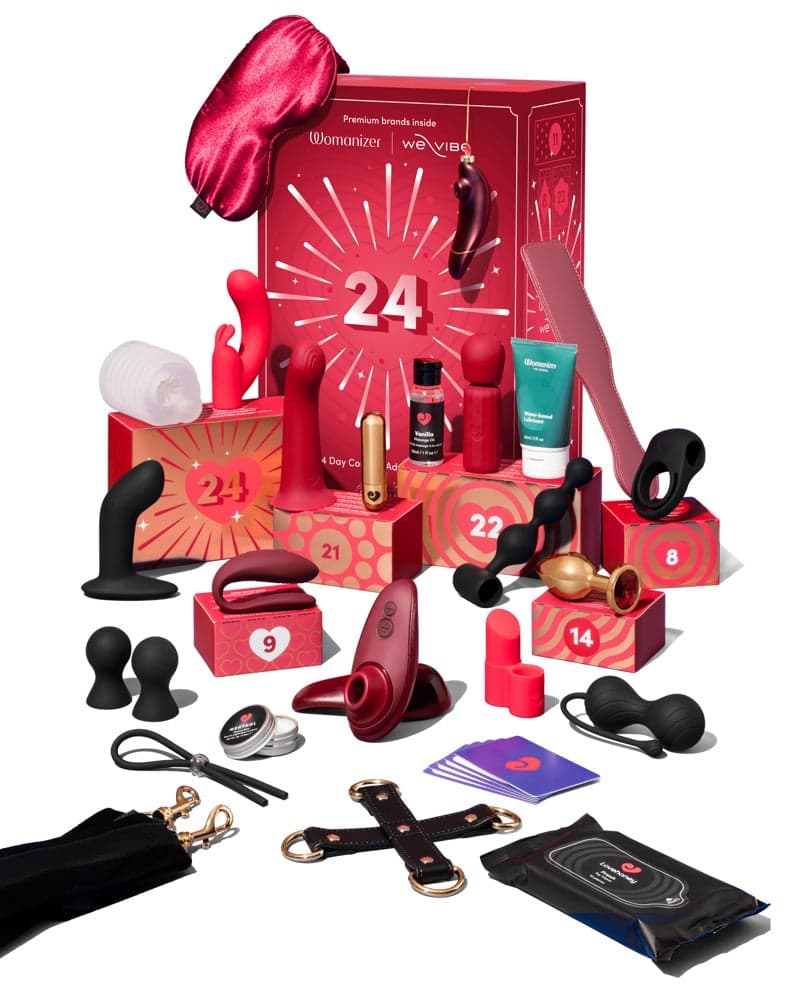
Retailer product photograph showing the red Couples 2026 calendar and arranged contents. Shown for identification; JASOTO has not tested the products.
A shared Christmas gift has two recipients, even when one person places the order. That makes choosing an adult Advent calendar a small joint project: both people need to welcome the idea, recognise something they would value and feel comfortable with what arrives. A festive box can be attractive while its contents are a poor match. The useful question is whether this particular collection suits the people receiving it, their home and their expectations for the gift. You do not need identical preferences, but you do need room for either person to decline an item without disappointing the other.
This UK guide helps adults choose a calendar together without turning the purchase into a test of their relationship. It focuses on a preference worksheet, checking the exact edition, comparing useful contents and arranging a private handover. House of Lucifer product information was checked on 29 October 2026; prices and availability can change. Product names identify the retailer’s listings and do not establish a manufacturer partnership. The examples are hypothetical shopping decisions, not customer experiences. No calendar or included product has been tested for this guide, and opening a gift never creates an obligation to use it.
Choose for the two people receiving the gift
- Agree that an adult shared gift is welcome before selecting one.
- Match the exact edition to each person’s preferences and practical needs.
- Value wanted contents rather than the number of boxes or advertised savings.
- Confirm dispatch, delivery arrangements and an unpressured handover.
1. Start with an invitation, not a surprise purchase
Introduce the category before naming a product. A clear invitation might be: “Would you enjoy choosing an adult Christmas calendar together, or would you prefer another kind of present?” This lets the other person answer the real question without having to reject a purchase already made. Ask privately at an ordinary moment, rather than during an argument or while other people are present. If the answer is uncertain, leave the idea open. A shared gift works best when both recipients have chosen its general nature; the surprise can be the wrapping, the note or a detail they have agreed to leave undisclosed.
Distinguish curiosity from permission to buy anything in the category. Someone may like the idea of a festive collection but dislike particular contents, apps or strongly scented products. Another may prefer selecting one item instead of accepting an assortment. Record that preference before looking at prices. You can browse the House of Lucifer Advent calendar collection once both people want to explore the format. Treat the collection as a starting list of options, then open the individual listing; a category label does not establish that every item is suitable for both of you.
2. Decide whether this is one shared present or two
“For us” can mean different things. One buyer may imagine replacing both Christmas presents with a calendar, while the other expects it to be an extra alongside individual gifts. Settle that distinction early. Agree who contributes, whose budget it comes from and whether either person still wants a separate small present. There is no need for equal contributions if another arrangement suits you, but the agreement should be explicit. Otherwise a generous purchase can unexpectedly create a second obligation, or one recipient may feel that their own present has been chosen mainly for someone else.
Talk about the spending limit without using the retailer’s highest-priced option as the reference point. MoneyHelper’s Christmas guidance recommends planning gift spending and discussing it with the people involved. For this purchase, a useful adaptation is to write down the maximum combined amount before either person presents a shortlist. Include the possibility of choosing nothing this year. Keep this conversation separate from product features: agreeing a budget does not commit you to spend all of it. If the available amount feels uncomfortable, reduce the scope of the gift while preserving the invitation to choose together.
Source: MoneyHelper: planning and discussing Christmas gift spending. Check the source for current guidance and terms.
3. Make a preference sheet that allows different answers
Use five headings on a sheet: welcome, possibly welcome, not wanted, needs more information and private practical requirements. Each person can fill it in separately, then share only what is necessary for buying. Welcome might include a particular product category or a simple conversation game. Needs more information might include ingredients, charging arrangements or the dimensions of a storage box. Private requirements can be expressed as a purchasing condition without an explanation. You do not need to justify why an item is unwelcome in order for the other person to exclude it from a shared gift.
Compare the sheets by category rather than trying to turn every answer into a compromise. Two different “welcome” lists can still support one well-chosen collection, provided neither person is expected to use the other’s selections. A hard exclusion deserves more weight than a vague interest. Mark unresolved questions with the name of the person who will check them, and leave the decision pending. Avoid circulating this document through a work account or a family group chat. Its purpose is to make this purchase easier; it need not become a permanent record of personal preferences.
4. Identify the exact Couples edition before comparing
The Magic Shiver × Lovehoney Couples 2026 listing identifies a 24-day calendar with SKU 06386500000. The retailer price was £139 on 29 October 2026. Save the full title and identifier together rather than relying on the word Couples, a cropped photograph or a search result. Those small details help you distinguish the listed edition from another year, another retailer’s collection or a similarly named gift box. A product family name is a useful navigation aid; it is not enough to prove that two packages contain identical items.
Make a compact comparison record with the listing date, edition, price seen and unanswered questions. If one person sends the other a screenshot, include the product title and the relevant part of the contents information, not just the festive artwork. Recheck the live listing before paying. Where a description leaves something important unclear, ask the retailer about that edition rather than filling the gap with information from a different bundle. This is especially important if one named component drives the purchase. An attractive photograph cannot settle a question about the actual model or what is included.
5. Judge the contents by preference coverage
Convert the contents list into decisions rather than a tally. For each disclosed item or category, ask who welcomes it, what remains unclear and whether it duplicates something you already have. Use three simple marks: clearly wanted, uncertain and excluded. You are not trying to predict every reaction in December. You are checking whether the collection has enough confirmed relevance to justify buying it while respecting both people’s exclusions. If the list only provides broad categories, keep the uncertainty visible. Do not award a confident “wanted” mark to an unnamed item merely because its category sounds promising.
An assortment can suit two different people without every compartment serving both. The concern is whether the shared label hides a substantial mismatch. For example, if one recipient is interested in only one named component and the other is indifferent to everything else, a calendar may add packaging and decisions without adding much gift value. Conversely, several modest items that both welcome may be more relevant than a headline component neither wants. Write a one-sentence reason for each shortlisted calendar. If the reason depends entirely on its claimed total retail value, return to the preference sheet.
6. Check duplication without creating a new shopping list
Look at what you already own, but keep the review brief and respectful. The aim is to avoid paying for unwanted repetition, not to inspect a partner’s belongings without permission. Ask which existing categories already meet their needs and whether there is a particular replacement they want. A duplicate can be useful when it has a clear role; it is less useful when the buyer assumes that a larger collection must be an improvement. If the answer is “we already have enough”, record it as a legitimate result rather than searching for reasons to increase the purchase.
Consider the less visible duplication too: another charger to identify, another set of instructions to retain or another bottle that will need storage. Ask whether a new item would replace something, sit alongside it or remain unused. Keep any hoped-for replacement provisional until you have checked the exact specification. Do not discard an existing product simply because the calendar photograph appears to contain a similar one. The most useful outcome of this review may be a shorter shortlist. A shared gift can be thoughtful precisely because it avoids adding things that either person would then have to manage.
7. Include everyday access and handling preferences
Practical preferences deserve a place alongside the contents. Small buttons, very small printed labels, complicated packaging or an unfamiliar charging connection may matter more to a recipient than the number of compartments. Ask what makes an item straightforward for that person to identify, store and maintain. Avoid interpreting a mobility, sight or dexterity requirement from a photograph. If a control or physical feature is essential, find the manufacturer information for the exact included model or ask the retailer to confirm it. Keep an unresolved requirement visible instead of treating an unknown as a positive feature.
The calendar itself also needs to fit the home. Think about where a large box can be kept, whether it needs to travel between addresses and whether the recipients want it on display. You can agree to keep the outer packaging in a private cupboard rather than using it as a decoration. If storage measurements matter, verify them before ordering; this guide has not measured the box. These checks are ordinary gift logistics. They help prevent a situation where someone likes the idea but cannot comfortably receive, handle or keep the collection in the space available.
8. Treat connected features as an optional preference
If a disclosed component includes an app or a remote feature, ask whether either person actually wants that function. More functions do not automatically make a better gift. Some recipients prefer a simpler product without another account, installation or update to manage. Others may welcome a connected option but still want to check phone compatibility and privacy information first. Record whether connectivity is wanted, unnecessary or a reason to choose something else. Do not assume that a product needs to be connected for every function, or that a particular function is available, without reading its exact documentation.
Leave account decisions to the person who will use the device. A buyer should not create an account in a partner’s name, choose their password or pair a personal phone as part of a surprise. If both people later decide to explore a connected feature, they can review its settings and permissions together. That is a separate decision from accepting the wrapped gift. For shopping purposes, your task is narrower: confirm the included model, identify any compatibility question and allow the recipient to prefer another option. This guide makes no performance or privacy assessment of any included electronic product.
9. Compare a single agreed item with the calendar
A useful comparison is not always another calendar. Browse House of Lucifer’s couples collection if the preference sheet points to a specific category rather than an assortment. Compare the actual item you would choose with the calendar’s confirmed relevance. Keep the comparison like for like where possible: exact model, listed inclusions, practical requirements and current total at checkout. Do not treat the presence of one similar-looking component in a calendar as proof that it is the same product as a standalone listing.
The standalone option is particularly useful when one recipient wants a clear choice and the other is happy to support it as the shared present. It can also reduce spoiler problems: both people know what they are accepting, while a note or presentation supplies the festive element. The calendar may still win if the assortment itself is welcome. What matters is that it has survived a credible alternative. Write down what extra value the calendar provides in your circumstances, such as jointly welcomed variety. Avoid vague answers about improving the relationship; a purchase cannot guarantee that outcome.
10. Read games as invitations with editable boundaries
If games are the main appeal, review the retailer’s sex games collection as a separate category rather than assuming that a calendar will provide the right format. Look for enough information to understand the tone, language and rules before buying. One person may enjoy light conversation prompts while the other dislikes competitive tasks, fixed challenges or any suggestion that declining loses points. Those are meaningful differences in gift preference. A game’s title or festive packaging cannot tell you whether its actual prompts suit the people who will receive it.
Agree a simple boundary for any game: either person may skip a prompt, change an activity or stop without explaining. You can decide this before seeing the specific contents. It gives the gift a usable context without prescribing a schedule or any intimate activity. Avoid handing over an adult game as a public joke and expecting the recipient to demonstrate enthusiasm in front of others. If the rules remain unclear at the buying stage, ask for clarification or choose a better-described option. The gift should offer something the recipients can elect to enjoy, rather than a set of expectations they inherit.
11. Compare other gift bundles without chasing volume
The bundles and gifts collection offers another route when a smaller or differently arranged present fits better. Assess each candidate on its own listing. A bundle might suit someone who wants all the contents identified at once; a calendar might suit someone who enjoys numbered compartments. Neither format is inherently more considerate. Keep the recipient’s stated preferences at the top of the comparison, followed by practical fit and the current cost. A seasonal name should not move an otherwise unsuitable option onto the shortlist.
Be cautious about value calculations built from items you would not otherwise choose. An advertised comparison price does not tell you how much usefulness the collection has for your household. Rather than converting claimed savings into a reason to spend, ask which option you would still want if no promotional percentage were shown. You can make a small table with three rows: calendar, selected bundle and single agreed item. Give each a short explanation under welcome contents, unresolved questions and home fit. This produces a decision you can explain to each other without relying on a large number printed beside the price.
12. Plan who can receive the parcel privately
Choose the receiving address together if delivery privacy matters. A home address may be convenient but shared with relatives, housemates or visiting family. A workplace can create its own problem if reception staff routinely open packages or record purchases in a shared system. Do not assume that a neutral outer parcel makes every receiving arrangement suitable. Check the current packaging information and carrier options, then decide whether the chosen address works for the people who live or work there. Never send an adult gift directly to a recipient who has not welcomed that kind of delivery.
Keep the order contact details equally deliberate. Decide whose email receives confirmations and whose phone can receive tracking messages without exposing the gift through a shared screen. The purpose is ordinary privacy, not hiding spending from someone who shares the budget. If the buyer and recipient use different addresses, check the checkout details carefully rather than relying on saved autofill. Ask how the parcel will move from its receiving address to the agreed handover place. A thoughtful plan includes that last step, especially when one person is travelling or staying with family during the Christmas period.
13. Separate dispatch time from arrival time
The current information for the named Couples calendar says to allow five to seven business days for dispatch from a European supplier. Dispatch means the parcel is sent; it does not mean it has reached your address. Review the House of Lucifer shipping policy alongside the product-specific notice, the delivery choice and your postcode at checkout. A general site banner should not replace the calendar’s stated dispatch information. If the timing is essential, ask the retailer a direct question about that product and the destination before placing the order.
Work backwards from your own handover date without inventing a guaranteed order deadline. Your plan needs room for the stated dispatch period, the separately quoted delivery stage and time to deal with a problem. Business days are different from calendar days, and any relevant closures or service changes need checking at the time. If the timetable feels uncertain, change the presentation plan rather than promising an arrival you cannot control. You might agree to choose the gift together now and hand over a written note, with the parcel following when it actually arrives. Make that arrangement honest and explicit.
14. Complete a worked shared-gift decision
Consider a hypothetical couple, Alex and Rowan, who have agreed that one joint Christmas present is welcome. They want to stay within a combined £160 limit including delivery, do not want app-dependent features to drive the purchase and need the parcel kept out of a shared hallway. Alex enjoys the idea of an assortment; Rowan wants the broad categories disclosed. Their worksheet records three questions: which contents both welcome, whether any essential product function depends on an app and whether the delivery arrangement fits the address. Their spending limit is an example, not a recommendation about what another household should afford.
They note the £139 product snapshot but leave the total blank until checkout supplies the actual delivery charge. They identify the exact edition, review its disclosed contents and mark several categories uncertain rather than assuming they are suitable. If the unanswered questions remain material, they pause the purchase and compare a single agreed item. If the answers satisfy both people and the current total fits their limit, one person orders using the agreed contact details. Their handover note says the box is a shared gift with no expectation to open everything immediately. The useful result is a clear decision process, whether or not they buy the calendar.
15. Keep the information needed if something is wrong
Save the order confirmation, the exact listing identifier and any written clarification that influenced the purchase. Keep this purchase record separate from the preference sheet; a retailer resolving a delivery or product issue does not need a private account of your relationship. On arrival, check that the parcel corresponds to the order before discarding labels or opening individual sealed contents. If something appears missing or incorrect, record the issue clearly and contact the seller. Describe what you can observe rather than diagnosing a technical fault or attempting a repair to make the Christmas plan work.
Read current return terms before buying, particularly where sealed hygiene-related items are involved. GOV.UK distinguishes a change of mind from problems such as faulty or misdescribed goods, and identifies an exception affecting certain opened sealed hygiene goods. That is a reason to check the position before breaking seals, not to assume that every adult product has no consumer protection. The person who placed the order should be prepared to handle any query. A gift recipient should not have to explain private preferences to obtain help with a parcel that did not match the buyer’s order.
Source: GOV.UK: returns, refunds and sealed hygiene-related goods. Check the source for current guidance and terms.
16. Make the handover easy to accept and easy to change
Give the calendar in a private setting that suits the recipients. A short note can explain why you chose it and repeat the agreement already made: there is no required pace, no obligation attached to an item and no need to perform a reaction. Avoid framing the present as a remedy for a relationship problem or evidence that December must become more adventurous. Those claims place a burden on the person receiving it. A better handover explains the practical arrangement, where the product information is kept and how the buyer will help if the delivered edition is incorrect.
After the handover, let each person decide how much discussion they want. If the collection turns out to be a poor fit, acknowledge the mismatch without defending the purchase through its price. That feedback can improve a future gift, but it need not become a scorecard for the recipient. Keep useful instructions and identifiers with the appropriate contents, follow their specific care information and choose storage that works for the household. The success of the gift is that it was welcomed and thoughtfully chosen. Buying fewer things, changing the format or deciding against a calendar can meet that aim just as well.
A shared-gift worksheet to complete before checkout
- Both adults welcome this type of gift and have agreed what it replaces.
- Welcome categories, exclusions and unresolved practical questions are recorded.
- The exact year, edition and SKU match the intended product.
- The current total fits the agreed limit, including delivery and any confirmed essentials.
- Dispatch information and delivery arrangements fit the intended handover without a guarantee being assumed.
- The receiving address, order contact and private handover are agreed.
- The buyer will keep the purchase record and handle any product or delivery query.
Frequently asked questions
Is a couples calendar suitable if we have different preferences?
It can be, if both people welcome the assortment and neither is expected to accept unwanted contents. Map the disclosed categories to each person’s preferences and give exclusions more weight than vague curiosity.
Is the Couples calendar in this guide definitely the same as another Lovehoney calendar?
Do not infer that from a similar name. The retailer’s snapshot identifies Magic Shiver × Lovehoney Couples 2026, SKU 06386500000. Compare exact editions and contents rather than assuming equivalence or an official partnership.
Does the five-to-seven-business-day notice mean delivery within that time?
No. The named calendar’s current product notice describes dispatch. Delivery is a separate stage whose options, destination coverage and timing need checking before purchase.
Should I keep all the contents secret from my partner?
Only to the extent both people want. You can agree the category and exclusions, review broad contents together and leave individual compartment details undisclosed.
What if one of us decides against the gift after comparing it?
Treat that as a useful outcome of choosing together. A single agreed item, a different present or no adult purchase can fit better than an assortment that one person does not welcome.
Explore more practical adult buying guides
Read JASOTO guides to choosing thoughtfully, discussing preferences and checking product information.
Browse Sexual Wellness guides