
Language Learning · UK Guide 2026
International Supplier Terminology List: A Practical Guide
JASOTO · Updated November 5, 2026 · 1,587 words
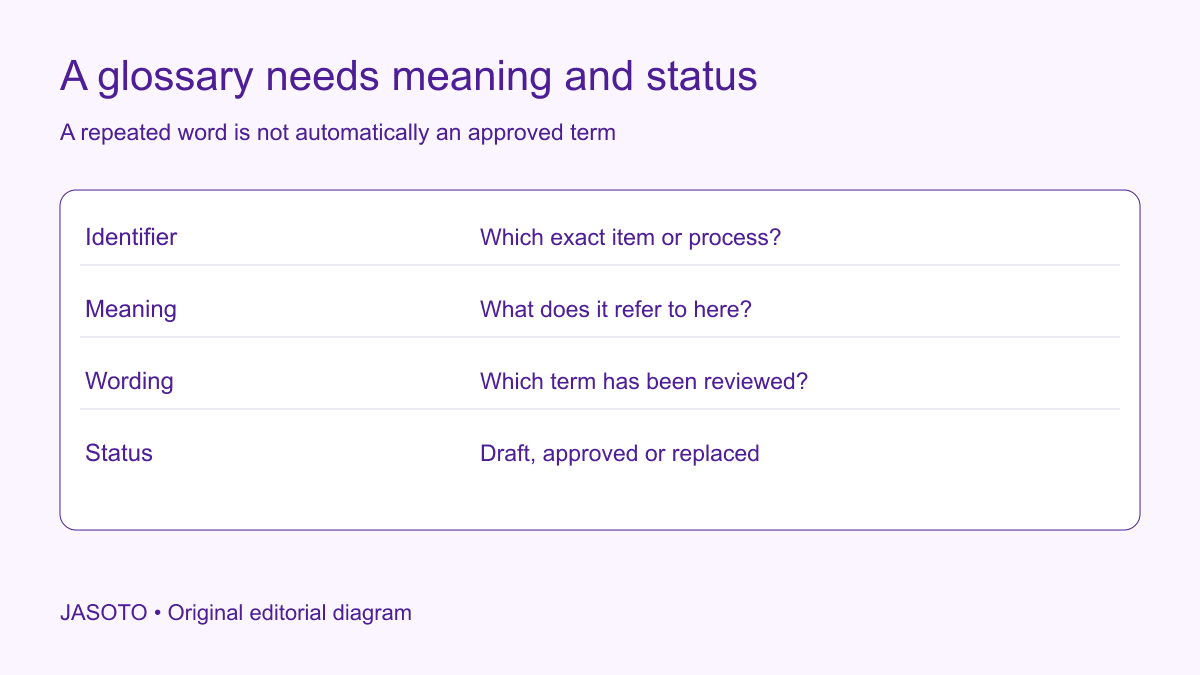
Original JASOTO editorial diagram. Its complete workflow is explained in the article; no actual customer outcome is depicted.
For an international supplier, keep a terminology list that records what a term means in your work, the approved wording in each required language and who confirmed it. Include the source context and a visible status for unresolved entries. A list of paired words is less useful if nobody can tell whether they refer to the same part, service or instruction.
This guide uses US English and an invented purchasing example. It offers an editorial coordination method, not a technical translation standard. W3C's explanation of localization is a primary reference for the broader point that adapting content involves more than substituting words. Appropriate subject and language reviewers are still needed, especially where the meaning affects safety, legal obligations or a product specification.
The practical answer
- Record the meaning and context before approving a translation.
- Keep part identifiers and official names distinct from descriptive wording.
- Give disputed terms an owner and a visible status.
- Update the glossary with the documents and processes that use it.
Choose terms that affect real decisions
Start with recurring words that have caused confusion or influence an order, specification or instruction. A small list of important terms is often easier to maintain than a large dictionary assembled without a purpose. Ask the people dealing with the supplier which distinctions they need to preserve. The relevant terms may describe a finish, service stage, component or acceptance check rather than a general business word.
Record why an entry is needed. If two teams use the same word for different things, the glossary should expose that conflict. If a term has never been understood outside one department, it may need explanation before translation. Avoid approving an unexplained acronym merely because it appears repeatedly in a supplier document. Repetition can show importance, but it does not establish shared meaning. Give the list a defined scope so users know which products, processes and relationships it covers.
Describe the meaning before selecting the wording
Write a short definition tied to the actual context. Identify what the term includes and, where important, what it excludes. “Inspection” may mean a visual check in one workflow and a documented technical assessment in another. Resolve the business meaning before asking a language reviewer to choose an equivalent. Otherwise two fluent translations can preserve two different assumptions.
Link the definition to a source document, drawing, item or process owner. A screenshot or photograph may help identify a physical feature, but it should not replace a precise reference when one is needed. Label illustrative material honestly. The glossary should help a reviewer ask a targeted question rather than create the appearance that every meaning is already settled. Where the source is ambiguous, mark that status and assign the question to someone who can resolve it.
Keep identifiers separate from descriptions
Preserve actual part numbers, document references, version codes and official product names as controlled identifiers. Put descriptive wording in a separate field. A familiar translation of a component name is not a dependable way to distinguish two similar items if the supplier orders and ships them by different references. The people using the glossary should be able to trace an entry back to the exact thing under discussion.
Check characters and formatting that may be confused when copied. A space, dash or letter can matter in an identifier even when it seems insignificant in ordinary prose. Do not silently normalize supplier codes or turn them into a new internal format without a verified mapping. If an internal identifier is also needed, record the relationship explicitly. This helps keep a purchasing conversation connected to the item that the supplier and receiving team will actually recognize.
Capture language and market context
Identify the language and relevant audience or regional convention where it matters. W3C describes localization as adaptation to a target market's requirements, including matters beyond language alone. A glossary can therefore include notes about units, formats or the context in which wording is appropriate. Keep those notes factual and relevant rather than treating a country label as an explanation of every reader's expectations.
Do not assume one approved term fits every document or service. A phrase suitable for an internal purchasing note may need different explanation in customer instructions. Record where the approved wording applies and when additional review is required. JASOTO languages can help explore language resources, while the business should use appropriate professional support for the actual subject. The glossary supports communication; it does not transform general language familiarity into expertise in a technical or regulated domain.
Give each entry a review status
Use clear states such as proposed, awaiting clarification, approved and superseded. Name the person responsible for the underlying meaning and the reviewer responsible for language. Those may be different people. A subject owner can confirm what the component does without being able to approve the target-language wording. A language reviewer can identify ambiguity without having authority to alter the technical specification.
Record the evidence or decision that resolves a disputed term. Do not let a suggestion become approved simply because it was copied into several emails. If a term remains open, say where it must not yet be used as a final instruction. The status should be visible in the working list, not hidden in an earlier conversation. This lets colleagues continue appropriate preparation without mistakenly treating an unresolved interpretation as a binding specification or approved customer statement.
Use examples to test the distinction
For important terms, add a short example sentence from the relevant context, with appropriate permission and information handling. Ask whether the approved wording preserves the intended distinction in that sentence. An equivalent may look correct in a list but become unclear when used with a quantity, condition or action. Review the complete instruction rather than approving every occurrence mechanically.
Include a contrasting example when it explains an easily confused concept. For instance, a record can distinguish a request for information from an instruction to proceed, using the parties' actual agreed terminology. Avoid inventing legal definitions or using a glossary to override contractual language. Where precise contractual meaning matters, obtain the right review. The example's job is to reveal ambiguity and support consistent usage, not give the glossary authority it does not have.
Worked example: a finish name and a product code
Imagine a business ordering display components from an overseas supplier. Staff use an informal translated colour name, while the supplier distinguishes several finishes through exact codes. This is an invented example, with no claim about a real product. The glossary records the item reference, the supplier's finish code, the intended descriptive wording and the context in which that wording may be used.
A sample discussion reveals that one team has been using the same name for two different codes. Rather than choosing a translation by preference, the subject owner confirms the intended item and the language reviewer revises the description accordingly. The approved order uses the controlled reference through the proper purchasing process. The glossary has helped expose a mismatch between language and identification; it has not certified the sample or replaced the supplier's specification.
Put the list into the workflow that needs it
Link the current glossary from quotation templates, translation briefs or shared project material where relevant. Tell the people preparing documents how to raise a new term and who reviews it. A glossary stored in a private folder will not improve a supplier conversation if the person writing the order does not know it exists. Test whether a new colleague can find the approved entry and identify its limits.
If a joint workshop is needed, agree the questions and required participants before arranging travel. JASOTO travel can support journey research after the location and appointment are confirmed. Use the workshop to resolve named ambiguities rather than assuming that an in-person meeting automatically creates shared meaning. Record outcomes in the glossary and connected documents promptly, with a clear distinction between proposals discussed and terms actually approved.
Update the documents when terminology changes
When an entry changes, identify the documents and active work affected. A corrected glossary does not automatically update an issued quotation, product instruction or order. Mark the previous term as superseded and provide the approved replacement and context. Decide who communicates the change to the supplier and internal users. Do not erase the earlier entry if doing so makes past correspondence impossible to interpret.
Use a version and review date that reflect actual updates rather than automatic freshness labels. Keep the change history proportionate: what changed, why, who approved it and which material needs action. If the business changes its products or supplier relationship, review whether the glossary's scope still fits. An old list can become misleading if readers assume it describes a new specification simply because the words look familiar.
Review whether the list is solving the problem
Ask users which misunderstandings continue and which entries they cannot apply. Repeated clarification about the same term may indicate that the definition, context or underlying specification remains weak. Improve that entry rather than adding many unrelated words. Avoid claiming fewer errors or faster purchasing unless you have recorded evidence that supports the comparison. A practical glossary can be valuable without an invented performance statistic.
If support is needed, find language or supplier service providers on JASOTO and explain the subject area and required responsibility. If coordination needs continuing ownership, explore relevant jobs. The useful outcome is a maintained record of shared meaning: people know which exact item or action is intended, which wording is approved and how to resolve an open question before it becomes an avoidable order or communication error.
Put the guide into practice
- Choose recurring terms that affect decisions or instructions.
- Record the source meaning, context and reference.
- Have appropriate subject and language reviewers resolve ambiguity.
- Issue approved versions and identify superseded wording.
Frequently asked questions
Is a terminology list the same as a complete translation?
No. It supports consistent meaning for recurring terms, but sentences and documents still require appropriate translation and review in context. An approved word does not make every sentence containing it correct.
Should I translate part numbers?
Preserve the actual identifier used by the supplier unless a verified system requires a different representation. Descriptive labels can be localized where appropriate, but the record should still identify the exact item reliably.
Who decides when two translations disagree?
Identify both the subject owner who can confirm the intended meaning and an appropriate language reviewer. Record the question and evidence, rather than choosing the most familiar-looking wording or letting an unreviewed suggestion become approved by repetition.
Explore JASOTO tools
Explore language resources alongside the business's actual review needs.
Find translation and supplier support providers →Discuss the subject area and required review with a suitable provider.
Explore language and procurement roles →Consider staffing where cross-language coordination is sustained work.
Plan a supplier workshop journey →Research travel after agreeing the workshop location and purpose.
Continue with JASOTO
Compare your next step
Discover UK businesses, compare services and request written quotes before making a decision.