
Business Growth · UK Guide 2026
Two-Hour Business Event Run Sheet: A Practical Template
JASOTO · Updated 5 November 2026 · 1,577 words
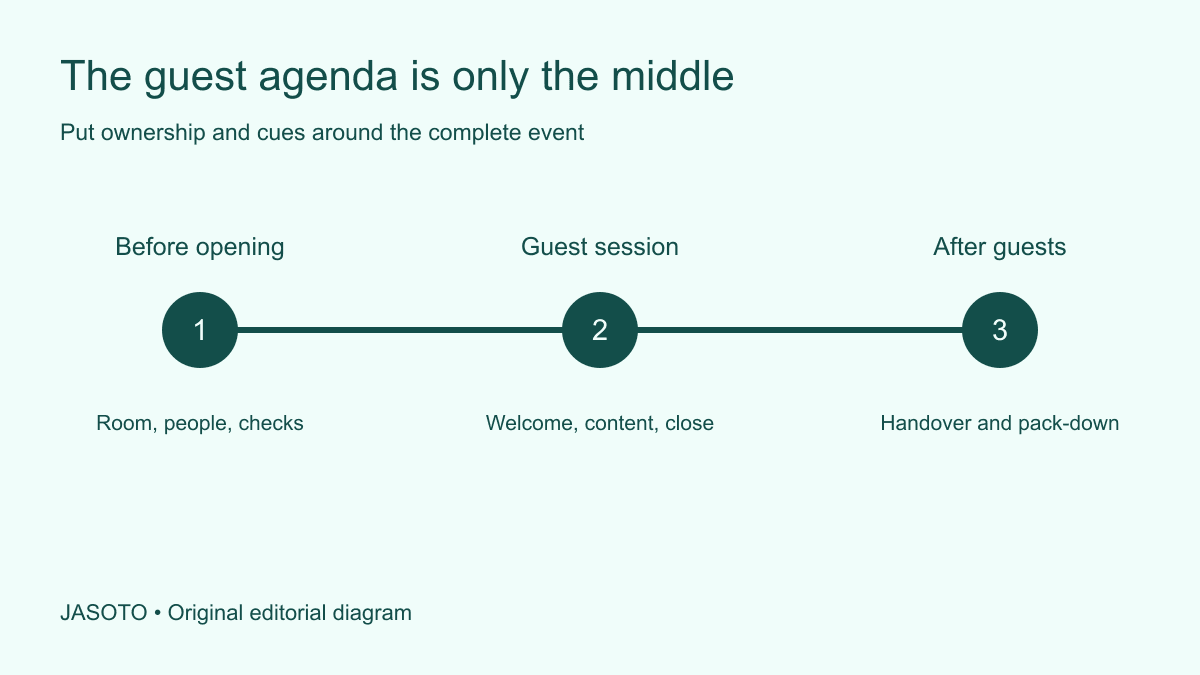
Original JASOTO editorial diagram. Its complete workflow is explained in the article; no actual customer outcome is depicted.
A run sheet for a two-hour business event should show what happens, who makes it happen and what cue moves the team to the next step. Include setup before guests arrive and pack-down after the advertised session. Keep the guest agenda separate: it explains the experience, while the operational sheet coordinates the people, equipment and decisions needed to deliver it.
This guide proposes a practical structure for a small workshop, demonstration or networking event. The example is invented and the timing method is an editorial recommendation, not an event safety plan. Venue procedures, accessibility arrangements and other specialist requirements still need their appropriate owners. A run sheet helps communicate the plan; it does not make an unconfirmed arrangement real.
The practical answer
- Separate the guest agenda from the operational run sheet.
- Give every transition a named owner and a clear cue.
- Include setup and pack-down outside the advertised session.
- Confirm participant arrangements and a fallback before opening.
Set the purpose before filling the timetable
Write the result the event should produce. A product demonstration may need guests to understand a process and ask questions, while a workshop may need them to create a draft plan. Decide which activities are essential to that result. A crowded agenda can make every item appear important even when several do not contribute to the main purpose. Remove or shorten unnecessary material before asking staff to rush transitions.
Define the advertised guest period and the operational access period separately. A two-hour session does not mean the venue is needed for only two hours. Confirm when the team can enter, when suppliers may deliver and when the room must be handed back. Keep those facts beside the run sheet so the organiser does not discover during setup that furniture changes or technical preparation were expected to be completed within the guest session.
Use operational fields that lead to action
A compact sheet can contain time, activity, owner, cue, required resources and fallback or note. The owner should be a named person or an unambiguous role assigned to a person before the event. “Team” is often too broad when something goes wrong. The cue explains what initiates the action: the host finishes a welcome, the room is confirmed ready or a technician gives an agreed signal.
Keep reference information linked rather than placing every supplier detail into the timetable. Contact numbers, room plans and approved procedures may belong in a supporting pack. The person using the run sheet should still be able to find them promptly. Test whether the document is readable on the actual printed page or device people will use. A beautifully formatted sheet is not useful if the critical owner or cue disappears outside a narrow screen.
Work backward from opening the doors
List what must be ready before guests enter: the room arrangement, registration process, working equipment, materials and relevant participant arrangements. Confirm who checks each one and who can resolve a problem. Distinguish “equipment delivered” from “equipment connected and tested”. A supplier's arrival does not automatically mean the event is ready to begin.
Put dependencies in order. A screen test may require the room setup to be complete; a speaker rehearsal may require their final materials. Give people realistic access to the space and avoid scheduling several incompatible tasks in the same place at once. Where setup cannot be completed as originally planned, revise the event arrangement rather than deleting the check from the sheet. The purpose is to expose unresolved preparation, not produce an attractive timetable with no gaps.
Plan arrival as an activity with an owner
Decide who greets guests, how they find the right room and where practical questions are handled. Confirm the arrival information sent to speakers and suppliers as well as guests. A presenter carrying equipment may need a different route or arrival time. If reception is managed by the venue, agree exactly what the venue team will do rather than assuming they will recognise every participant and delivery.
Use the confirmed location when researching journeys through JASOTO travel. Travel arrangements and the event booking remain separate, so notify the relevant people if the venue changes. Give the person receiving arrivals a current contact for the event lead. A delay or missing name should have a route to resolution; otherwise a guest can stand at reception while every organiser assumes another colleague is looking after them.
Make transitions explicit rather than invisible
Record the change between activities, not only the activities themselves. Moving from a presentation to a demonstration may involve a different screen input, microphone, seating arrangement or set of materials. Give the transition an owner and cue. Ask what guests will experience while it happens. A silent unplanned technical pause can consume time that the timetable appeared to allocate fully to useful discussion.
Rehearse the transitions that carry the most uncertainty. Use the actual equipment and people where practical. The objective is to discover what the sheet omitted, not prove that the first draft was perfect. If a transition needs more time, shorten another item or change the method deliberately. Do not rely on the audience to compensate for an unrealistic programme by asking fewer questions or skipping a break that participants need.
Coordinate participant arrangements across the schedule
W3C's accessible-events checklist addresses participation needs, including the physical or remote setting and communication arrangements. Use it as a reference when discussing the event with participants and providers. The run sheet should identify who implements the agreed arrangements and when they are needed, without distributing unnecessary personal information to everyone working at the event.
Ask whether breaks, movement between spaces or a change in format affect the plan. Keep the relevant information in the supporting brief and make the responsible people aware of it. Do not treat the word accessible in a venue description as a complete answer for every person. If the plan changes during the event, consider the effect on those arrangements before issuing a new instruction. A shortened session can still create a problem if a necessary support element is moved or omitted without coordination.
Give the event lead a practical fallback
Choose a small set of plausible disruptions to discuss: a late speaker, a failed display connection or an unavailable room. Decide who can alter the programme and how staff will hear the decision. A fallback should preserve the essential purpose where possible. It should not be a vague instruction to “improvise” given to someone who lacks the authority or information to change anything.
Record the decision point and communication route. If a speaker is not ready, who confirms whether another item moves forward? If a remote connection fails, who contacts the remote participant and what can be delivered through the agreed alternative? Keep technical and safety responses with the appropriate people and procedures. The run sheet can identify those owners, but it should not invent untested technical fixes or replace the venue's established arrangements for emergencies.
Worked example: a demonstration with questions
Imagine a small supplier event consisting of a welcome, a demonstration, questions and an informal discussion. This is an invented operational example. The organiser first writes only the guest agenda. During rehearsal, the team discovers that the demonstration needs a different table arrangement and that the presenter cannot also manage guest questions while moving the product. The run sheet adds a transition owner and a separate host.
The revised sheet records the cue for moving the table, the person responsible for the display connection and the host's role in bringing questions into the discussion. The team also confirms who checks the room before guests arrive and who accepts it back after pack-down. No attendance or satisfaction result is claimed. The improvement is a clearer division of responsibilities around the activities that the guest agenda previously left invisible.
Include the closing and handback
Give the closing moment an owner: who summarises, explains the next step and tells guests where to go afterwards? If a follow-up resource is promised, confirm who will send it and when the business can actually do so. Do not announce a commitment that has no owner simply because it sounds appropriate at the end of an event. The operational plan continues after the final presentation slide.
List pack-down responsibilities, supplier collections and the venue handback requirement. Check that people have time and access to complete them. Keep materials, loaned equipment and personal items distinguishable so they are not swept into the wrong box. If another event immediately follows, confirm the shared boundary with the venue. An orderly exit is part of delivering the booking, rather than work that can safely be left to whoever happens to remain in the room.
Issue one current version and review what happened
Give the run sheet a version and issue time. Tell participants where the current copy lives and how material changes are communicated. Avoid several independently edited copies that continue circulating after the plan changes. After the event, collect observations from the people who used it: missing cues, unclear owners and assumptions that did not hold. Keep those separate from guesses about why guests behaved a certain way.
Use JASOTO businesses to research suitable event providers, confirming the actual scope directly. If delivery needs a dedicated team member, explore relevant jobs. The next run sheet should improve from actual experience, not merely become longer. A useful document lets the team see what happens next, who acts and what remains unresolved, while keeping the event's purpose clear enough to guide sensible decisions when circumstances change.
Put the guide into practice
- Confirm venue access and actual session boundaries.
- Assign an owner, cue and dependency to each operational step.
- Rehearse the transitions with the people involved.
- Issue one current version and communicate material changes.
Frequently asked questions
Is a guest agenda the same as a run sheet?
No. The guest agenda explains the experience. The operational run sheet also identifies responsibilities, setup, cues, dependencies and decisions that staff need to deliver it.
How much spare time should I add?
Base it on the actual activities, room changes and participant arrangements. There is no universal buffer. Rehearse the relevant transitions and revise the plan if it requires people to do more than can realistically fit.
Who should change the run sheet during the event?
Nominate a lead and an agreed communication route. Other people can report problems, but avoid several conflicting versions circulating. Make sure the lead has a backup and the authority to act within the defined event plan.
Explore JASOTO tools
Continue with JASOTO
Compare your next step
Discover UK businesses, compare services and request written quotes before making a decision.