
Daily Living UK · UK Guide 2026
How to Choose a Camping Chair
Updated 9 September 2026 · 2,313 words
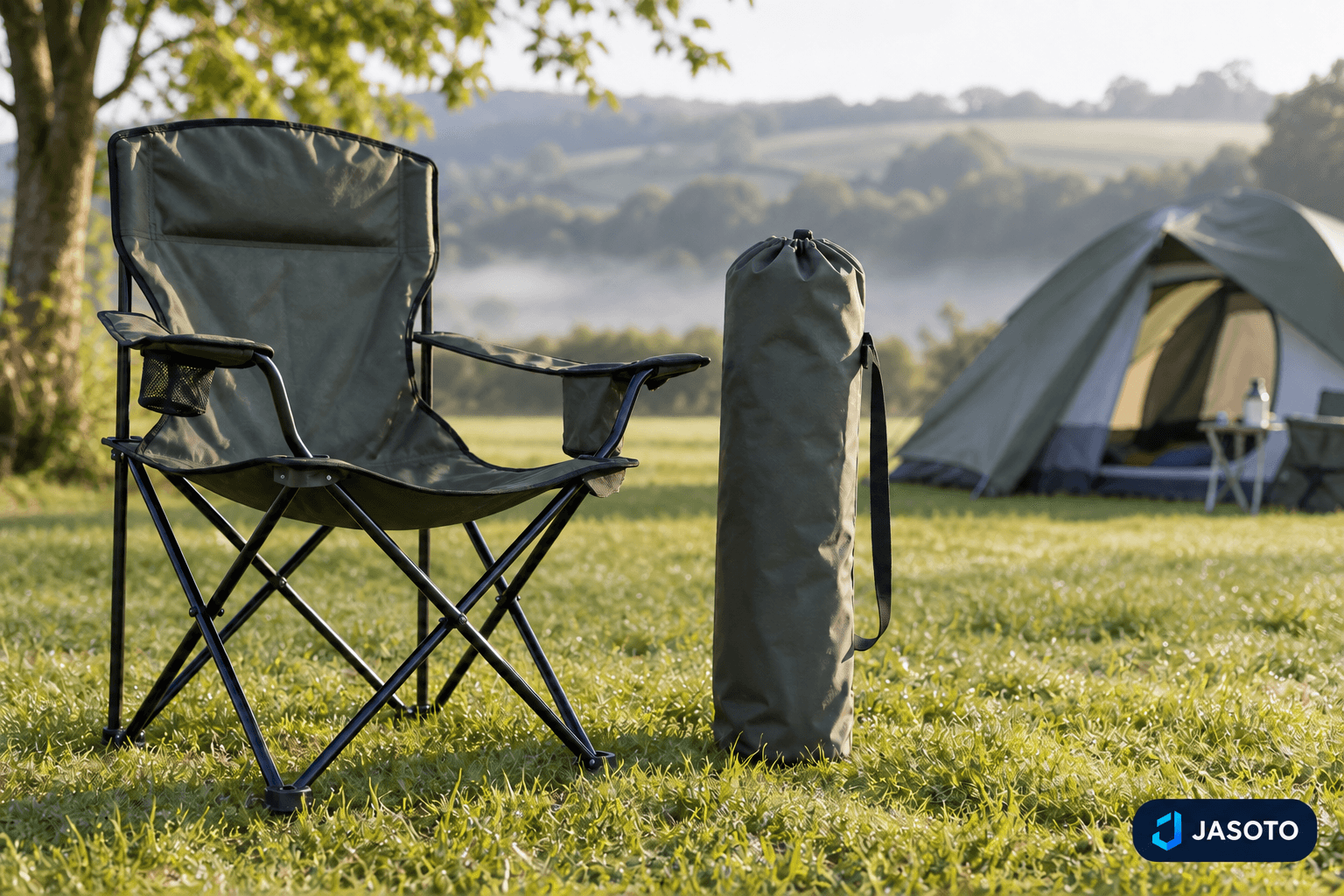
AI-generated illustrative image. It does not depict an actual customer project or a tested product.
Choosing a camping chair is less about finding the “best” model in the abstract and more about matching a chair to the trip you actually take. The right chair for a car-camping weekend may be the wrong choice for a festival, a day event or a fishing session where you have to carry everything a fair distance.
The most useful comparisons are usually the practical ones: packed size, carrying weight, seat height, stability, drying time and the way the chair folds, locks and stores. Once those basics suit the journey, extras such as cup holders, side tables or reclining backs become easier to judge for what they really are: conveniences rather than deciding factors.
At a glance
- Start with transport, packed size and carrying weight before comparing extras.
- Seat height, width and back angle are central to comfort and ease of use.
- Check capacity, stability, drying needs and the ground you will actually sit on.
- Choose features and materials that suit your most common trip type.
Start with the way you will get it there
Before comparing fabrics or add-ons, think about how the chair will travel. A boot full of camping gear gives you different options from a trip where the chair has to be carried over a field, through a festival entrance or down to a riverside bank. The question is not simply whether the chair fits in the car, but whether it still feels manageable once the tent, food, cool bag and other kit are already packed around it.
Packed length and carrying weight matter together. A chair may seem fine in an empty boot, especially if it can sit diagonally, but the shape can become awkward once other equipment is loaded. If you expect to carry it any distance, look closely at the handle or shoulder strap as well. A light chair that swings into your leg or digs into your shoulder can be more tiring than a slightly heavier one with a better carry point. The most sensible choice is the one that suits your route, not just the one with the lowest number on the label.
Measure the packed size properly
Packed size is easy to overlook because it feels like a storage detail, yet it often decides whether a chair is genuinely convenient. Look at the chair’s folded length and overall bundle shape, then compare that with the space you actually have once the rest of your equipment is accounted for. If the chair has a bag, include that too, because the bag can add a little bulk and change how neatly the chair sits beside other items.
It helps to imagine the whole journey rather than only the first few minutes after leaving home. A chair that slides into the car without fuss may still be annoying when you have to carry it from the car park to the pitch or down to a fishing spot. For that reason, packed size should be considered alongside the likely walking distance and how often you expect to move the chair during the trip. A model that folds compactly but takes extra effort to organise may be less suitable than one that is slightly larger but easier to handle.
Compare seat height before anything else feels comfortable
Seat height shapes the whole experience. A low chair can feel relaxed and slightly reclined, which suits lazy campsite sitting or settling in for an evening outdoors. A higher, more upright chair can be easier for eating, chatting at a table or standing up without effort. Neither is automatically better; the right choice depends on how you plan to use it most often.
The other seat dimensions matter too. Usable width affects how roomy the chair feels, while back angle and arm support influence whether you can sit comfortably for a while or keep shifting position. People often assume comfort is a simple matter of padding, but posture is usually more important. If possible, try the chair before buying, because comfort varies from person to person. A chair that feels perfect to one user may feel too low, too upright or oddly supported to another. When comparing options online, look for the details that tell you how the chair places your body, not just how soft it looks.
Treat capacity as a limit, not a promise of stability
Rated capacity is worth checking, but it should not be read as a guarantee that the chair will feel secure in every setting. A chair can have a respectable capacity rating and still be awkward on soft, sloping or uneven ground. The label gives you a boundary, not a verdict on real-world performance.
Set the chair up on appropriate ground and make sure all feet are supported. That simple step matters because an uneven base can make any chair feel less steady, whatever the rating says. It also helps to check the manufacturer’s instructions for how the chair is meant to be used and set up. If the directions mention a particular way to unfold, lock or position the chair, follow them rather than relying on guesswork. This is especially useful when you are comparing similar chairs, because a design that appears sturdy in a shop may only feel that way when the feet are properly placed.
Think about the ground you will actually sit on
Camping chairs are often judged as if all campsites were identical, but the ground under the chair matters a great deal. A level campsite beside the car is very different from a patch of uneven grass at a festival or a bank near water. When you compare chairs, imagine the conditions where it will spend most of its time, not the most flattering possible setting.
This is where stability and seat design meet. A low chair may feel grounded and relaxed on firm ground, while a taller chair may feel easier to get out of if the surface is flat and supportive. On less predictable ground, the question becomes whether the chair can be positioned with all feet properly supported. If you use a chair for fishing, for example, the bank may be less even than a campsite pitch, so it is sensible to think about how the chair sits on the terrain you expect. The chair does not need to suit every surface, but it should suit the surfaces you are likely to meet.
Consider weather, dampness and drying time
Weather affects camping chairs more than many buyers expect. If the seat gets wet, drying time becomes part of the buying decision, not just part of the cleaning routine. Read the material and care details so you know what the chair is made of and how it should be looked after after rain or damp conditions. Some materials may feel different in use as well: mesh, padded fabric and solid panels can each give a distinct seating experience, especially on a cool evening.
It also helps to plan where the chair will go overnight and on the way home. A damp chair left in a bag for too long can become inconvenient to store, so check the instructions and dry it properly before longer storage. Mud around the feet and on the bag can also affect how pleasant the chair is to pack away after a trip, so cleaning matters as much as comfort. If you expect mixed weather, choose with drying and cleaning in mind, not only with comfort in a dry showroom mindset.
Match the material to the kind of sitting you do
Material choice changes the feel of the chair in subtle but important ways. Mesh may feel airier, which can be helpful when you want ventilation, while padded fabric can feel softer to sit in for longer periods. Solid panels may offer a different kind of support again. These are not dramatic technical differences, but they affect how the chair behaves when you actually sit down for a meal, a long conversation or a quiet evening outside.
Because comfort is personal, there is no single “best” material for all users. The more useful question is which material suits the climate and use pattern you expect. A chair used mainly for short breaks at a campsite may not need the same feel as one used for lingering around a fishing spot or sitting out after dinner. If you are comparing chairs remotely, pay attention to material descriptions and care instructions rather than assuming a padded seat is always better or that mesh is always cooler in a way you will prefer. Practical comfort depends on the whole design working together.
Choose features for the trip, not for the brochure
Extra features can be helpful, but they should be judged against the journey and the way you will use the chair. A side table can be handy, yet it adds size and can make packing less neat. A reclining mechanism may improve relaxation, but it can also make folding and storing slower. The right feature set is the one that supports your actual routine instead of complicating it.
It is also worth checking practical details such as pinch points, locking mechanisms and whether any small parts can be lost. These are the sorts of details that affect convenience more than appearance does. A chair that folds quickly and locks clearly may be better for a short day event than one that offers more lounging positions but takes longer to manage. For a weekend campsite beside the car, comfort and easy cleaning may be more important. For a festival or other day event with a long walk, a simpler design with lower carrying weight and quicker folding may make far more sense.
Use the trip type to narrow the shortlist
A good way to decide is to think in trip patterns rather than in product features alone. For a car-camping weekend, you can often prioritise comfort, seat feel and cleaning convenience because the chair does not have to travel far on foot. For a festival, the balance may shift towards carrying weight, packed size and ease of folding, because the journey matters as much as the sitting. For fishing, the terrain and session length may push you towards a chair that feels stable, is easy to position and still remains comfortable after a while.
This approach prevents a common mistake: buying for an imagined version of outdoor life rather than the one you actually lead. If your trips are mostly short and close to the car, do not overvalue a very compact design at the expense of comfort. If your chair must travel a long way, do not ignore carrying ease just because a feature list looks appealing. The best comparison is the one built around your ordinary use case, not the most dramatic possibility.
Test the routine from unpacking to storage
A chair is only useful if the whole routine works smoothly. Think through how you will carry it, unfold it, sit in it, pack it away and store it afterwards. The more steps involved, the more opportunities there are for frustration. That is why a simple chair with sensible dimensions can sometimes be a better match than a more feature-rich model.
When you evaluate the routine, check whether the chair feels intuitive to open and close, whether the bag is easy to use and whether the packed form is easy to stow once the trip ends. Then look at post-trip care: does it need to dry fully before being put away, and do you have a place to keep it overnight if it is still damp? These questions may sound mundane, but they are what determine whether a chair becomes part of your kit or a nuisance you avoid using. If you can see the whole process clearly, you are far more likely to choose a chair that suits your trips in practice rather than just in theory.
Your practical checklist
- Measure the packed chair against your car boot or storage space with other kit in mind.
- Compare folded length, carrying weight and the comfort of the handle or shoulder strap.
- Check seat height, usable width, back angle and arm support.
- Read the rated capacity and the setup instructions, then plan to use it on suitable ground.
- Consider how the material dries, how it cleans and where it will be stored after the trip.
- Review any extras such as side tables or reclining mechanisms for size and folding convenience.
Frequently asked questions
Is a smaller packed chair always the better choice?
Not always. A smaller packed chair can be easier to carry and store, but comfort, seat height and stability may matter more depending on the trip. The right balance depends on how far you will carry it and how long you expect to sit in it.
What matters more for comfort: padding or seat height?
Seat height and overall seating position often matter more than padding alone. A chair that places you at the right height and angle may feel better than a softer chair that is awkward to get in and out of.
Do I need a different chair for fishing and camping?
Not necessarily, but the same chair may not suit both uses equally well. Fishing may involve uneven ground and longer still periods, while campsite use may put more emphasis on eating comfort and easy cleaning. Compare the chair against the main setting you will use most often.
Should I worry about drying time if the chair only gets lightly damp?
Yes, because drying time still affects storage and packing away. Even a lightly damp chair is more convenient if it can dry properly before longer storage, and the care instructions should guide how you handle it.
Explore Daily Living UK
Use the guide to compare suitable products. Check the current specifications, availability, delivery and price on Daily Living UK before ordering.
Browse Daily Living UK